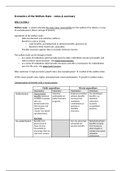
Economics of the Welfare State – notes & summary
WSE-1 & WSE-2
Welfare state = a system whereby the state takes responsibility for the welfare of its citizens, in case
of unemployment, illness, old age of poverty.
Ingredients of the welfare state:
- State involvement (not voluntary welfare).
- Benefits in cash or in kind;
o Cash benefits: unemployment or sickness benefits, pensions etc.
o Benefits in kind: health care, education.
- Provides insurance against risks or provides minimum income.
The welfare state can be thought of both:
o as a series of institutions which provide poverty relief, redistribute income and wealth, and
seek to reduce social exclusion - the Robin Hood function.
o as a series of institutions which provide insurance and offer a mechanism for redistribution
over the life cycle - the piggy bank function.
After world war 2: high economic growth rates, low unemployment creation of the welfare state.
1970s: lower growth rates, higher unemployment, lower participation growth in welfare states.
Categorization of benefits with a social purpose
Public expenditure Private expenditure
Mandatory Voluntary Mandatory Voluntary
Redistribution Means-tested Voluntary Employer-provided Tax-advantaged
benefits (payment participation in sickness benefits benefits, e.g.
available to people public insurance accruing from individual
who can programs. mandatory retirement
demonstrate that contributions to accounts,
their income and pension or occupational
capital (their disability pensions.
'means') are below insurance.
specified limits).
BIJSTAND
No redistribution Benefits from Non tax-advantage Exclusively private:
government to actuarially fair benefits accruing
lower income pension benefits. from insurance
households to plans bought at
encourage them to market prices given
save more money. individual
preferences.
WSE-1 & WSE-2
Welfare state = a system whereby the state takes responsibility for the welfare of its citizens, in case
of unemployment, illness, old age of poverty.
Ingredients of the welfare state:
- State involvement (not voluntary welfare).
- Benefits in cash or in kind;
o Cash benefits: unemployment or sickness benefits, pensions etc.
o Benefits in kind: health care, education.
- Provides insurance against risks or provides minimum income.
The welfare state can be thought of both:
o as a series of institutions which provide poverty relief, redistribute income and wealth, and
seek to reduce social exclusion - the Robin Hood function.
o as a series of institutions which provide insurance and offer a mechanism for redistribution
over the life cycle - the piggy bank function.
After world war 2: high economic growth rates, low unemployment creation of the welfare state.
1970s: lower growth rates, higher unemployment, lower participation growth in welfare states.
Categorization of benefits with a social purpose
Public expenditure Private expenditure
Mandatory Voluntary Mandatory Voluntary
Redistribution Means-tested Voluntary Employer-provided Tax-advantaged
benefits (payment participation in sickness benefits benefits, e.g.
available to people public insurance accruing from individual
who can programs. mandatory retirement
demonstrate that contributions to accounts,
their income and pension or occupational
capital (their disability pensions.
'means') are below insurance.
specified limits).
BIJSTAND
No redistribution Benefits from Non tax-advantage Exclusively private:
government to actuarially fair benefits accruing
lower income pension benefits. from insurance
households to plans bought at
encourage them to market prices given
save more money. individual
preferences.