Diversity Review
Chapter 9
Classification of living things
3 concepts that helps scientists define a specie
Morphological concept: defines body, size and shape
Biological concept: defines whether two organisms can produce a fertile offspring
- Does apply to species who reproduce asexually
Phylogenetic concept: evolutionary history of the species
3 ways to classify organisms
- Binomial Nomenclature
- Taxonomy
- Determining relatedness
Binomial nomenclature - two part naming system using its genus and species.
Typed - italic and capitalized
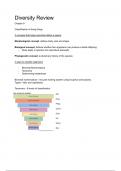
Taxonomy - 8 levels of classification
Did
King
Philip
Come
Over
For
Good
Sex
,Determining relatedness
Various types of evidence is used to determine relatedness of species
- Anatomies (structure)
- Physiological (function)
- Dna (similarities in dna sequence)
Reminder of cell theory
1. All living things are made up of cells
2. All cells come from pre-existing cells
3. The cell is the simplest unit that can carry out all life processes
Biodiversity
There 3 types of biodiversity that makes up what biodiversity is
Species diversity: the number of different species in an ecosystem. This is commonly used as
a definition for biodiversity
Ecosystem diversity: the variety of ecosystems in the biosphere.
Genetic diversity: the variety of inheritable traits within a species.
Negative things that affect biodiversity
- Climate change
- Urbanization
- Pollution
- Invasive species
- Stocking lakes
- Global travel
Positive things that affects biodiversity
- Higher diversity in plants means higher diversity in consumers
- Higher diversity in habitats available
- Conservation in biology (mating programs)
, Resilience in ecosystems
- An ecosystem is considered resilient if it able to maintain an equilibrium after
significant disturbances
- Ecosystems with higher diversity of native species are more likely to be resilient.
Viruses and prions
Classification of viruses
- They are not made up of cells , or classified as a living thing
- They exist in made shapes and types
- They are classified by their shape
- Exist virtually for species (they can mutate)
- They contain DNA and RNA and are surrounded by a tough coat of protein called
capsid
How they infect a host
- They attach themselves to the surface of the cell and inject their DNA/RNA in the hosts
cell and it must have the same protein coating like a “puzzle piece”
- That's why they are cell and species specific
2 cycle for reproduction of viruses
- Lytic cycle: the virus genetic material uses the copying machinery of the host’s cell to
reproduce new viruses
- Lysogenic cycle: The viral DNA enters the host’s cell and lays dormant in the bacterial
chromosome until it is triggered. This helps the virus to replicate and not be detected
until it is triggered and it does no harm when it lays dormant in the cell.
Biotechnology
- Biotechnologists can manipulate the virus’s DNA and get the desirable genetic material
to be replicated.
Prions
- It is a small piece of protein that does the same as the virus does but not as complex in
form of shape.
- They can cause damage to nerve cells
- A disease caused by prions is mad cow disease
, Kingdom Archaea
Classification
- They are unicellular
- Autotrophic or Heterotrophic
- Prokaryotic
- Asexual reproduction
- Live in extreme environments
Classification pt2
- Until recently, archaea were considered to be a kind of bacteria, but scientists have
found difference in RNA genes and cell membrane composition
- They are now classified in their own kingdom as they can live extreme environments like
salty, hot and cold
They can be found at
- Antarctic subglacial ice
- Yellowstone Hot Spring
- Atacama desert
- Sea vents
They are classified into 3 groups
- Methanogens: archaea that produces methane
- Halophiles: Salt loving archaea, where they can live in concentrations of salt in up to
15% like the Dead sea
- Thermoacidophiles: heat and acid loving archaea, can live in places with very low pH 5
and survive best in temperatures above 80 degrees celsius
Chapter 9
Classification of living things
3 concepts that helps scientists define a specie
Morphological concept: defines body, size and shape
Biological concept: defines whether two organisms can produce a fertile offspring
- Does apply to species who reproduce asexually
Phylogenetic concept: evolutionary history of the species
3 ways to classify organisms
- Binomial Nomenclature
- Taxonomy
- Determining relatedness
Binomial nomenclature - two part naming system using its genus and species.
Typed - italic and capitalized
Taxonomy - 8 levels of classification
Did
King
Philip
Come
Over
For
Good
Sex
,Determining relatedness
Various types of evidence is used to determine relatedness of species
- Anatomies (structure)
- Physiological (function)
- Dna (similarities in dna sequence)
Reminder of cell theory
1. All living things are made up of cells
2. All cells come from pre-existing cells
3. The cell is the simplest unit that can carry out all life processes
Biodiversity
There 3 types of biodiversity that makes up what biodiversity is
Species diversity: the number of different species in an ecosystem. This is commonly used as
a definition for biodiversity
Ecosystem diversity: the variety of ecosystems in the biosphere.
Genetic diversity: the variety of inheritable traits within a species.
Negative things that affect biodiversity
- Climate change
- Urbanization
- Pollution
- Invasive species
- Stocking lakes
- Global travel
Positive things that affects biodiversity
- Higher diversity in plants means higher diversity in consumers
- Higher diversity in habitats available
- Conservation in biology (mating programs)
, Resilience in ecosystems
- An ecosystem is considered resilient if it able to maintain an equilibrium after
significant disturbances
- Ecosystems with higher diversity of native species are more likely to be resilient.
Viruses and prions
Classification of viruses
- They are not made up of cells , or classified as a living thing
- They exist in made shapes and types
- They are classified by their shape
- Exist virtually for species (they can mutate)
- They contain DNA and RNA and are surrounded by a tough coat of protein called
capsid
How they infect a host
- They attach themselves to the surface of the cell and inject their DNA/RNA in the hosts
cell and it must have the same protein coating like a “puzzle piece”
- That's why they are cell and species specific
2 cycle for reproduction of viruses
- Lytic cycle: the virus genetic material uses the copying machinery of the host’s cell to
reproduce new viruses
- Lysogenic cycle: The viral DNA enters the host’s cell and lays dormant in the bacterial
chromosome until it is triggered. This helps the virus to replicate and not be detected
until it is triggered and it does no harm when it lays dormant in the cell.
Biotechnology
- Biotechnologists can manipulate the virus’s DNA and get the desirable genetic material
to be replicated.
Prions
- It is a small piece of protein that does the same as the virus does but not as complex in
form of shape.
- They can cause damage to nerve cells
- A disease caused by prions is mad cow disease
, Kingdom Archaea
Classification
- They are unicellular
- Autotrophic or Heterotrophic
- Prokaryotic
- Asexual reproduction
- Live in extreme environments
Classification pt2
- Until recently, archaea were considered to be a kind of bacteria, but scientists have
found difference in RNA genes and cell membrane composition
- They are now classified in their own kingdom as they can live extreme environments like
salty, hot and cold
They can be found at
- Antarctic subglacial ice
- Yellowstone Hot Spring
- Atacama desert
- Sea vents
They are classified into 3 groups
- Methanogens: archaea that produces methane
- Halophiles: Salt loving archaea, where they can live in concentrations of salt in up to
15% like the Dead sea
- Thermoacidophiles: heat and acid loving archaea, can live in places with very low pH 5
and survive best in temperatures above 80 degrees celsius