Summary Methodology: Qualitative methods
Week 1:
o Naturalistic inquiry = Studying people in everyday circumstances by ordinary means.
The researcher does not want to control or manipulate the situation. Naturalistic
inquiry aims to bridge the gulf that has emerged between social scientists on the one
hand and the rest of humanity on the other hand.
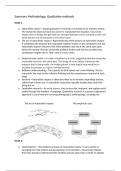
o The arc of naturalistic inquiry = Represents the whole process of naturalistic inquiry.
It symbolizes the distance the naturalistic inquirer travels. It also symbolizes that the
naturalistic inquirer returns to her initial problem, but not at the same spot upon
which she started. She has carried the problem further and she has provided new
and deeper insights into it. That’s why it’s not a circle.
o Empirical cycle, spiral = It is often visualized as a circle, suggesting that the researcher
eventually returns to the same spot. The image of an arc better represents the
progress that is being made, the insight gained. A next logical step would be to
visualize the process as a spiral, moving forward.
o Reflexive understanding = The capacity to think about one’s own thinking. The arc
represents the road to this reflexive thinking and the competences required at each
stage.
o Iterative = Naturalistic inquiry is often described as an iterative (repeating) process,
rather than a linear one. A naturalistic researcher typically shuttles back and forth
along the arc.
o Qualitative research = In social science: aims to describe, interpret, and explain social
reality through the medium of language. Qualitative research is a generic (algemeen)
approach in social research covering ethnography, anthropology, sociology etc.
The arc of naturalistic inquiry: The empirical cycle:
Week 2:
o Interpretivism = The intellectual home of naturalistic inquiry. It sees society as
emerging from the actions and perspectives of its members. Social order follows
from how humans understand their situation and act upon that. In order to explain
, human actions, we first have to understand what those actions mean to those who
perform them. Max Weber Erfurt
o Positivism = Looks for universal social laws in society. The researcher seeks to control
the research situation. Epistemological assumption that the natural world and the
social world are ordered by similar principles. These principles are thought to take
the form of law-like regularities. Auguste Comte is associated with positivism in
studying the social world. Auguste Comte Montpellier
o Qualitative = It is about the qualities or properties or attributes of the object under
study. Use of language. Most of the time in naturalistic inquiry, qualitative methods
are used BUT it is also possible to use quantitative methods in naturalistic inquiry.
o Quantitative = It is about the scale on which these properties are measured. Use of
numbers.
o Validity = Does the research measure what it claims to measure?
o Reliability = Can the results of the research be checked independently, will repeating
it yield similar outcomes?
o Verstehen = Doorgronden. Deeply understanding someone else’s
understandings/interpretations. Understanding somethings through the eyes of your
participants.
o Emic = Part of interpretation. It is the meaning of things to the people involved, the
insiders.
o Etic = Part of explanation. The meaning or significance attributed by those studying
them, the social scientist, the outsiders.
o Heider-Simmel experiment = It showed how humans instinctively attribute intentions
to abstract shapes. In a short animation, simple geometric figures moved around, yet
viewers described them as if they had emotions and motives. Conclusion of the
experiment: We attach meaning to the behavior of other people by attribution.
o Social fact = William Isaac Thomas: “If people define situations as real, they are real in
their consequences.” Social facts can be as objective and as hard as a rock or any
other physical facts. Today’s definitions of situations are tomorrow’s social facts; and
tomorrow’s social facts precondition the-day-after-tomorrow’s definitions of
situations. human understandings, and the actions that they spawn, interlock into
social formations. The sum total of social formations we call societies. The force of
the social is phenomenal: it works via the experiences of individuals. To understand
how it works, you have to understand and interpret these experiences – therefore
the label ‘interpretivism’.
o Four powerful tools that help to steer clear of subjectivism:
- Grounded theory = a systematic procedure to develop theoretical concepts about
society from empirical research. The system in grounded theory revolves around
the procedure of constant comparison and open coding. Each piece of evidence is
compared to material already collected. broader academic community
outside verification.
- Triangulation = the use of different data collection methods. Confronting the
same empirical situation with different research methods. Triangulation is
twinned to iteration.
- Reflexive attitude = Note taking, diary keeping. An important function of this is to
confront you own predispositions and inclinations with what you have observed
Week 1:
o Naturalistic inquiry = Studying people in everyday circumstances by ordinary means.
The researcher does not want to control or manipulate the situation. Naturalistic
inquiry aims to bridge the gulf that has emerged between social scientists on the one
hand and the rest of humanity on the other hand.
o The arc of naturalistic inquiry = Represents the whole process of naturalistic inquiry.
It symbolizes the distance the naturalistic inquirer travels. It also symbolizes that the
naturalistic inquirer returns to her initial problem, but not at the same spot upon
which she started. She has carried the problem further and she has provided new
and deeper insights into it. That’s why it’s not a circle.
o Empirical cycle, spiral = It is often visualized as a circle, suggesting that the researcher
eventually returns to the same spot. The image of an arc better represents the
progress that is being made, the insight gained. A next logical step would be to
visualize the process as a spiral, moving forward.
o Reflexive understanding = The capacity to think about one’s own thinking. The arc
represents the road to this reflexive thinking and the competences required at each
stage.
o Iterative = Naturalistic inquiry is often described as an iterative (repeating) process,
rather than a linear one. A naturalistic researcher typically shuttles back and forth
along the arc.
o Qualitative research = In social science: aims to describe, interpret, and explain social
reality through the medium of language. Qualitative research is a generic (algemeen)
approach in social research covering ethnography, anthropology, sociology etc.
The arc of naturalistic inquiry: The empirical cycle:
Week 2:
o Interpretivism = The intellectual home of naturalistic inquiry. It sees society as
emerging from the actions and perspectives of its members. Social order follows
from how humans understand their situation and act upon that. In order to explain
, human actions, we first have to understand what those actions mean to those who
perform them. Max Weber Erfurt
o Positivism = Looks for universal social laws in society. The researcher seeks to control
the research situation. Epistemological assumption that the natural world and the
social world are ordered by similar principles. These principles are thought to take
the form of law-like regularities. Auguste Comte is associated with positivism in
studying the social world. Auguste Comte Montpellier
o Qualitative = It is about the qualities or properties or attributes of the object under
study. Use of language. Most of the time in naturalistic inquiry, qualitative methods
are used BUT it is also possible to use quantitative methods in naturalistic inquiry.
o Quantitative = It is about the scale on which these properties are measured. Use of
numbers.
o Validity = Does the research measure what it claims to measure?
o Reliability = Can the results of the research be checked independently, will repeating
it yield similar outcomes?
o Verstehen = Doorgronden. Deeply understanding someone else’s
understandings/interpretations. Understanding somethings through the eyes of your
participants.
o Emic = Part of interpretation. It is the meaning of things to the people involved, the
insiders.
o Etic = Part of explanation. The meaning or significance attributed by those studying
them, the social scientist, the outsiders.
o Heider-Simmel experiment = It showed how humans instinctively attribute intentions
to abstract shapes. In a short animation, simple geometric figures moved around, yet
viewers described them as if they had emotions and motives. Conclusion of the
experiment: We attach meaning to the behavior of other people by attribution.
o Social fact = William Isaac Thomas: “If people define situations as real, they are real in
their consequences.” Social facts can be as objective and as hard as a rock or any
other physical facts. Today’s definitions of situations are tomorrow’s social facts; and
tomorrow’s social facts precondition the-day-after-tomorrow’s definitions of
situations. human understandings, and the actions that they spawn, interlock into
social formations. The sum total of social formations we call societies. The force of
the social is phenomenal: it works via the experiences of individuals. To understand
how it works, you have to understand and interpret these experiences – therefore
the label ‘interpretivism’.
o Four powerful tools that help to steer clear of subjectivism:
- Grounded theory = a systematic procedure to develop theoretical concepts about
society from empirical research. The system in grounded theory revolves around
the procedure of constant comparison and open coding. Each piece of evidence is
compared to material already collected. broader academic community
outside verification.
- Triangulation = the use of different data collection methods. Confronting the
same empirical situation with different research methods. Triangulation is
twinned to iteration.
- Reflexive attitude = Note taking, diary keeping. An important function of this is to
confront you own predispositions and inclinations with what you have observed