Aneesa Ahmed
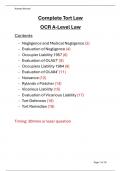
Complete Tort Law
OCR A-Level Law
Contents
- Negligence and Medical Negligence (2)
- Evaluation of Negligence (4)
- Occupier Liability 1957 (6)
- Evaluation of OLA57’ (8)
- Occupiers Liability 1984 (9)
- Evaluation of OLA84’ (11)
- Nuisance (12)
- Rylands v Fletcher (14)
- Vicarious Liability (15)
- Evaluation of Vicarious Liability (17)
- Tort Defences (18)
- Tort Remedies (19)
Timing: 30mins or less/ question
Page 1 of 19
,Aneesa Ahmed
Negligence AO1
- Common law offence began in Donoghue v Stevenson
- Comprised of 3 elements (duty, breach damage)
DUTY
- Established duty? (Robinson v CC west yorks)
Novel situations (Caparo)(Only mention the test if Caparo is needed!!)
1. Proximity (Bourhill v young- woman was not in close proximity, she moved
towards the blood scene)
2. Forseeability (Haley v LEB- foreseeable for blind man to fall though hole in
ground)
3. FJR (Griffiths v Lindsay- not FJR to expect taxi driver to wait for man to go inside)
BREACH
Breach is falling below the standard of a reasonable person (Blyth v Birmingham
waterworks)
1.Standard can change
- Children- Mullins v Richard’s- ruler fight breaks into child’s eye, low standard for
children
- Experts- Bollam v Friern- doctors have a higher standard
- Knowledge at the time- Roe v Minister of Health
- Beginners- Nettleship v Western- learner driver till liable
2.Four risk factors:
1. Likelihood- Bolton v stone- low likelihood of cricket ball going over fence
2. Seriousness- Paris v Stepney- very serious to not
3. Cost of avoiding- Latimer v AEC- high cost of avoiding would be closing down
the factory
4. Utility- Watt v Hertz- utility in fireman standing on the back of truck to save
woman
- Res Ipsa Loquitur (Ward v Tesco- split yogurt, facts speak for themselves )
DAMAGE
1.Causation:
a) Factual Causation: Barnett v Chelsea- stomach pain was acc arsenic
poisoning, undiagnosed
Page 2 of 19
,Aneesa Ahmed
b) Legal causation (break in the chain of causation or reasonable action): The
Oropesa- after crash, lifeboat capsized but reasonable action for captain to
tell them to get on lifeboat
2.Thin Skull Rule- doesn’t break chain (Smith v Leech Brain- lip had pre-cancerous
cells)
3.Multiple causes means D not liable (Wilsher v Essex- multiple causes for death of
baby)
4.Remoteness: damage must be foreseeable, not remote (Wagon Mound- fire on
harbour too remote damage, Hughes v Lord Advocate- burns from paraffin lamp was
foreseeable)
Defences (2)
- Contributory negligence (Froom v Butcher- not wearing seatbelt 20%, Sayers v
Harlow-escape bathroom by stepping on toilet roll holder- 25% and Clay v TUI-
claim failed)
- Volenti- if the claimant accepts the risk and still continues there is a complete
defence (Morris v Murray- consent to be a passenger in plane with drunk pilot)
Medical Negligence
- Bollam and Friern- act as a reasonable expert
- Bolitho v Hackney- adds another level (illogical- determined by judge)
- FB v Princess Alexandra Hospital (standard for new doctor is the same)
- Montgomery v Lanarkshire (mother given C-section—> client needs to be made
aware of the alternative treatments)
- FC: Barnett v Chelsea
A02 Checklist
- Established or novel situation?- 3 part test
- Does the standard change?
- Breach- Risk factors, Res Ipsa Loquitur
- Is there damage? Factual and Legal cause- is there a break or reasonable?
- Thin skull rule?
- Are there multiple causes?
- Is the damage remote or foreseeable?
- Is the Claimant also negligent- (defences) contributory negligence? / Volenti
Page 3 of 19
,Aneesa Ahmed
Evaluation of Negligence
AO3
Intro:
- Common law offence been around for many years aims to question duty, breach
and damage
- Aim is to help and ensure justice but there are still many issues especially due to
money and medical negligence and experts
1. Need to prove fault/ breach (compensation)
- Can be costly especially with the need to expert advice e.g. in med neg
- Need to prove fault results in delays
- Burden of proof on claimant can be harsh BUT seems fair
2. Ad hoc (case by case) development of law
- Starts with decisions made in Donoghue v Stevenson
- There is no statute, it is all common law: undemocratic even though negligence
issues often conflict with society… judges have to make political and moral
decisions without experiences that parliament does
3. Inconsistent decisions
- Some decisions do not align with moral views
- E.g. Nettleship v Western—> morally blameless but legally at fault because she
is insured, perhaps unfair on beginner
- But in other contexts this is helpful e.g, Mullins v Richard’s —> makes sense for
lower standard for children
4. Vague tests (lack of definition, scope etc) —> hard to define bc they are part
of judgements
- Donoghue v Stevenson ‘neighbour principle’- Lord Atkin questions if there is a
duty of care at all —> broad test which is narrowed by Caparo
- Vague on the degree of proximity in situations not regarding a manufacturer
- Leaves too much space for Judges to use subjective opinion
- Caparo test is vague about factors: foreseeability, proximity, FJR
- Remoteness of damage is vague
- Thin skull rule vague but good because protects weaker parties
- Risk factors—> too many, but their to protect, how to measure things like size of
risk
- Tests like causation and remoteness —> where to draw the line between
foreseeable and remote.
5. Determining scope of medical negligence
- Bolam test criticised for being heavily weighted in favour of professionals
needing only another doctor to agree with the decision—> issues with primary
etc
Page 4 of 19
, Aneesa Ahmed
- Solved/adapted by Bolitho test by adding illogical test but again issue of opinion
as this is left up to Judges
- Issues with BUT FOR tests where there are multiple causes e.g. Wilsher v Essex
—> unfair that just because there are multiple causes that the doctor was not
liable, what about the parents that lost their baby, seams harsh to forget about
them VS Fairchild v Glenhaven —> all people liable for asbestos because unsure
where the poisoning came from
- But fair in terms of communication e.g. Montgomery v Lanarkshire—> pregnant
lady should have been made aware of all of her options
6. Juries
- Juries do not have the knowledge especially with medneg cases for the decision
to be left up to them
7. Unfair on Defendants
- Success may depend on a different in the outcome—> this could be a technical
point e.g. Fairchild v Glenhaven which could be unjust
Conclusion + reforms
- Many problems with the current law especially with medical negligence despite
some changes being made
- To avoid costly issues there could be compulsory insurance e.g. America to
protect those in these situations
- Possible ‘no-fault’ compensation system
Page 5 of 19
Complete Tort Law
OCR A-Level Law
Contents
- Negligence and Medical Negligence (2)
- Evaluation of Negligence (4)
- Occupier Liability 1957 (6)
- Evaluation of OLA57’ (8)
- Occupiers Liability 1984 (9)
- Evaluation of OLA84’ (11)
- Nuisance (12)
- Rylands v Fletcher (14)
- Vicarious Liability (15)
- Evaluation of Vicarious Liability (17)
- Tort Defences (18)
- Tort Remedies (19)
Timing: 30mins or less/ question
Page 1 of 19
,Aneesa Ahmed
Negligence AO1
- Common law offence began in Donoghue v Stevenson
- Comprised of 3 elements (duty, breach damage)
DUTY
- Established duty? (Robinson v CC west yorks)
Novel situations (Caparo)(Only mention the test if Caparo is needed!!)
1. Proximity (Bourhill v young- woman was not in close proximity, she moved
towards the blood scene)
2. Forseeability (Haley v LEB- foreseeable for blind man to fall though hole in
ground)
3. FJR (Griffiths v Lindsay- not FJR to expect taxi driver to wait for man to go inside)
BREACH
Breach is falling below the standard of a reasonable person (Blyth v Birmingham
waterworks)
1.Standard can change
- Children- Mullins v Richard’s- ruler fight breaks into child’s eye, low standard for
children
- Experts- Bollam v Friern- doctors have a higher standard
- Knowledge at the time- Roe v Minister of Health
- Beginners- Nettleship v Western- learner driver till liable
2.Four risk factors:
1. Likelihood- Bolton v stone- low likelihood of cricket ball going over fence
2. Seriousness- Paris v Stepney- very serious to not
3. Cost of avoiding- Latimer v AEC- high cost of avoiding would be closing down
the factory
4. Utility- Watt v Hertz- utility in fireman standing on the back of truck to save
woman
- Res Ipsa Loquitur (Ward v Tesco- split yogurt, facts speak for themselves )
DAMAGE
1.Causation:
a) Factual Causation: Barnett v Chelsea- stomach pain was acc arsenic
poisoning, undiagnosed
Page 2 of 19
,Aneesa Ahmed
b) Legal causation (break in the chain of causation or reasonable action): The
Oropesa- after crash, lifeboat capsized but reasonable action for captain to
tell them to get on lifeboat
2.Thin Skull Rule- doesn’t break chain (Smith v Leech Brain- lip had pre-cancerous
cells)
3.Multiple causes means D not liable (Wilsher v Essex- multiple causes for death of
baby)
4.Remoteness: damage must be foreseeable, not remote (Wagon Mound- fire on
harbour too remote damage, Hughes v Lord Advocate- burns from paraffin lamp was
foreseeable)
Defences (2)
- Contributory negligence (Froom v Butcher- not wearing seatbelt 20%, Sayers v
Harlow-escape bathroom by stepping on toilet roll holder- 25% and Clay v TUI-
claim failed)
- Volenti- if the claimant accepts the risk and still continues there is a complete
defence (Morris v Murray- consent to be a passenger in plane with drunk pilot)
Medical Negligence
- Bollam and Friern- act as a reasonable expert
- Bolitho v Hackney- adds another level (illogical- determined by judge)
- FB v Princess Alexandra Hospital (standard for new doctor is the same)
- Montgomery v Lanarkshire (mother given C-section—> client needs to be made
aware of the alternative treatments)
- FC: Barnett v Chelsea
A02 Checklist
- Established or novel situation?- 3 part test
- Does the standard change?
- Breach- Risk factors, Res Ipsa Loquitur
- Is there damage? Factual and Legal cause- is there a break or reasonable?
- Thin skull rule?
- Are there multiple causes?
- Is the damage remote or foreseeable?
- Is the Claimant also negligent- (defences) contributory negligence? / Volenti
Page 3 of 19
,Aneesa Ahmed
Evaluation of Negligence
AO3
Intro:
- Common law offence been around for many years aims to question duty, breach
and damage
- Aim is to help and ensure justice but there are still many issues especially due to
money and medical negligence and experts
1. Need to prove fault/ breach (compensation)
- Can be costly especially with the need to expert advice e.g. in med neg
- Need to prove fault results in delays
- Burden of proof on claimant can be harsh BUT seems fair
2. Ad hoc (case by case) development of law
- Starts with decisions made in Donoghue v Stevenson
- There is no statute, it is all common law: undemocratic even though negligence
issues often conflict with society… judges have to make political and moral
decisions without experiences that parliament does
3. Inconsistent decisions
- Some decisions do not align with moral views
- E.g. Nettleship v Western—> morally blameless but legally at fault because she
is insured, perhaps unfair on beginner
- But in other contexts this is helpful e.g, Mullins v Richard’s —> makes sense for
lower standard for children
4. Vague tests (lack of definition, scope etc) —> hard to define bc they are part
of judgements
- Donoghue v Stevenson ‘neighbour principle’- Lord Atkin questions if there is a
duty of care at all —> broad test which is narrowed by Caparo
- Vague on the degree of proximity in situations not regarding a manufacturer
- Leaves too much space for Judges to use subjective opinion
- Caparo test is vague about factors: foreseeability, proximity, FJR
- Remoteness of damage is vague
- Thin skull rule vague but good because protects weaker parties
- Risk factors—> too many, but their to protect, how to measure things like size of
risk
- Tests like causation and remoteness —> where to draw the line between
foreseeable and remote.
5. Determining scope of medical negligence
- Bolam test criticised for being heavily weighted in favour of professionals
needing only another doctor to agree with the decision—> issues with primary
etc
Page 4 of 19
, Aneesa Ahmed
- Solved/adapted by Bolitho test by adding illogical test but again issue of opinion
as this is left up to Judges
- Issues with BUT FOR tests where there are multiple causes e.g. Wilsher v Essex
—> unfair that just because there are multiple causes that the doctor was not
liable, what about the parents that lost their baby, seams harsh to forget about
them VS Fairchild v Glenhaven —> all people liable for asbestos because unsure
where the poisoning came from
- But fair in terms of communication e.g. Montgomery v Lanarkshire—> pregnant
lady should have been made aware of all of her options
6. Juries
- Juries do not have the knowledge especially with medneg cases for the decision
to be left up to them
7. Unfair on Defendants
- Success may depend on a different in the outcome—> this could be a technical
point e.g. Fairchild v Glenhaven which could be unjust
Conclusion + reforms
- Many problems with the current law especially with medical negligence despite
some changes being made
- To avoid costly issues there could be compulsory insurance e.g. America to
protect those in these situations
- Possible ‘no-fault’ compensation system
Page 5 of 19