
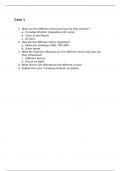
Case 1
1. What are the different clocks and how do they interact?
a. Circadian Rhythm (regulation 24h cycle)
b. Clock of the Muscle
c. GI-clock
2. How are the different clocks regulated?
a. Molecular pathways (PER, TIM, DBT)
b. Other genes
3. What are external influences on the different clocks and how are
they influenced?
c. Different factors
d. (Focus on light)
4. What factors are affected by the different clocks?
5. Explain the case / camping situation (in detail)
, 1. What are the different clocks and how do they interact?
a. Circadian Rhythm (regulation 24h cycle)
b. Clock of the Muscle
c. GI-clock
Biological rhythms are the inherent rhythmicity in living systems that
are characterized by any behavioural, physiological, or molecular events.
Rhythmicity is regulated by biological clocks which are complex systems
consisting of multiple oscillators that each has at least one feedback loop.
Various classification systems have been used for biological rhythms, mot
of them is based on the cycle light-dark: ultradian (shorter than 24 hours),
circadian (almost equal to 24h), infradian (longer than 24h.
- Ultradian clock: cycle repeated throughout a 24h day, but longer
than 1h (thus 1-24h cycle)
- Circadian clock: 24h rhythm created due to light/dark cycles (and
temperature). Clock genes regulate the physiological behaviour and
are orientated on the 24h cycle.
- Infradian clock: longer than 24h cycle (mostly used in menstruation
cycle/breeding cycles)
- Diurnal clock: time period repeated once every 24h during daytime
- Nocturnal clock: a clock during the period of darkness
Others:
- Muscular strength rhythm: maximal isometric muscle strength
greatest in late afternoon compared with morning.
- Heart rate
- Glycemia rhythm
- Leptin rhythm
- Insulin rhythm
,Muscle clock
Molecular clock components: Bmal1, Per2 and Cry1
Muscle specific genes: Myod1, Ucp2, Fbxo32/atrogin, Myh1
Myod1 is expressed in a circadian manner in adult tissue and is under
direct control of CLOCK:BMAL1.
Exercise is a sufficient environmental cue to effect clock gene expression
in the SCN (central clock). Activity during light condition decreased peak
expression of Per1 and Per2 in the SCN. The timing of exercise may be
critical for the maintenance of molecular rhythms in the SCN.
, Lowest body temperature – shortly before we awaken in the morning.
Mammals have
neuron clusters in the hypothalamus that serve as a biological clock: the
suprachiasmatic nuclei (SCN). When the SCN is stimulated, circadian
rhythms can be shifted in a predictable way. Behaviour is normally
synchronized with light-dark cycles, this is why SCN synapses with the
retinohypothalamic tract to make it photosensitive. The photopigment
called melanopsin is present in ganglion cell, this is responsible for the
photosensitivity of the SCN. Almost all SCN neurons use GABA as their
pimariy neurotranmitters, this is why they inhbit the neurons they
innervate.
Each SCN cell is a miniscule clock with cycles of about 24 hours. The
system involves clock genes known as period (per), timeless (tim)
and clock. The clock gene is transcribed to produce mRNA which is then
translated into proteins. after a delay these proteins send feedback and
interact with the transcription mechanism, causing a decrease in gene
expression. As a result, less protein is produced and gene expression
leads to a new cycle. The entire cycle is about 14 hours.
1. What are the different clocks and how do they interact?
a. Circadian Rhythm (regulation 24h cycle)
b. Clock of the Muscle
c. GI-clock
2. How are the different clocks regulated?
a. Molecular pathways (PER, TIM, DBT)
b. Other genes
3. What are external influences on the different clocks and how are
they influenced?
c. Different factors
d. (Focus on light)
4. What factors are affected by the different clocks?
5. Explain the case / camping situation (in detail)
, 1. What are the different clocks and how do they interact?
a. Circadian Rhythm (regulation 24h cycle)
b. Clock of the Muscle
c. GI-clock
Biological rhythms are the inherent rhythmicity in living systems that
are characterized by any behavioural, physiological, or molecular events.
Rhythmicity is regulated by biological clocks which are complex systems
consisting of multiple oscillators that each has at least one feedback loop.
Various classification systems have been used for biological rhythms, mot
of them is based on the cycle light-dark: ultradian (shorter than 24 hours),
circadian (almost equal to 24h), infradian (longer than 24h.
- Ultradian clock: cycle repeated throughout a 24h day, but longer
than 1h (thus 1-24h cycle)
- Circadian clock: 24h rhythm created due to light/dark cycles (and
temperature). Clock genes regulate the physiological behaviour and
are orientated on the 24h cycle.
- Infradian clock: longer than 24h cycle (mostly used in menstruation
cycle/breeding cycles)
- Diurnal clock: time period repeated once every 24h during daytime
- Nocturnal clock: a clock during the period of darkness
Others:
- Muscular strength rhythm: maximal isometric muscle strength
greatest in late afternoon compared with morning.
- Heart rate
- Glycemia rhythm
- Leptin rhythm
- Insulin rhythm
,Muscle clock
Molecular clock components: Bmal1, Per2 and Cry1
Muscle specific genes: Myod1, Ucp2, Fbxo32/atrogin, Myh1
Myod1 is expressed in a circadian manner in adult tissue and is under
direct control of CLOCK:BMAL1.
Exercise is a sufficient environmental cue to effect clock gene expression
in the SCN (central clock). Activity during light condition decreased peak
expression of Per1 and Per2 in the SCN. The timing of exercise may be
critical for the maintenance of molecular rhythms in the SCN.
, Lowest body temperature – shortly before we awaken in the morning.
Mammals have
neuron clusters in the hypothalamus that serve as a biological clock: the
suprachiasmatic nuclei (SCN). When the SCN is stimulated, circadian
rhythms can be shifted in a predictable way. Behaviour is normally
synchronized with light-dark cycles, this is why SCN synapses with the
retinohypothalamic tract to make it photosensitive. The photopigment
called melanopsin is present in ganglion cell, this is responsible for the
photosensitivity of the SCN. Almost all SCN neurons use GABA as their
pimariy neurotranmitters, this is why they inhbit the neurons they
innervate.
Each SCN cell is a miniscule clock with cycles of about 24 hours. The
system involves clock genes known as period (per), timeless (tim)
and clock. The clock gene is transcribed to produce mRNA which is then
translated into proteins. after a delay these proteins send feedback and
interact with the transcription mechanism, causing a decrease in gene
expression. As a result, less protein is produced and gene expression
leads to a new cycle. The entire cycle is about 14 hours.





