
Biology of Cancer notes
Lecture 1 – Origin of cancer
Each cancer has its own pathway and protein that it is depending on.
Treatment must be tailored according to this.
Cancer: genetic disease
● Change in DNA/expression of the DNA. There are a few that are viral
related but there could also be mutations.
● Multi step process where due to genetic changes normal cells are
transformed into cancer cells with increasing rate
● Darwinian evolution based on growth advantage
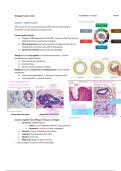
Benign tumours stay together in a closed environment → remain
localised at the original location
● Intact basement membrane
● Residual lumen
● Denser stroma & cellular crowding
Malignant tumours invade the surrounding tissue and can spread →
metastasize
● structural disorganization → no lumen, irregular nuclei
● invasive growth → stromal invasion
Cancers originate from diff type of tissues / cell types
1. Carcinoma: epithelial tissue
a. Adeno = gland epithelium (breast, lung, pancreas)
b. Squamous = epithelium (skin, esophagus)
2. Sarcoma: muscle, connective tissue, bone
3. Leukemia: hematopoietic stem cells
4. Gliomas: brain cells
5. Melanoma: pigment cells in the skin
→ many subtypes of cancers within these types
,World’s most common type of cancers:
● epithelial tumors of the lung, colon, breast, stomach and cervix.
● Epithelial cancers are most common because epithelial cells divide fast and they are exposed to the
environment (food, light, smoke etc).
I. Origin of cancer
1 abnormal cell
Cancers are monoclonal = arise from a single mutated cell that proliferates uncontrollably
● Normal cell: heterogeneous expression of G6PD → Mixed X-chromosome activation (both mom’s and
dad’s X are seen in different cells).
● Tumor: only 1 expression of G6PD → Only one X-chromosome version (all cells came from the same
"mother" cancer cell).
Somatic Mutation in the cell
● SM appear in normal cells in the body and aren't hereditary
● SM can arise through chromosomal translocations, carcinogenic substances, radiation and viruses
Germline vs somatic mutation
● GL mutations
○ Happens in germ cells (sperm/egg) pre fertilization
○ affect the entire organism → passed to offspring.
○ E.g.,: inheritable mutation → BRCA-1 or 2
● Somatic mutations
○ affect only specific tissues
○ are not inherited.
○ Causes cancer in one part of the body (e.g., lung, skin).
○ E.g.,: UV-induced skin cancer, smoking-induced lung cancer, translocation bn chr 9 and 22
(philadelphia chr)
Some cancers run in families (germ-line), while others happen due to environmental factors (somatic mutations).
Cancer arises from the accumulation of mutations overtime
● Spontaneous mutation freq: 1/gene/105-106 cell divisions
● The incidence of cancer increases with age → accumulation of cancer-causing mutations
● Exponential growth of cancer overtime you age: could be due to evolution
Cancer development – from less abnormal cells (pre-malignant) → malignant
II. Cancer development process is accelerated by
1. Consecutive cycles of mutations/selections → Cells with harmful mutations outcompete normal cells.
● Successive cycles of mutations ultimately lead to cancer
● Genetic and epigenetic inactivation of genes
○ Inactivating mutation (eg TSG mutations: TP53 in many cancers)
○ Histone modification (eg silencing of TSG)
○ DNA methylation: promoter can't bind to DNA → protein can’t be transcribed (eg
hypermethylation of BRCA1 in BC)
NOTE: last 2 are epigenetic inactivation → reversible → potential target for therapies
● Histone: proteins where DNA wrap around
○ Tightly wrapped DNA → inactive genes → silenced genes
○ Loosely wrapped DNA → active genes → transcription
, ● DNA methylation: methyl group attached to cytosine nt → gene silencing
Not all mutations are beneficial for cancer cells
● Cancer needs a balance of mutations—enough to drive growth, but not so many that the
cells die.
● Natural selection favors cancer cells with an optimal level of mutations.
● Too little or too much genetic instability prevents cancer from developing successfully.
Cancer may also arise from cancer stem cells (tumor initiating cells)
● Genetic or epigenetic changes → cancer cells with self-renewal ability → uncontrolled
growth.
● Cancer stem cells drive tumor formation, producing rapidly dividing cells.
● Therapy resistant
2. Increased genetic instability → More mutations occur as DNA repair mechanisms fail.
Many changes in cancer cells on a chromosomal level
● Chromosomal instability (translocations) and changes in a total number of chromosomes
are frequently observed in cancers
3. Decreased cell death (apoptosis) and differentiation
→ Mutated cells avoid programmed death.
Decreased apoptosis in abnormal cells
● Apoptosis = a process of programmed cell death
● Plays an important role in
○ Embryogenesis
○ Removal of old epithelial cells and activated
immune cells
4. Increased proliferation → Cells divide uncontrollably.
● Polyp formation in the gut = consequence of increased proliferation in the intestinal epithelium
● Disruption of homeostasis in abnormal cells
○ Both increased cell division and decreased apoptosis → change in homeostasis (living & dead
cells balance) → tumorigenesis
5. Independence from the environment (metastasizing) → Cells become metastatic, spreading to other
organs.
● How big can a cancer be before you need a vasculature? Around 3 mm → hypoxic → cells are dying and
it needs oxygen
● Formation of a metastasis
○ Few stage process, tumor cells need to be decoupled from their environment
○ Crossing the stroma
○ Vascular growth (angiogenesis) is required
External cancer risk factors
1. Epidemiology of cancer
● Great differences between countries
● Japan: lots of stomach cancer → smoked foods
, 2. Environmental factors
● Mutagens: smoke, asbestos
● Radiation induced DNA damage: UV light, radioactive agents
● Viruses: HPV, HIV
The Ames test is used to analyse the mutagenicity of substances
● Rat liver extract tested with possible mutagen → added to a plate → look at how many colonies are
formed → more colonies, more independence without histidine
● Some drugs need to be activated by the liver (due to the metabolites) hence the use of rat liver
increased prevalence of smoking results in a sharp increase of lung cancer cases among women and men
known/suspected causes of human cancers
● Asbestos → mesothelioma
● UV → Melanoma
● HPV → cervical cancer
Identification of cancer-causing genes
1. Oncogenes: 1 mutation is sufficient → activating mutation
enables oncogene to stimulate cell proliferation. It will disturb the
angiogenesis. Oncogenes are not heritable.
a. Gain of function mutation
b. Dominant growth stimulating effect
2. Tumor suppressor gene: 2 mutations needed → 2 inactivating
mutations functionally eliminates the tumor suppressor gene,
stimulating cell proliferation.
a. Loss of function mutation
b. Hereditary cancer
→ Activating oncogene mutations are not inherited because they cause early lethal consequences, while tumor
suppressor gene mutations are inherited because they require an additional mutation to trigger cancer.
Viral infection causes cancer
● Retroviruses could transform cells by inserting viral DNA into genes → these were oncogenes
● V-onc = viral oncogene, carried by a virus
● C-onc = cellular oncogene, resides in a host chromosome → regulate cell growth and cell cyce
Many different v-onc for different types of viruses
A mutation in overexpression of an oncogene (e.g. Ras) results in an increased gene activity, causing continuous
proliferation and overcoming cell-cell contact inhibition
● Cancer cells: able to grow on top of each other
3 reasons for increased activity of a proto-oncogene
1. Deletions or points mutations (Ras)
2. Amplification and resulting overexpression (Myc)
3. Chromosomal rearrangement
a. Gene under control of an another promoter
b. Gene fused with another gene (Bcr-Abl)
1. Ras
Lecture 1 – Origin of cancer
Each cancer has its own pathway and protein that it is depending on.
Treatment must be tailored according to this.
Cancer: genetic disease
● Change in DNA/expression of the DNA. There are a few that are viral
related but there could also be mutations.
● Multi step process where due to genetic changes normal cells are
transformed into cancer cells with increasing rate
● Darwinian evolution based on growth advantage
Benign tumours stay together in a closed environment → remain
localised at the original location
● Intact basement membrane
● Residual lumen
● Denser stroma & cellular crowding
Malignant tumours invade the surrounding tissue and can spread →
metastasize
● structural disorganization → no lumen, irregular nuclei
● invasive growth → stromal invasion
Cancers originate from diff type of tissues / cell types
1. Carcinoma: epithelial tissue
a. Adeno = gland epithelium (breast, lung, pancreas)
b. Squamous = epithelium (skin, esophagus)
2. Sarcoma: muscle, connective tissue, bone
3. Leukemia: hematopoietic stem cells
4. Gliomas: brain cells
5. Melanoma: pigment cells in the skin
→ many subtypes of cancers within these types
,World’s most common type of cancers:
● epithelial tumors of the lung, colon, breast, stomach and cervix.
● Epithelial cancers are most common because epithelial cells divide fast and they are exposed to the
environment (food, light, smoke etc).
I. Origin of cancer
1 abnormal cell
Cancers are monoclonal = arise from a single mutated cell that proliferates uncontrollably
● Normal cell: heterogeneous expression of G6PD → Mixed X-chromosome activation (both mom’s and
dad’s X are seen in different cells).
● Tumor: only 1 expression of G6PD → Only one X-chromosome version (all cells came from the same
"mother" cancer cell).
Somatic Mutation in the cell
● SM appear in normal cells in the body and aren't hereditary
● SM can arise through chromosomal translocations, carcinogenic substances, radiation and viruses
Germline vs somatic mutation
● GL mutations
○ Happens in germ cells (sperm/egg) pre fertilization
○ affect the entire organism → passed to offspring.
○ E.g.,: inheritable mutation → BRCA-1 or 2
● Somatic mutations
○ affect only specific tissues
○ are not inherited.
○ Causes cancer in one part of the body (e.g., lung, skin).
○ E.g.,: UV-induced skin cancer, smoking-induced lung cancer, translocation bn chr 9 and 22
(philadelphia chr)
Some cancers run in families (germ-line), while others happen due to environmental factors (somatic mutations).
Cancer arises from the accumulation of mutations overtime
● Spontaneous mutation freq: 1/gene/105-106 cell divisions
● The incidence of cancer increases with age → accumulation of cancer-causing mutations
● Exponential growth of cancer overtime you age: could be due to evolution
Cancer development – from less abnormal cells (pre-malignant) → malignant
II. Cancer development process is accelerated by
1. Consecutive cycles of mutations/selections → Cells with harmful mutations outcompete normal cells.
● Successive cycles of mutations ultimately lead to cancer
● Genetic and epigenetic inactivation of genes
○ Inactivating mutation (eg TSG mutations: TP53 in many cancers)
○ Histone modification (eg silencing of TSG)
○ DNA methylation: promoter can't bind to DNA → protein can’t be transcribed (eg
hypermethylation of BRCA1 in BC)
NOTE: last 2 are epigenetic inactivation → reversible → potential target for therapies
● Histone: proteins where DNA wrap around
○ Tightly wrapped DNA → inactive genes → silenced genes
○ Loosely wrapped DNA → active genes → transcription
, ● DNA methylation: methyl group attached to cytosine nt → gene silencing
Not all mutations are beneficial for cancer cells
● Cancer needs a balance of mutations—enough to drive growth, but not so many that the
cells die.
● Natural selection favors cancer cells with an optimal level of mutations.
● Too little or too much genetic instability prevents cancer from developing successfully.
Cancer may also arise from cancer stem cells (tumor initiating cells)
● Genetic or epigenetic changes → cancer cells with self-renewal ability → uncontrolled
growth.
● Cancer stem cells drive tumor formation, producing rapidly dividing cells.
● Therapy resistant
2. Increased genetic instability → More mutations occur as DNA repair mechanisms fail.
Many changes in cancer cells on a chromosomal level
● Chromosomal instability (translocations) and changes in a total number of chromosomes
are frequently observed in cancers
3. Decreased cell death (apoptosis) and differentiation
→ Mutated cells avoid programmed death.
Decreased apoptosis in abnormal cells
● Apoptosis = a process of programmed cell death
● Plays an important role in
○ Embryogenesis
○ Removal of old epithelial cells and activated
immune cells
4. Increased proliferation → Cells divide uncontrollably.
● Polyp formation in the gut = consequence of increased proliferation in the intestinal epithelium
● Disruption of homeostasis in abnormal cells
○ Both increased cell division and decreased apoptosis → change in homeostasis (living & dead
cells balance) → tumorigenesis
5. Independence from the environment (metastasizing) → Cells become metastatic, spreading to other
organs.
● How big can a cancer be before you need a vasculature? Around 3 mm → hypoxic → cells are dying and
it needs oxygen
● Formation of a metastasis
○ Few stage process, tumor cells need to be decoupled from their environment
○ Crossing the stroma
○ Vascular growth (angiogenesis) is required
External cancer risk factors
1. Epidemiology of cancer
● Great differences between countries
● Japan: lots of stomach cancer → smoked foods
, 2. Environmental factors
● Mutagens: smoke, asbestos
● Radiation induced DNA damage: UV light, radioactive agents
● Viruses: HPV, HIV
The Ames test is used to analyse the mutagenicity of substances
● Rat liver extract tested with possible mutagen → added to a plate → look at how many colonies are
formed → more colonies, more independence without histidine
● Some drugs need to be activated by the liver (due to the metabolites) hence the use of rat liver
increased prevalence of smoking results in a sharp increase of lung cancer cases among women and men
known/suspected causes of human cancers
● Asbestos → mesothelioma
● UV → Melanoma
● HPV → cervical cancer
Identification of cancer-causing genes
1. Oncogenes: 1 mutation is sufficient → activating mutation
enables oncogene to stimulate cell proliferation. It will disturb the
angiogenesis. Oncogenes are not heritable.
a. Gain of function mutation
b. Dominant growth stimulating effect
2. Tumor suppressor gene: 2 mutations needed → 2 inactivating
mutations functionally eliminates the tumor suppressor gene,
stimulating cell proliferation.
a. Loss of function mutation
b. Hereditary cancer
→ Activating oncogene mutations are not inherited because they cause early lethal consequences, while tumor
suppressor gene mutations are inherited because they require an additional mutation to trigger cancer.
Viral infection causes cancer
● Retroviruses could transform cells by inserting viral DNA into genes → these were oncogenes
● V-onc = viral oncogene, carried by a virus
● C-onc = cellular oncogene, resides in a host chromosome → regulate cell growth and cell cyce
Many different v-onc for different types of viruses
A mutation in overexpression of an oncogene (e.g. Ras) results in an increased gene activity, causing continuous
proliferation and overcoming cell-cell contact inhibition
● Cancer cells: able to grow on top of each other
3 reasons for increased activity of a proto-oncogene
1. Deletions or points mutations (Ras)
2. Amplification and resulting overexpression (Myc)
3. Chromosomal rearrangement
a. Gene under control of an another promoter
b. Gene fused with another gene (Bcr-Abl)
1. Ras



