Chapter 9 Managing quality
Definitions of quality
- The characteristics of a product or service that satisfy stated or implied needs
- A product or service free of deficiencies
- ‘fit for purpose’
- So fit purpose and reliability is key!!
Measuring quality can be quite complex..Qualtiy is relative..so? It is always compared to some
standard or performance
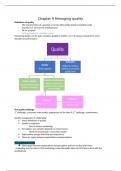
Quality
Reliability
Quality ability to continue
fit for purpose working at accepted
quality level
Quality of conformance
Quality of design
degree to which the
degree to which design
product or service agrees
achieves its purpose
with the design
Attributes
Variables
thing you can assess and
things you can measure
accept or reject
The quality challenge
1st challenge: customers make quality judgements all the time & 2 nd challenge: conformance
Quality management is challenging
o Many definitions of quality
o Quality is subjective
(You're always comparing)
o Perceptions are variable. Depends on many factors
(Think of servicescape / servuction model)
o Expectations change with time and experience
o There are 'gaps' between expectations and perceptions
The quality gap model
Shows gaps between expectations and perception and how to deal with them
= marketing tool, but also in OM (marketing created beautiful ideas, but OM has to deal with the
implications)
, Gap 1: between management perceptions of
customer expectations and the expectations
themselves
Gap 2: between management perceptions of
customer expectations and the actual
product/service specified
Gap 3: between the product/service
promised and that actually delivered
Gap 4: between the product/service actually
delivered an that externally communicated
to customers (e.g. through advertising)
Gap 5: between the product/service quality
perceived and that expected by customers
Cost of quality
Can ranges from 20% to 30% of gross sales!!
1. Prevention - costs of setting up standard and a system to maintain them, e.g. training staff
2. Assurance – costs of actually maintaining standards, e.g. resources required for inspection
3. Internal failure – cost due to waste or losses before the product reaches the customer, e.g.
rejection of raw materials
4. External failure – costs due to defective items reaching the customer, e.g. warranty costs or
poor word-of-mouth
Price of non-conformance (PONC) by Crosby (1979) = cost to management of not getting it right first
time and every time / cost of internal and external failure (25-40% of operating cost)
Alternatives for managing quality
- Quality inspection (QI) – ‘inspect the product before it sold’, mainly used in relatively small
context
- Quality control (QC) – ‘processes designed to monitor operations in order to maintain
quality’
Definitions of quality
- The characteristics of a product or service that satisfy stated or implied needs
- A product or service free of deficiencies
- ‘fit for purpose’
- So fit purpose and reliability is key!!
Measuring quality can be quite complex..Qualtiy is relative..so? It is always compared to some
standard or performance
Quality
Reliability
Quality ability to continue
fit for purpose working at accepted
quality level
Quality of conformance
Quality of design
degree to which the
degree to which design
product or service agrees
achieves its purpose
with the design
Attributes
Variables
thing you can assess and
things you can measure
accept or reject
The quality challenge
1st challenge: customers make quality judgements all the time & 2 nd challenge: conformance
Quality management is challenging
o Many definitions of quality
o Quality is subjective
(You're always comparing)
o Perceptions are variable. Depends on many factors
(Think of servicescape / servuction model)
o Expectations change with time and experience
o There are 'gaps' between expectations and perceptions
The quality gap model
Shows gaps between expectations and perception and how to deal with them
= marketing tool, but also in OM (marketing created beautiful ideas, but OM has to deal with the
implications)
, Gap 1: between management perceptions of
customer expectations and the expectations
themselves
Gap 2: between management perceptions of
customer expectations and the actual
product/service specified
Gap 3: between the product/service
promised and that actually delivered
Gap 4: between the product/service actually
delivered an that externally communicated
to customers (e.g. through advertising)
Gap 5: between the product/service quality
perceived and that expected by customers
Cost of quality
Can ranges from 20% to 30% of gross sales!!
1. Prevention - costs of setting up standard and a system to maintain them, e.g. training staff
2. Assurance – costs of actually maintaining standards, e.g. resources required for inspection
3. Internal failure – cost due to waste or losses before the product reaches the customer, e.g.
rejection of raw materials
4. External failure – costs due to defective items reaching the customer, e.g. warranty costs or
poor word-of-mouth
Price of non-conformance (PONC) by Crosby (1979) = cost to management of not getting it right first
time and every time / cost of internal and external failure (25-40% of operating cost)
Alternatives for managing quality
- Quality inspection (QI) – ‘inspect the product before it sold’, mainly used in relatively small
context
- Quality control (QC) – ‘processes designed to monitor operations in order to maintain
quality’