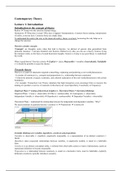
Contemporary Theory
Lecture 1: Introduction
Introduction to the concept of theory
Reality Trump won the elections (factual thing),
Abstraction What does it mean? Why does it happen? Interpretations, Common Sense making, interpretation
of reality, everyone does. Common Sense are simple ideas.
To understand the reality (the why to the observed reality), theory is critical; Answering the why helps us to
change the outcome.
Theories consider concepts
‘Concepts’ are thoughts, notes, ideas that lead to theories. ‘an abstract of generic idea generalized from
particular instances’. Concepts transform into theories. Behind every idea you can see a theory; Science trying
the interpret reality on the basis of sound theoretical insights. Science is trying to use good theory to understand
the world.
What is good theory? Four key criteria Explicit (= clear), Measurable (= testable), Generalizable, Falsifiable
(= it should be possible to reject the theory)
Towards theory
Theory is a system of statements targeted at describing, explaining and predicting a real world phenomenon.
- It consists of constructs (i.e. concepts) and propositions (i.e. relationship between constructs)
- Collectively presents a logical, systematic, and coherent explanation of the real-world phenomenon with certain
boundaries.
- For example: Transaction Cost Theory stipulates that high transaction costs encourage firms to insource the
making of a product or service. (Constructs in this theory are Asset Specificity, Uncertainty or Frequency).
Empirical Plane (= testing of theoretical insights) vs. Theoretical Plane (= theoretical thinking)
Empirical Plane = Cause (= observable) Effect (= unobservable) Consequence (= observable)
Independent Variable (= observable) Hypothesis (= unobservable) Dependent Variable (= observable)
Theoretical Plane = understand the relationship between the independent and dependent variables. ‘Why?’
We need constructs to generate theories. Construct A Propositions Construct B.
Scientific thinking uses variables, hypothesis, constructs and propositions
Variables is observable (= manifest), empirically measurable, is a representation of an abstract construct (=
latent).
Hypothesis states (expected) relationships between variables, is empirically testable, is stated in a falsifiable
form
Constructs is an abstract conceptual entity, is inferred from observable actions or states of phenomena, needs an
operational definition to become measurable.
Proposition is a relationship between constructs, is stated in a declarative form, must be falsifiable, explicitly
delineates constructs, typically introduces causality.
,In simpler form
Who? When? Where? = Generalizability, to who, when, where does it apply?
What? = Level of concepts, what we derive from theory or (in)dependent variables in empirical plane
How? Why? = hypothesis (empirical plane) and propositions (theoretical plane)
Above = empirical plane
Below = theoretical plane
Alcohol consumption (IV) =
intake of hard liquor (constructs)
Etc.
But be advised
- Theory can be represented in different forms box-and-arrow diagram, mathematic formula, symbolic logic,
tables, prototypes or simply words (e.g. narratives).
Types of theories (and models and frameworks)
Theory Type Distinguishing Attributes
I. Analyis Framewor The theory does not extend beyond analysis and
(Says what is) k description. No causal relationships among
phenomena are specified and no predictions are
made.
II. Explanation Theory The theory provides explanations but does not aim
(Says what is, how, why, when and to predict with any precision. There are no testable
where) propositions
III. Prediction Model The theory provides predictions and has testable
(Says what is and what will be) propositions but does not have well-developed
justificatory causal explanations
IV. Explanation and Prediction Theory Provides predictions and has both testable
(Says what is, how, why, when, where propositions and causal explanations
and what will be)
V. Design and Action Model The theory gives explicit prescriptions (e.g.
(Says how to do something) methods, techniques, principles of form and
function) for constructing an artifact
,Design and action
Design science
- Scientific insights can be used as input to build better solutions
> Theory as an input to problem solving (understanding ‘’why’’; generalizability is important)
> Theory as a result of problem solving
- Problem solving as a accolade of ‘’learning by doing’’ and ‘’trial and error’’
> Especially helpful for ‘’ill-defined’’ problems (wants to solve a specific problem in an organization)
Design and action research = scientist consciously intervenes into the natural setting and alters the course of
events to study the effect of his/her interventions and creates respective artifacts
Traditional behavioural research = scientist should not interfere with the setting being studies and tries not the
alter the natural course of events in order to build good explanatory and predictive theory.
Generalized processes for design research
Solution Incubation Problem Formulation
Substantive & Formal Theory Reflection and Learning
Models do have some overlap!
Theory versus Practice
Difference between theory and practice is more fundamental; not one of knowledge transfer
Traditional behavioural research = Why? vs. Design and action research = solving a problem for one
organization
In management we need both types (exploratory and explanatory); linking the two is needed. No one is
superior
Quality of theory and theorizing
What theory is not
, Whetten’s building blokcs
(1) What? Factor taken into account
(2) How? How are the factors related
(3) Why so? Justification for the causal relationships
(4) Who, Where, When? Generalizability, substantive and formal theory
Shapira adds formal testing as the ultimate test for good theory
Some (selected) quality criteria
Theorizing as reasoning
1. Inductive Theorizing data-driven, bottom-up, a posteriori explanation, ‘’climbing the ladder of
abstraction’’, many paradigms for theory building exist (e.g. case-based theory building, grounded theory,
simulation and experiments).
2. Deductive Theorizing theory-driven, top-down, a priori explanations, hinges on the ability to craft solid
hypotheses, strongly associated with surveys, experiments and simulations
3. Other forms of Theorizing
- Retroductive and abductive modes of theorizing.
- Pragmatic approaches to theorizing increasingly recognized real-world experiments, creating possible
words, action and design research as interventions that make dynamics of phenomenon observable.
Summary
Theory matters because
1. Helps to synthesize and integrate observations made into a consistent explanatory framework
2. Can serve as a basis for making predictions on the effects of managerial decision making
3. Force us to think about our (implicit) assumptions about any given situation and make these accessible for
discussion
4. Helps conclusions to be generalizable across different settings (within specified boundaries)
5. Don’t just ask ‘’what’’ but also look at the ‘’how’’ and ‘’why’’
Lecture 1: Articles
Article 1: Bridging Practice and Theory: A Design Science Approach
Ill structured decision situations where decision makers may not know or agree on the goals of the decision,
and even if the goals are known, the means by which these goals are achieved are not known and requisite
solution designs to solve the problem may not even exist.
Lecture 1: Introduction
Introduction to the concept of theory
Reality Trump won the elections (factual thing),
Abstraction What does it mean? Why does it happen? Interpretations, Common Sense making, interpretation
of reality, everyone does. Common Sense are simple ideas.
To understand the reality (the why to the observed reality), theory is critical; Answering the why helps us to
change the outcome.
Theories consider concepts
‘Concepts’ are thoughts, notes, ideas that lead to theories. ‘an abstract of generic idea generalized from
particular instances’. Concepts transform into theories. Behind every idea you can see a theory; Science trying
the interpret reality on the basis of sound theoretical insights. Science is trying to use good theory to understand
the world.
What is good theory? Four key criteria Explicit (= clear), Measurable (= testable), Generalizable, Falsifiable
(= it should be possible to reject the theory)
Towards theory
Theory is a system of statements targeted at describing, explaining and predicting a real world phenomenon.
- It consists of constructs (i.e. concepts) and propositions (i.e. relationship between constructs)
- Collectively presents a logical, systematic, and coherent explanation of the real-world phenomenon with certain
boundaries.
- For example: Transaction Cost Theory stipulates that high transaction costs encourage firms to insource the
making of a product or service. (Constructs in this theory are Asset Specificity, Uncertainty or Frequency).
Empirical Plane (= testing of theoretical insights) vs. Theoretical Plane (= theoretical thinking)
Empirical Plane = Cause (= observable) Effect (= unobservable) Consequence (= observable)
Independent Variable (= observable) Hypothesis (= unobservable) Dependent Variable (= observable)
Theoretical Plane = understand the relationship between the independent and dependent variables. ‘Why?’
We need constructs to generate theories. Construct A Propositions Construct B.
Scientific thinking uses variables, hypothesis, constructs and propositions
Variables is observable (= manifest), empirically measurable, is a representation of an abstract construct (=
latent).
Hypothesis states (expected) relationships between variables, is empirically testable, is stated in a falsifiable
form
Constructs is an abstract conceptual entity, is inferred from observable actions or states of phenomena, needs an
operational definition to become measurable.
Proposition is a relationship between constructs, is stated in a declarative form, must be falsifiable, explicitly
delineates constructs, typically introduces causality.
,In simpler form
Who? When? Where? = Generalizability, to who, when, where does it apply?
What? = Level of concepts, what we derive from theory or (in)dependent variables in empirical plane
How? Why? = hypothesis (empirical plane) and propositions (theoretical plane)
Above = empirical plane
Below = theoretical plane
Alcohol consumption (IV) =
intake of hard liquor (constructs)
Etc.
But be advised
- Theory can be represented in different forms box-and-arrow diagram, mathematic formula, symbolic logic,
tables, prototypes or simply words (e.g. narratives).
Types of theories (and models and frameworks)
Theory Type Distinguishing Attributes
I. Analyis Framewor The theory does not extend beyond analysis and
(Says what is) k description. No causal relationships among
phenomena are specified and no predictions are
made.
II. Explanation Theory The theory provides explanations but does not aim
(Says what is, how, why, when and to predict with any precision. There are no testable
where) propositions
III. Prediction Model The theory provides predictions and has testable
(Says what is and what will be) propositions but does not have well-developed
justificatory causal explanations
IV. Explanation and Prediction Theory Provides predictions and has both testable
(Says what is, how, why, when, where propositions and causal explanations
and what will be)
V. Design and Action Model The theory gives explicit prescriptions (e.g.
(Says how to do something) methods, techniques, principles of form and
function) for constructing an artifact
,Design and action
Design science
- Scientific insights can be used as input to build better solutions
> Theory as an input to problem solving (understanding ‘’why’’; generalizability is important)
> Theory as a result of problem solving
- Problem solving as a accolade of ‘’learning by doing’’ and ‘’trial and error’’
> Especially helpful for ‘’ill-defined’’ problems (wants to solve a specific problem in an organization)
Design and action research = scientist consciously intervenes into the natural setting and alters the course of
events to study the effect of his/her interventions and creates respective artifacts
Traditional behavioural research = scientist should not interfere with the setting being studies and tries not the
alter the natural course of events in order to build good explanatory and predictive theory.
Generalized processes for design research
Solution Incubation Problem Formulation
Substantive & Formal Theory Reflection and Learning
Models do have some overlap!
Theory versus Practice
Difference between theory and practice is more fundamental; not one of knowledge transfer
Traditional behavioural research = Why? vs. Design and action research = solving a problem for one
organization
In management we need both types (exploratory and explanatory); linking the two is needed. No one is
superior
Quality of theory and theorizing
What theory is not
, Whetten’s building blokcs
(1) What? Factor taken into account
(2) How? How are the factors related
(3) Why so? Justification for the causal relationships
(4) Who, Where, When? Generalizability, substantive and formal theory
Shapira adds formal testing as the ultimate test for good theory
Some (selected) quality criteria
Theorizing as reasoning
1. Inductive Theorizing data-driven, bottom-up, a posteriori explanation, ‘’climbing the ladder of
abstraction’’, many paradigms for theory building exist (e.g. case-based theory building, grounded theory,
simulation and experiments).
2. Deductive Theorizing theory-driven, top-down, a priori explanations, hinges on the ability to craft solid
hypotheses, strongly associated with surveys, experiments and simulations
3. Other forms of Theorizing
- Retroductive and abductive modes of theorizing.
- Pragmatic approaches to theorizing increasingly recognized real-world experiments, creating possible
words, action and design research as interventions that make dynamics of phenomenon observable.
Summary
Theory matters because
1. Helps to synthesize and integrate observations made into a consistent explanatory framework
2. Can serve as a basis for making predictions on the effects of managerial decision making
3. Force us to think about our (implicit) assumptions about any given situation and make these accessible for
discussion
4. Helps conclusions to be generalizable across different settings (within specified boundaries)
5. Don’t just ask ‘’what’’ but also look at the ‘’how’’ and ‘’why’’
Lecture 1: Articles
Article 1: Bridging Practice and Theory: A Design Science Approach
Ill structured decision situations where decision makers may not know or agree on the goals of the decision,
and even if the goals are known, the means by which these goals are achieved are not known and requisite
solution designs to solve the problem may not even exist.