Main Topics Notes
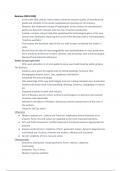
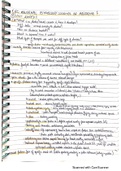
1. Introduction to - group dynamics = the influential actions, processes and changes that occur within and
Group Dynamics between groups; the scientific study of these processes; about 30 billion groups in the planet
defining groups - various definitions, some stress communication, mutual dependence, shared purpose…
- group = 2+ individuals who are connected by and within social relationships (subjective)
- "groups tend to gravitate to the smallest size, two" —> size influences its nature
- number of ties needed to connect all members grows exponentially as the group gets larger:
n(n-1)/2, but members feel connected to group as a whole; "strength of weak ties": are also
crucial
- when linked by a relationship, members people become interdependent; social: "actual,
imagined, or implied presence of other human beings"
- membership = state of belonging to, or being included in, a social group; the collective body
of all members in a group; is boundaried; vs social network (not relationship w/ the whole,
boundaried)
describing groups 1. task interaction: conjointly adjusted actions of members to group's projects, tasks,
(characteristics of goals; relationship interaction (socioemotional): relate/ influence the nature/ strength
groups) of <3 ties
-(e-groups are until now considered groups - same processes)
2. unity by common goals; most effective when conscientious about purposes: 4 types:
generating (ideas), choosing (alternatives), negotiating, executing (a plan)
3. interdependence = mutual dependence, when outcomes, actions, thoughts are partially
influenced by others; a)symmetric interdep. w/ reciprocity, b)hierarchical interdep.
without recip., c)hierarchical interdep. w/ unequal recip., d)sequential interdep.
without reciprocity
4. structure = complex roles, norms and intermember relations that organizes the groups;
roles = beh. expected by people in positions, norms = consensual standards for beh.
5. cohesion = integrity, solidarity, social integration, unity; recognized by members of the
groups and those outside of it
types of groups - primary: small intimate clusters; families, good friends, cliques of peers, the Impressionists;
profound influence on one another, forming social nature and ideals of individual
- social: larger, more formal organization, shorter membership, less emotional; work, clubs,
congregations, task-oriented mostly
- collectives: any aggregate of 2 or more, larger and more spontaneous, looser; queues,
audience, protests, relations are transitory and dissolve as soon as members separate
- social category: collection of individuals similar to one another in some way; gamblers, New
Yorkers… may have no social implication (just describing common feature) or highly influential
- social identity (part of one's self-concept); differentiating 'they' vs 'us' may cause conflicts
perceiving groups - entitativity: the extent to which group seems to be single unified unity (Gestalt), influenced
by: similarity, proximity, common fate, pragnanz (perceptual) and permeability
- people spontaneously distinct between the different types of groups
- Thomas Theorem applied to groups: if people define groups as real, they are real in their
interpersonal consequences (within and outside the group), perceptions influenced by
stereotypes
- groups high in entitativity have basic essence defining nature of group members
(essentialism)
- Eastern culture indiv pay more attention to groups than Western cultures (individualism)!
Group Dynamics - Lewin first used 'group dynamics' to describe the processes, but it's also a scientific field of
study
- paradigms (as in Kuhn) were shaped by: 1) Le Bon, social theorist, book on psychology of
crowds, 2) Wundt, psychologist, Völkerspychologie, 3) Durkheim, sociologist, 'society is made
possible by collective representations of individuals', 4) Allport, psychol., avoided holistic
approaches to groups
, - early researchers disagreed on their theorizing and methods to study: sociological
investigators adopted group level of analysis, psychologists focused on individuals - group
mind/collective consciousness/'espirit de group' (new charact. that individuals alone wouldn't
have, transcendent) as group fallacy! by Allport ("the group feel.. the group does..." - just a sum
of the parts!)
- Sherif demonstrated group processes can be studied through experimentation (no group
mind, but group level processes!; Lewin's field theory: behavior of group member is a function
of both the person and the environ (law of interactionism B=f(P, E), more than the sum);
Tuckman's theory of group development: forming, storming, norming, performing,
adjourning
- Social Value Orientation questionnaire: prosocial (+ cooperative to ingroup than to outgroup)/
individualistic (less cooperative, regardless of group membership)/ competitive; predicts
cooperation within & between groups, concessions in negotiations, self-sacrifice in partners...
- studying groups require multilevel, interdisciplinary analysis
(ind>group>organization>community): micro-level factors (qualities, characteristics, actions of
members), meso-level factors (group-level: cohesiveness, size, structure…), macro-level factors
(of larger collectives enfolding groups); Hackman's study of orchestras show the performance
depends on multilevel factors
- groups are influential: alter member's attitudes, values, perceptions (Tripplet's early study on
group performance), Milgram's study; hypothesis about groups give clearer results than other
fields in psychology
- groups influence society (mediate connection between individuals and society, provide
microstructure for social transformation)
- applied studies of groups, dynamics give solutions to significant social practical problems, as
action research: expands theoretical knowledge and identifies solutions (usefulness of groups)
- despite all problems stemming from groups, humans could not survive without groups (Buys)
- topics of scientific study of group dynamics: group structure, performance, e-groups,
diversity… group formation, development, structure, power, conflict, context
3. Inclusion & Identity - groups transform me into we
- 3 interrelated processes determine relationship btw individuals to groups: inclusion/
exclusion, individualism/ collectivism, personal identity/ social identity
Isolation to Inclusion - human behavior is motivated by the need to belong = pervasive drive to maintain lasting,
positive, impactful interpersonal relationships (though solitude is sometimes rewarding), most
adults prefer the company of others; levels of social capital (extensiveness of social
interpersonal connectedness) are decreasing due to reduction in involvement in groups (but
may indicate just a quantitative change rather than qualitative),
- groups help members avoid basic forms of loneliness (social & <3) = aversive psychol reaction
to perceived lack of personal/ social relations; people who belong to groups are healthier and
happier; loneliness can be contagious (likely to be lonely if linked to lonely person, up to 4
degrees of separation)
ostracism = deliberate exclusion from groups, highly stressful:
- temporal need-threat model's 3 stages in response to exclusion: reflexive (negative <3 &
confusion), reflective, resignation (loss of self-worth)
- ind w/ fight or flight response confront (also self-defeating, when it's overt unwarranted) or
withdraw from group, may have freezing responses (numbing) in extreme exclusion
- those w/ tend-and-befriend seek social connection, become more socially perceptive, women
try to compensate working harder;
- Gaertner & Leary studied violent attacks of individuals on groups (school shooting): one
common variable was being rejected
- same negative reaction in cyberostracism! When it's unintentional, by outgroup, by whom they
loathe… overlap between social and physical pain! (anterior cingulate)
- fundamental needs are threatened: to belong, control, self-esteem, meaningful existence
- mitigating factors: pain killers, financial compensation (less activation, felt less dependent)
, human nature - need to belong comes from natural selection, the herd instinct: we are prepared for social life
- sociometer theory: self-worth feelings are monitors of degree of acceptance by others, it's
confirmed by several studies
- biological basis (physiological and neurological) of negative emotional reactions: social is
neurologically similar to physical pain (relieved by painkillers! - fMRI), oxytocin
Individualism to - individualism & collectivism distinguished by emphasis on individuals and the collective
Collectivism across people (micro level), groups (meso level), and cultures (macro level)
in micro level - self-concept is based on personal identity and social identity; M=F, Millenials are shi ing
towards Me;
- individualists stress personal qualities (independents, idiocentrics) & goals, competition,
uniqueness, privacy, self-knowledge, directness; more trusting of strangers, exchange relation
- collectivists (interdependents, allocentrics): relationships, belong, duty, harmony, seeking
advice, context, hierarchy, group's needs; more likely to favor members of ingroup (us vs them)
- optimal distinctiveness theory: we have three fundamental needs: to be linked to a group, to
be connected to friends and loved ones, and for autonomy and differentiation; achieving
optimal distinctiveness makes you the happiest
in meso level - the group culture determines emphasis of the group on members or groups as a whole
- conformity ("the tall nail gets pounded down") vs. uniqueness ("the squeaky wheel gets the
grease")
- exchange (rewards matters) vs communal (focus on what the group receives) relationships;
clearly seen in bargaining game: Ultimatum Game (reallocate $20, partner rejects = lose all)
- norm of reciprocity: individualistic groups: equity norm (outcome in proportion of input),
egocentric; collectivistic groups: equality norm (payoff equal regardless of input), sociocentric
(concerned w/ contributing)
in macro level - cultural differences; only 60% of individuals in collective/ individualist cultures are so (tend to
leave the culture); collectivist cultures may be vertically or horizontally structured, also
different approaches to resolving conflicts; take ethnic, subgroups into account!
Personal Identity to - social identity theory: to understand causes of conflicts between people of ≠ groups; even in
Social Identity minimal intergroup situations (a few, linked by irrelevant similarity) the group interferes w/
behavior: categorization and identification
- self-categorization: social identity depends on social categorization; stereotypes (prototypes)
are socially shared cognitive generalization —> self-stereotyping once in the group
- identification w/ the group: accepting the group as an extension of the self; as social
identification increases, members see membership as personally significant; sense of self
changes as group becomes more and more included in the self
- identity shi s when membership becomes more salient; collective self-esteem, in protecting
the collective self, may have ingroup-outgroup bias (positive to self-esteem and well-being of
group); using social creativity to protect social esteem: only comparing where ingroup would
be better (may be dangerous)
- stereotype creates but also constrains identity… negative ingroup stereotyping protect's
individual's self-worth (it's group's foul, more disturbed by personal than collective self-esteem
threat); individual mobility = disconnecting w/ group to protect individual self-esteem;
- effects of stereotype threat
4. Formation - artists circle = as the impressionists, small group of peers, collaborative to each other's work
Joining Groups - personality: Five Factor Model: extraversion (assertive), agreeableness, conscientiousness,
neuroticism, openness; groups prefer extravert (seem happier, networking, happier - social,
active) and agreeable; seek to join group that fit personality (personality-group fit)
- gender: women are more extraverted and agreeable, higher relationality (facilitate having
connections), smaller, informal, intimate, safety; men seek larger, more formal, task-focused,
power → society roles, sexism
- social motivation: level of need for affiliation (join more, consider more enjoyable, fear
rejection); need for intimacy (think more about other people, interact more, reciprocity); need
for power (desire to influence others, large groups); → FIRO (Fundamental Interpersonal
1. Introduction to - group dynamics = the influential actions, processes and changes that occur within and
Group Dynamics between groups; the scientific study of these processes; about 30 billion groups in the planet
defining groups - various definitions, some stress communication, mutual dependence, shared purpose…
- group = 2+ individuals who are connected by and within social relationships (subjective)
- "groups tend to gravitate to the smallest size, two" —> size influences its nature
- number of ties needed to connect all members grows exponentially as the group gets larger:
n(n-1)/2, but members feel connected to group as a whole; "strength of weak ties": are also
crucial
- when linked by a relationship, members people become interdependent; social: "actual,
imagined, or implied presence of other human beings"
- membership = state of belonging to, or being included in, a social group; the collective body
of all members in a group; is boundaried; vs social network (not relationship w/ the whole,
boundaried)
describing groups 1. task interaction: conjointly adjusted actions of members to group's projects, tasks,
(characteristics of goals; relationship interaction (socioemotional): relate/ influence the nature/ strength
groups) of <3 ties
-(e-groups are until now considered groups - same processes)
2. unity by common goals; most effective when conscientious about purposes: 4 types:
generating (ideas), choosing (alternatives), negotiating, executing (a plan)
3. interdependence = mutual dependence, when outcomes, actions, thoughts are partially
influenced by others; a)symmetric interdep. w/ reciprocity, b)hierarchical interdep.
without recip., c)hierarchical interdep. w/ unequal recip., d)sequential interdep.
without reciprocity
4. structure = complex roles, norms and intermember relations that organizes the groups;
roles = beh. expected by people in positions, norms = consensual standards for beh.
5. cohesion = integrity, solidarity, social integration, unity; recognized by members of the
groups and those outside of it
types of groups - primary: small intimate clusters; families, good friends, cliques of peers, the Impressionists;
profound influence on one another, forming social nature and ideals of individual
- social: larger, more formal organization, shorter membership, less emotional; work, clubs,
congregations, task-oriented mostly
- collectives: any aggregate of 2 or more, larger and more spontaneous, looser; queues,
audience, protests, relations are transitory and dissolve as soon as members separate
- social category: collection of individuals similar to one another in some way; gamblers, New
Yorkers… may have no social implication (just describing common feature) or highly influential
- social identity (part of one's self-concept); differentiating 'they' vs 'us' may cause conflicts
perceiving groups - entitativity: the extent to which group seems to be single unified unity (Gestalt), influenced
by: similarity, proximity, common fate, pragnanz (perceptual) and permeability
- people spontaneously distinct between the different types of groups
- Thomas Theorem applied to groups: if people define groups as real, they are real in their
interpersonal consequences (within and outside the group), perceptions influenced by
stereotypes
- groups high in entitativity have basic essence defining nature of group members
(essentialism)
- Eastern culture indiv pay more attention to groups than Western cultures (individualism)!
Group Dynamics - Lewin first used 'group dynamics' to describe the processes, but it's also a scientific field of
study
- paradigms (as in Kuhn) were shaped by: 1) Le Bon, social theorist, book on psychology of
crowds, 2) Wundt, psychologist, Völkerspychologie, 3) Durkheim, sociologist, 'society is made
possible by collective representations of individuals', 4) Allport, psychol., avoided holistic
approaches to groups
, - early researchers disagreed on their theorizing and methods to study: sociological
investigators adopted group level of analysis, psychologists focused on individuals - group
mind/collective consciousness/'espirit de group' (new charact. that individuals alone wouldn't
have, transcendent) as group fallacy! by Allport ("the group feel.. the group does..." - just a sum
of the parts!)
- Sherif demonstrated group processes can be studied through experimentation (no group
mind, but group level processes!; Lewin's field theory: behavior of group member is a function
of both the person and the environ (law of interactionism B=f(P, E), more than the sum);
Tuckman's theory of group development: forming, storming, norming, performing,
adjourning
- Social Value Orientation questionnaire: prosocial (+ cooperative to ingroup than to outgroup)/
individualistic (less cooperative, regardless of group membership)/ competitive; predicts
cooperation within & between groups, concessions in negotiations, self-sacrifice in partners...
- studying groups require multilevel, interdisciplinary analysis
(ind>group>organization>community): micro-level factors (qualities, characteristics, actions of
members), meso-level factors (group-level: cohesiveness, size, structure…), macro-level factors
(of larger collectives enfolding groups); Hackman's study of orchestras show the performance
depends on multilevel factors
- groups are influential: alter member's attitudes, values, perceptions (Tripplet's early study on
group performance), Milgram's study; hypothesis about groups give clearer results than other
fields in psychology
- groups influence society (mediate connection between individuals and society, provide
microstructure for social transformation)
- applied studies of groups, dynamics give solutions to significant social practical problems, as
action research: expands theoretical knowledge and identifies solutions (usefulness of groups)
- despite all problems stemming from groups, humans could not survive without groups (Buys)
- topics of scientific study of group dynamics: group structure, performance, e-groups,
diversity… group formation, development, structure, power, conflict, context
3. Inclusion & Identity - groups transform me into we
- 3 interrelated processes determine relationship btw individuals to groups: inclusion/
exclusion, individualism/ collectivism, personal identity/ social identity
Isolation to Inclusion - human behavior is motivated by the need to belong = pervasive drive to maintain lasting,
positive, impactful interpersonal relationships (though solitude is sometimes rewarding), most
adults prefer the company of others; levels of social capital (extensiveness of social
interpersonal connectedness) are decreasing due to reduction in involvement in groups (but
may indicate just a quantitative change rather than qualitative),
- groups help members avoid basic forms of loneliness (social & <3) = aversive psychol reaction
to perceived lack of personal/ social relations; people who belong to groups are healthier and
happier; loneliness can be contagious (likely to be lonely if linked to lonely person, up to 4
degrees of separation)
ostracism = deliberate exclusion from groups, highly stressful:
- temporal need-threat model's 3 stages in response to exclusion: reflexive (negative <3 &
confusion), reflective, resignation (loss of self-worth)
- ind w/ fight or flight response confront (also self-defeating, when it's overt unwarranted) or
withdraw from group, may have freezing responses (numbing) in extreme exclusion
- those w/ tend-and-befriend seek social connection, become more socially perceptive, women
try to compensate working harder;
- Gaertner & Leary studied violent attacks of individuals on groups (school shooting): one
common variable was being rejected
- same negative reaction in cyberostracism! When it's unintentional, by outgroup, by whom they
loathe… overlap between social and physical pain! (anterior cingulate)
- fundamental needs are threatened: to belong, control, self-esteem, meaningful existence
- mitigating factors: pain killers, financial compensation (less activation, felt less dependent)
, human nature - need to belong comes from natural selection, the herd instinct: we are prepared for social life
- sociometer theory: self-worth feelings are monitors of degree of acceptance by others, it's
confirmed by several studies
- biological basis (physiological and neurological) of negative emotional reactions: social is
neurologically similar to physical pain (relieved by painkillers! - fMRI), oxytocin
Individualism to - individualism & collectivism distinguished by emphasis on individuals and the collective
Collectivism across people (micro level), groups (meso level), and cultures (macro level)
in micro level - self-concept is based on personal identity and social identity; M=F, Millenials are shi ing
towards Me;
- individualists stress personal qualities (independents, idiocentrics) & goals, competition,
uniqueness, privacy, self-knowledge, directness; more trusting of strangers, exchange relation
- collectivists (interdependents, allocentrics): relationships, belong, duty, harmony, seeking
advice, context, hierarchy, group's needs; more likely to favor members of ingroup (us vs them)
- optimal distinctiveness theory: we have three fundamental needs: to be linked to a group, to
be connected to friends and loved ones, and for autonomy and differentiation; achieving
optimal distinctiveness makes you the happiest
in meso level - the group culture determines emphasis of the group on members or groups as a whole
- conformity ("the tall nail gets pounded down") vs. uniqueness ("the squeaky wheel gets the
grease")
- exchange (rewards matters) vs communal (focus on what the group receives) relationships;
clearly seen in bargaining game: Ultimatum Game (reallocate $20, partner rejects = lose all)
- norm of reciprocity: individualistic groups: equity norm (outcome in proportion of input),
egocentric; collectivistic groups: equality norm (payoff equal regardless of input), sociocentric
(concerned w/ contributing)
in macro level - cultural differences; only 60% of individuals in collective/ individualist cultures are so (tend to
leave the culture); collectivist cultures may be vertically or horizontally structured, also
different approaches to resolving conflicts; take ethnic, subgroups into account!
Personal Identity to - social identity theory: to understand causes of conflicts between people of ≠ groups; even in
Social Identity minimal intergroup situations (a few, linked by irrelevant similarity) the group interferes w/
behavior: categorization and identification
- self-categorization: social identity depends on social categorization; stereotypes (prototypes)
are socially shared cognitive generalization —> self-stereotyping once in the group
- identification w/ the group: accepting the group as an extension of the self; as social
identification increases, members see membership as personally significant; sense of self
changes as group becomes more and more included in the self
- identity shi s when membership becomes more salient; collective self-esteem, in protecting
the collective self, may have ingroup-outgroup bias (positive to self-esteem and well-being of
group); using social creativity to protect social esteem: only comparing where ingroup would
be better (may be dangerous)
- stereotype creates but also constrains identity… negative ingroup stereotyping protect's
individual's self-worth (it's group's foul, more disturbed by personal than collective self-esteem
threat); individual mobility = disconnecting w/ group to protect individual self-esteem;
- effects of stereotype threat
4. Formation - artists circle = as the impressionists, small group of peers, collaborative to each other's work
Joining Groups - personality: Five Factor Model: extraversion (assertive), agreeableness, conscientiousness,
neuroticism, openness; groups prefer extravert (seem happier, networking, happier - social,
active) and agreeable; seek to join group that fit personality (personality-group fit)
- gender: women are more extraverted and agreeable, higher relationality (facilitate having
connections), smaller, informal, intimate, safety; men seek larger, more formal, task-focused,
power → society roles, sexism
- social motivation: level of need for affiliation (join more, consider more enjoyable, fear
rejection); need for intimacy (think more about other people, interact more, reciprocity); need
for power (desire to influence others, large groups); → FIRO (Fundamental Interpersonal