Logical empiricist philosophy of science
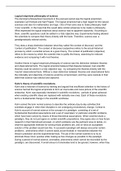
The dominant philosophical movement in the post-war period was the logical empiricism,
examples Carl Hempel and Karl Popper. The logical empiricist had a high regard for the natural
sciences and also for mathematics and logic. One of their aims was to make philosophy itself
'more' scientific, in the hope that this would allow similar advances to be made in philosophy.
What impressed the logical empiricist about science was its apparent objectivity. According to
them, scientific questions could be settled in a fully objective way. Experimental testing allowed
the scientists to compare their theory directly with the facts. Therefore, science was a
paradigmatically rational activity.
They draw a sharp distinction between what they called 'the context of discovery' and the
'context of justification'. The context of discovery (subjective) refers to the actual historical
process by which a scientist arrives at a given theory. The context of justification (objective)
refers to the means by which the scientist tries to justify the theory, searching for relevant
evidence and comparing it with rival theories.
Another theme in logical empiricist philosophy of science was the distinction between theories
and observational facts. The logical empiricist believed that disputes between rival scientific
theories could be solved in a fully objective way - by comparing the theories directly with the
'neutral' observational facts. Without a clear distinction between theories and observational facts
the rationality and objectivity of science would be compromised, and they were resolute in their
belief that science was rational and objective.
Kuhn's theory of scientific revolutions
Kuhn was a historian of science by training and argued that insufficient attention to the history of
science had led the logical empiricists to form an inaccurate and naive picture of the scientific
enterprise. Kuhn was especially interested in scientific revolutions - periods of great upheaval
when existing scientific ideas are replaced with radically new ones. Each of these revolutions
led to a fundamental change in the scientific worldview.
Kuhn coined the term normal science to describe the ordinary day-to-day activities that
scientists engage in when their discipline is not undergoing revolutionary change. Central to
Kuhn's account of normal science is the concept of a paradigm: consisting of a set of
fundamental theoretical assumptions and a set of 'exemplars' or particular scientific problems,
which have been solved by means of those theoretical assumptions. When scientist share a
paradigm, they do not just agree on certain scientific propositions, they agree also on how future
research in their field should proceed, on which problems are the pertinent ones to tackle, on
what the appropriate methods for solving those problems are, and on what an acceptable
solution of the problem would look like. A successful paradigm will always encounter certain
problems - phenomena which it cannot easily accommodate or mismatches between the
theory's prediction and the experimental facts. The job of the normal scientist is to try to
eliminate these minor puzzles while making as few changes as possible to the paradigm.
During a period of normal science, anomalies, phenomena which cannot be reconciled by the
paradigm, are discovered. A small amount of anomalies tend to be ignored, however, when they
The dominant philosophical movement in the post-war period was the logical empiricism,
examples Carl Hempel and Karl Popper. The logical empiricist had a high regard for the natural
sciences and also for mathematics and logic. One of their aims was to make philosophy itself
'more' scientific, in the hope that this would allow similar advances to be made in philosophy.
What impressed the logical empiricist about science was its apparent objectivity. According to
them, scientific questions could be settled in a fully objective way. Experimental testing allowed
the scientists to compare their theory directly with the facts. Therefore, science was a
paradigmatically rational activity.
They draw a sharp distinction between what they called 'the context of discovery' and the
'context of justification'. The context of discovery (subjective) refers to the actual historical
process by which a scientist arrives at a given theory. The context of justification (objective)
refers to the means by which the scientist tries to justify the theory, searching for relevant
evidence and comparing it with rival theories.
Another theme in logical empiricist philosophy of science was the distinction between theories
and observational facts. The logical empiricist believed that disputes between rival scientific
theories could be solved in a fully objective way - by comparing the theories directly with the
'neutral' observational facts. Without a clear distinction between theories and observational facts
the rationality and objectivity of science would be compromised, and they were resolute in their
belief that science was rational and objective.
Kuhn's theory of scientific revolutions
Kuhn was a historian of science by training and argued that insufficient attention to the history of
science had led the logical empiricists to form an inaccurate and naive picture of the scientific
enterprise. Kuhn was especially interested in scientific revolutions - periods of great upheaval
when existing scientific ideas are replaced with radically new ones. Each of these revolutions
led to a fundamental change in the scientific worldview.
Kuhn coined the term normal science to describe the ordinary day-to-day activities that
scientists engage in when their discipline is not undergoing revolutionary change. Central to
Kuhn's account of normal science is the concept of a paradigm: consisting of a set of
fundamental theoretical assumptions and a set of 'exemplars' or particular scientific problems,
which have been solved by means of those theoretical assumptions. When scientist share a
paradigm, they do not just agree on certain scientific propositions, they agree also on how future
research in their field should proceed, on which problems are the pertinent ones to tackle, on
what the appropriate methods for solving those problems are, and on what an acceptable
solution of the problem would look like. A successful paradigm will always encounter certain
problems - phenomena which it cannot easily accommodate or mismatches between the
theory's prediction and the experimental facts. The job of the normal scientist is to try to
eliminate these minor puzzles while making as few changes as possible to the paradigm.
During a period of normal science, anomalies, phenomena which cannot be reconciled by the
paradigm, are discovered. A small amount of anomalies tend to be ignored, however, when they