

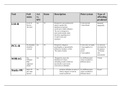
Tool Full Act Items Description Point system Type of
name vs. offending
SPJ predicted
Level of Act 54 Designed to use psychosocial 0=item present General/
LSI-R Service status to predict the 1=item absent unspecific
Revised likelihood of general
recidivism in adult offenders.
The tool is designed to
assist professionals make
decisions regarding level
of supervision and
treatment
Psychopathy Act 20 Designed to diagnose 0=item does not apply n/a (tool not
PCL-R checklist psychopathy as operationally 1=item applies to a developed for
-revised defined in Cleckley's (1941) certain the purpose
The mask of sanity extent of forensic
2=item applies risk
assessment)
Sex Act 14 Designed to assess the n/a (different point Violent
SORAG Offender likelihood of violent values awarded for
Risk (including sexual) recidivism different items)
Appraisal specifically in previously
Guide convicted sex offenders
Static 99 Act 10 - positions offenders in terms of n/a (different point Sexual
Static-99/ (for static relative degrees of risk for values awarded for
factors) sexual recidivism different items)
, Designed to predict the - has norms from
Static long-term probability of low to high risk
2002R sexual recidivism
amongst adult male offenders who
have committed a sexual offense
- based on demographic and
criminal history
Violence Act 12 Designed to be used to predict risk of n/a (different point Violent
VRAG Risk violence in previously violent values awarded for
Appraisal mentally disordered offenders different items)
Guide
Historical, SPJ 20 Designed to assess violence risk in 0=item not present Violent
HCR-20 Clinical and forensic, criminal justice, 1=item possibly present reoffending
Risk - with and civil psychiatric settings 2=item definitely
20 items present
1. historical factors- themes:
- adjustment/living,
mental health,
antisociality
2. clinical factors (re-evaluated
periodically)
- recent or current
psychosocial, mental
health, and
behavioural
functioning
name vs. offending
SPJ predicted
Level of Act 54 Designed to use psychosocial 0=item present General/
LSI-R Service status to predict the 1=item absent unspecific
Revised likelihood of general
recidivism in adult offenders.
The tool is designed to
assist professionals make
decisions regarding level
of supervision and
treatment
Psychopathy Act 20 Designed to diagnose 0=item does not apply n/a (tool not
PCL-R checklist psychopathy as operationally 1=item applies to a developed for
-revised defined in Cleckley's (1941) certain the purpose
The mask of sanity extent of forensic
2=item applies risk
assessment)
Sex Act 14 Designed to assess the n/a (different point Violent
SORAG Offender likelihood of violent values awarded for
Risk (including sexual) recidivism different items)
Appraisal specifically in previously
Guide convicted sex offenders
Static 99 Act 10 - positions offenders in terms of n/a (different point Sexual
Static-99/ (for static relative degrees of risk for values awarded for
factors) sexual recidivism different items)
, Designed to predict the - has norms from
Static long-term probability of low to high risk
2002R sexual recidivism
amongst adult male offenders who
have committed a sexual offense
- based on demographic and
criminal history
Violence Act 12 Designed to be used to predict risk of n/a (different point Violent
VRAG Risk violence in previously violent values awarded for
Appraisal mentally disordered offenders different items)
Guide
Historical, SPJ 20 Designed to assess violence risk in 0=item not present Violent
HCR-20 Clinical and forensic, criminal justice, 1=item possibly present reoffending
Risk - with and civil psychiatric settings 2=item definitely
20 items present
1. historical factors- themes:
- adjustment/living,
mental health,
antisociality
2. clinical factors (re-evaluated
periodically)
- recent or current
psychosocial, mental
health, and
behavioural
functioning



