TASK 1: IS IT ALL ABOUT THE BRAIN?
Brainstorm:
• Case Parkinson’s disease: neurodegenerative disease starts slowly, and then you only notice it
in the end, because of the slow progress.
• Compensation mechanisms
• Cognitive reserve
• Age —> pathology can also be mistaken for ‘Normal aging’
• Case Alzheimer’s disease:
• Husband is taking over tasks
• Link with trauma (PTSD)
• ICF:
• Health condition: dementia
• Body functions and structures: something in the brain (stage of dementia)
• (impairments): motor, cognition, affection
• Activities: loses keys, forgetting, difficulties with scheduling
• Participation: grocery shopping, social activities
• Environmental factors: heart attack of her husband
• Personal factors: age, gender, education
• Case Stroke:
• Age might play a role
• Cognitive reserve
• Mr. D did maybe more exercise, etc. so the effect was not as big
• Biopsychosocial model
• ICF
Task is not about specific brain diseases
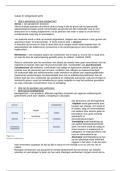
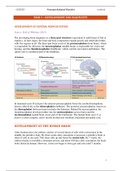
One type of biopsychosocial model:
, 3 domains are affected by the disease (body functions, activities, participation), 2 factors (environmental
and personal) leading to the 3 domains
[If I remember correctly, the relationship goes in both directions. In the biopsychosocial view, the disease is also influenced by all the other factors, that
can improve (or worsen) the disease or at least how the person experiences it (especially for chronic illnesses). Some studie s have also shown that a
comprehensive and empathetic attitude in doctors can lead to a reduction of the patient CRP (a marker of inflammation) and a faster recovery.
See: A systematic review of the association between empathy measures and patient outcomes in cancer care (Lelorain et al., 2012) DOI:
10.1002/pon.2115]
Learning goals:
1. What is neuroplasticity? (Definition and few mechanisms) —> brief
a. How does it affect behavior?
2. What is the biopsychosocial model and what are the main components?
a. What is the ICF?
3. What is neuropsychological rehabilitation?
a. What is the difference between clinical rehabilitation and neurorehabilitation?
b. What are the goals of rehabilitation?
Post-Discussion
1. What is neuroplasticity? (Definition and few mechanisms) —> brief
Neuroplasticity: capacity of the brain to recognize by changes in structure and function in reaction to
experience or environmental stimulation throughout life
- Homeostatic plasticity => a negative feedback-mediated form of plasticity that serves to keep
network activity at a desired set point by ensuring that neurons receive an adequate amount of
synaptic input through the attenuation of synaptic activity resulting in the upregulation of both
the presynaptic release of and the postsynaptic response to NT’s. (This happens naturally).
- Hebbian plasticity => a positive feedback-mediated form of plasticity in which synapses
between presynaptic and postsynaptic neurons that are coincidentally active are strengthened
(main rule here: ‘what fires together wires together’). There is a reinforcement of some
connections that are more used. Less stimulation is needed for an action potential.
- Synaptogenesis => the growth of new functional synapses
- Neurogenesis => the birth and growth of new neurons, happens in dentate gyrus, hippocampus,
damaged areas and olfactory bulb – lifelong
Brainstorm:
• Case Parkinson’s disease: neurodegenerative disease starts slowly, and then you only notice it
in the end, because of the slow progress.
• Compensation mechanisms
• Cognitive reserve
• Age —> pathology can also be mistaken for ‘Normal aging’
• Case Alzheimer’s disease:
• Husband is taking over tasks
• Link with trauma (PTSD)
• ICF:
• Health condition: dementia
• Body functions and structures: something in the brain (stage of dementia)
• (impairments): motor, cognition, affection
• Activities: loses keys, forgetting, difficulties with scheduling
• Participation: grocery shopping, social activities
• Environmental factors: heart attack of her husband
• Personal factors: age, gender, education
• Case Stroke:
• Age might play a role
• Cognitive reserve
• Mr. D did maybe more exercise, etc. so the effect was not as big
• Biopsychosocial model
• ICF
Task is not about specific brain diseases
One type of biopsychosocial model:
, 3 domains are affected by the disease (body functions, activities, participation), 2 factors (environmental
and personal) leading to the 3 domains
[If I remember correctly, the relationship goes in both directions. In the biopsychosocial view, the disease is also influenced by all the other factors, that
can improve (or worsen) the disease or at least how the person experiences it (especially for chronic illnesses). Some studie s have also shown that a
comprehensive and empathetic attitude in doctors can lead to a reduction of the patient CRP (a marker of inflammation) and a faster recovery.
See: A systematic review of the association between empathy measures and patient outcomes in cancer care (Lelorain et al., 2012) DOI:
10.1002/pon.2115]
Learning goals:
1. What is neuroplasticity? (Definition and few mechanisms) —> brief
a. How does it affect behavior?
2. What is the biopsychosocial model and what are the main components?
a. What is the ICF?
3. What is neuropsychological rehabilitation?
a. What is the difference between clinical rehabilitation and neurorehabilitation?
b. What are the goals of rehabilitation?
Post-Discussion
1. What is neuroplasticity? (Definition and few mechanisms) —> brief
Neuroplasticity: capacity of the brain to recognize by changes in structure and function in reaction to
experience or environmental stimulation throughout life
- Homeostatic plasticity => a negative feedback-mediated form of plasticity that serves to keep
network activity at a desired set point by ensuring that neurons receive an adequate amount of
synaptic input through the attenuation of synaptic activity resulting in the upregulation of both
the presynaptic release of and the postsynaptic response to NT’s. (This happens naturally).
- Hebbian plasticity => a positive feedback-mediated form of plasticity in which synapses
between presynaptic and postsynaptic neurons that are coincidentally active are strengthened
(main rule here: ‘what fires together wires together’). There is a reinforcement of some
connections that are more used. Less stimulation is needed for an action potential.
- Synaptogenesis => the growth of new functional synapses
- Neurogenesis => the birth and growth of new neurons, happens in dentate gyrus, hippocampus,
damaged areas and olfactory bulb – lifelong