
The Adolescent Brain
Brain
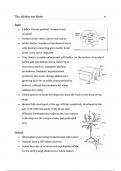
● 4 lobes: frontal, parietal, temporal and
occipital
● Surface of the cortex: gyrus and sulcus
● White matter: bundles of myelinated nerve
cells (axons) connecting grey matter brain
areas, carry nerve impulses
● Gray matter: consists of neuronal cell bodies, on the surface of cerebral
cortex and cerebellum and in subcortical
structures (such as; amygdala, nucleus
accumbens, thalamus, hypothalamus,
putamen), decreases during adolescence
(growing up to be an adult, characterized by
puberty, cultural determinants for when
adolescence ends)
● Global pattern of brain development; from the back to the front of the
brain
● Almost fully developed at the age of 8 but completely developed at the
age of 30, different parts of the brain have
different developmental trajectories; last regions
to develop are the temporal lobe and prefrontal
area
Neuron
● Information processing/transmission takes place
● Humans have a 100 billion neurons
● Linear increase of neurons and myelination of the
cortex until young adolescence; white matter
, keeps increasing until old age, whereas, gray matter peaks earlier in
adolescence and decreases early
● Nonlinear decrease of grey matter in adolescence; explained by
synaptogenesis and pruning
● Synaptogenesis: increase in synapses
● Pruning: elimination of excess synapses
● Neuron consists of: myelin, axon, synapse and dendrite
● Myelin: fatty insulating substance surrounding axons, enables
optimal/enhanced neurotransmission
● Axon: extends from cell body, conducts electrical impulses
● Dendrites: branched projections of a neuron that receives electrical
impulses
fMRI
● Functional Magnetic Resonance Imaging, a special MRI technique to
measure brain activity
● MRI lets us observe the brain
structure, while the fMRI lets us
observe different brain functions
(differentiates active parts from
inactive ones)
● Measurement of increased blood
flow (more oxygen means more
activity); blood-oxygen level
dependent (BOLD) effect: it is a
relative measure, not absolute
● Changing haemoglobin in red blood
cells; magnetic properties of
hemoglobin are measurable
, ● Advantages; non-invasive technique, high spatial resolution/low
temporal resolution
● EEG; high temporal resolution/low spatial resolution, used for tracking
activation during a long period of time (such as sleep)
Structures
● Areas associated with processing rewards; striatum, nucleus accumbens
(primary component in the circuitry of reward), ventromedial prefrontal
cortex
● Prefrontal cortex is associated with behavior regulation, medial (MPFC)
and lateral (LPFC) prefrontal cortex
● Social brain network; temporoparietal junction (TPJ), posterior superior
temporal sulcus (pSTS) and dorsomedial prefrontal cortex (dmPFC)
● Regulation of emotions; the connection between the amygdala and the
prefrontal cortex is important
Experimental designs
● When conducting a study using an fMRI, control condition is of vast
importance to differentiate between relevant and irrelevant brain
activation
● All stimuli is shown for 2500 milliseconds to have a constant signal
change and to interpret the results more easily; there is a equally lasting
fixation between trials
● Many trials are needed, at least 20, but participants need to be engaged
● fMRI analysis; number of slices, slice thickness, matrix size, in plane
resolution (voxel/volumetric pixel)
Nelson et al. (2005)
● Social information processing network; detection node (first node that
comes into play when in social interactions, early maturation), cognitive
Brain
● 4 lobes: frontal, parietal, temporal and
occipital
● Surface of the cortex: gyrus and sulcus
● White matter: bundles of myelinated nerve
cells (axons) connecting grey matter brain
areas, carry nerve impulses
● Gray matter: consists of neuronal cell bodies, on the surface of cerebral
cortex and cerebellum and in subcortical
structures (such as; amygdala, nucleus
accumbens, thalamus, hypothalamus,
putamen), decreases during adolescence
(growing up to be an adult, characterized by
puberty, cultural determinants for when
adolescence ends)
● Global pattern of brain development; from the back to the front of the
brain
● Almost fully developed at the age of 8 but completely developed at the
age of 30, different parts of the brain have
different developmental trajectories; last regions
to develop are the temporal lobe and prefrontal
area
Neuron
● Information processing/transmission takes place
● Humans have a 100 billion neurons
● Linear increase of neurons and myelination of the
cortex until young adolescence; white matter
, keeps increasing until old age, whereas, gray matter peaks earlier in
adolescence and decreases early
● Nonlinear decrease of grey matter in adolescence; explained by
synaptogenesis and pruning
● Synaptogenesis: increase in synapses
● Pruning: elimination of excess synapses
● Neuron consists of: myelin, axon, synapse and dendrite
● Myelin: fatty insulating substance surrounding axons, enables
optimal/enhanced neurotransmission
● Axon: extends from cell body, conducts electrical impulses
● Dendrites: branched projections of a neuron that receives electrical
impulses
fMRI
● Functional Magnetic Resonance Imaging, a special MRI technique to
measure brain activity
● MRI lets us observe the brain
structure, while the fMRI lets us
observe different brain functions
(differentiates active parts from
inactive ones)
● Measurement of increased blood
flow (more oxygen means more
activity); blood-oxygen level
dependent (BOLD) effect: it is a
relative measure, not absolute
● Changing haemoglobin in red blood
cells; magnetic properties of
hemoglobin are measurable
, ● Advantages; non-invasive technique, high spatial resolution/low
temporal resolution
● EEG; high temporal resolution/low spatial resolution, used for tracking
activation during a long period of time (such as sleep)
Structures
● Areas associated with processing rewards; striatum, nucleus accumbens
(primary component in the circuitry of reward), ventromedial prefrontal
cortex
● Prefrontal cortex is associated with behavior regulation, medial (MPFC)
and lateral (LPFC) prefrontal cortex
● Social brain network; temporoparietal junction (TPJ), posterior superior
temporal sulcus (pSTS) and dorsomedial prefrontal cortex (dmPFC)
● Regulation of emotions; the connection between the amygdala and the
prefrontal cortex is important
Experimental designs
● When conducting a study using an fMRI, control condition is of vast
importance to differentiate between relevant and irrelevant brain
activation
● All stimuli is shown for 2500 milliseconds to have a constant signal
change and to interpret the results more easily; there is a equally lasting
fixation between trials
● Many trials are needed, at least 20, but participants need to be engaged
● fMRI analysis; number of slices, slice thickness, matrix size, in plane
resolution (voxel/volumetric pixel)
Nelson et al. (2005)
● Social information processing network; detection node (first node that
comes into play when in social interactions, early maturation), cognitive



