

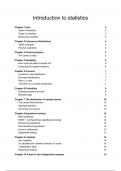
Introduction to statistics
Chapter 1 Intro 3
Types of statistics 3
Types of variables 3
Measuring variables 3
Chapter 2 Frequency distributions 4
Types of graphs 4
Practice questions 4
Chapter 3 Central tendency 5
The centre of data 5
Chapter 4 Variability 6
How much the data is spread out 6
Correcting for sample statistics 6
Chapter 5 Z-scores 7
Locations in the distribution 7
Re-scale distributions 7
Infer z, μ, and 7
Transform to a simpler distribution 7
Chapter 6 Probability 8
Example question terrorist 8
Binomial data 9
Chapter 7 The distribution of sample means 10
The central limit theorem 10
Example question 10
Two kinds of z-scores 10
Chapter 8 Hypothesis testing 12
Null hypothesis 12
NHST = null hypothesis significance testing 12
Directional hypothesis 12
Non-directional hypothesis 12
Errors in inferences 13
Hypothesis testing 13
Chapter 9 t-statistic 14
The t-statistic 14
To calculate the t-statistic instead of z-score 14
T-distribution table 14
Hypothesis testing 14
Chapter 10 T-test for two independent samples 15
, Pooled variance 15
To get s2 : 15
To get SE: s(M1-M2): 15
To get t: 15
Chapter 11 T-test for two related samples 16
To get MΔ: 16
To get SSΔ: 16
To get s2Δ : 16
SSΔn-1 16
To get SE (Smd): 16
To get t: 16
Chapter 12 Analysis of variance 17
Effect sizes 17
Cohen’s d 17
Confidence intervals 17
The CIs are influenced by two factors 18
To calculate r2: t2(t2+df) 18
8.6 Statistical power 19
What is statistical power 19
How to calculate statistical power 20
Chapter 15 Correlation 21
Pearson correlation 21
From variance to correlation 22
Hypothesis testing with Pearson correlation 22
Spearman correlation 23
Chapter 17 The Chi-square statistic 24
Calculating X2 (chi square) 24
What does the X2 value mean? 25
Effect sizes for chi-square test 25
Chapter 18 The binomial test 26
Ways of the binomial test 26
, Chapter 1 Intro
Types of statistics
1. Descriptive statistics: about describing data, often through summary statistics. E.g.
on average, a spanish woman is 1.63m tall. They are statistical procedures used to
summarize and simplify data.
2. Inferential statistics: we want to make an inference from something to something
else, like we want to make an inference from the sample to the population.
Types of variables
1. Discrete variables, variable can only consist of a limited number of categories, and
there cannot be a value between 1 and 2.
2. Continuous variables, it can take all values between two points, like income or
height.
Measuring variables
1. Nominal scale: named categories (e.g. dog, cat, hamster) and no quantitative
distinction between them (not ranked), and no true zero.
2. Ordinal scale: ranked named categories (e.g. 1st, 2nd, 3rd), no equal distance
between ranks and no true zero.
3. Interval scale: consists of equally sized intervals between values, each unit has the
same size and there is no true zero, like temperature.
4. Ratio scale: consists of equally sized intervals between values, each unit has the
same size and there is a true zero! Like age.
A parameter is a value that describes a population.
A statistic is a value that describes a sample.
Chapter 1 Intro 3
Types of statistics 3
Types of variables 3
Measuring variables 3
Chapter 2 Frequency distributions 4
Types of graphs 4
Practice questions 4
Chapter 3 Central tendency 5
The centre of data 5
Chapter 4 Variability 6
How much the data is spread out 6
Correcting for sample statistics 6
Chapter 5 Z-scores 7
Locations in the distribution 7
Re-scale distributions 7
Infer z, μ, and 7
Transform to a simpler distribution 7
Chapter 6 Probability 8
Example question terrorist 8
Binomial data 9
Chapter 7 The distribution of sample means 10
The central limit theorem 10
Example question 10
Two kinds of z-scores 10
Chapter 8 Hypothesis testing 12
Null hypothesis 12
NHST = null hypothesis significance testing 12
Directional hypothesis 12
Non-directional hypothesis 12
Errors in inferences 13
Hypothesis testing 13
Chapter 9 t-statistic 14
The t-statistic 14
To calculate the t-statistic instead of z-score 14
T-distribution table 14
Hypothesis testing 14
Chapter 10 T-test for two independent samples 15
, Pooled variance 15
To get s2 : 15
To get SE: s(M1-M2): 15
To get t: 15
Chapter 11 T-test for two related samples 16
To get MΔ: 16
To get SSΔ: 16
To get s2Δ : 16
SSΔn-1 16
To get SE (Smd): 16
To get t: 16
Chapter 12 Analysis of variance 17
Effect sizes 17
Cohen’s d 17
Confidence intervals 17
The CIs are influenced by two factors 18
To calculate r2: t2(t2+df) 18
8.6 Statistical power 19
What is statistical power 19
How to calculate statistical power 20
Chapter 15 Correlation 21
Pearson correlation 21
From variance to correlation 22
Hypothesis testing with Pearson correlation 22
Spearman correlation 23
Chapter 17 The Chi-square statistic 24
Calculating X2 (chi square) 24
What does the X2 value mean? 25
Effect sizes for chi-square test 25
Chapter 18 The binomial test 26
Ways of the binomial test 26
, Chapter 1 Intro
Types of statistics
1. Descriptive statistics: about describing data, often through summary statistics. E.g.
on average, a spanish woman is 1.63m tall. They are statistical procedures used to
summarize and simplify data.
2. Inferential statistics: we want to make an inference from something to something
else, like we want to make an inference from the sample to the population.
Types of variables
1. Discrete variables, variable can only consist of a limited number of categories, and
there cannot be a value between 1 and 2.
2. Continuous variables, it can take all values between two points, like income or
height.
Measuring variables
1. Nominal scale: named categories (e.g. dog, cat, hamster) and no quantitative
distinction between them (not ranked), and no true zero.
2. Ordinal scale: ranked named categories (e.g. 1st, 2nd, 3rd), no equal distance
between ranks and no true zero.
3. Interval scale: consists of equally sized intervals between values, each unit has the
same size and there is no true zero, like temperature.
4. Ratio scale: consists of equally sized intervals between values, each unit has the
same size and there is a true zero! Like age.
A parameter is a value that describes a population.
A statistic is a value that describes a sample.



