

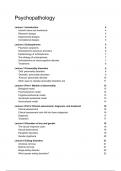
Psychopathology
Lecture 1 Introduction 4
Ancient views and treatments 4
Research designs 5
Experimental designs 5
Correlational designs 5
Lecture 2 Schizophrenia 5
Psychotic symptoms 6
Schizophrenia spectrum disorders 6
Epidemiology of schizophrenia 7
The etiology of schizophrenia 7
Schizophrenia as neurocognitive disorder 7
Treatments 8
Lecture 3 Personality disorders 9
‘Odd’ personality disorders 9
‘Dramatic’ personality disorders 9
‘Anxious’ personality disorder 10
Other ways to classify personality disorders are 11
Lecture 4 Part 1 Models of abnormality 12
Biological model 12
Psychodynamic model 12
Cognitive-behavioral model 13
Humanistic-existential model 13
Sociocultural model 14
Lecture 4 Part 2 Clinical assessment, diagnosis, and treatment 16
Clinical assessment 16
Clinical assessment tools fall into three categories: 16
Diagnosis 17
Treatment 17
Lecture 5 Disorders of sex and gender 18
The sexual response cycle: 18
Sexual dysfunctions 18
Paraphilic disorders 19
Gender dysphoria 20
Lecture 6 Eating disorders 21
Anorexia nervosa 21
Bulimia nervosa 21
Binge-eating disorder 22
What causes eating disorders? 22
, How are eating disorders treated? 23
Lecture 7 mood disorder 24
Unipolar depression 24
Models of unipolar depression 24
Treatments for unipolar depression 25
Bipolar disorders 26
Lecture 7 part 2 Suicide 27
Lecture 8 Disorders of trauma and stress 28
Stress and arousal 28
Stress disorders 28
Dissociative disorders 29
Dissociative amnesia 29
Dissociative identity disorder (multiple personality disorder) 29
Depersonalization-derealization disorder 30
Lecture 9 Anxiety, obsessive-compulsive, and related disorders 31
Anxiety disorders 31
Phobias 32
Social anxiety disorder 32
Panic disorders 32
Obsessive-compulsive disorder 33
Obsessive-compulsive-related disorders 34
Lecture 10 Substance use and addictive disorders 35
Depressants 35
Stimulants 35
Hallucinogens, cannabis and combinations of substances 36
Cause of substance use disorder 36
Treatment of substance use disorder 37
Other addictive disorders 37
Lecture 11 Somatic and related disorders 38
Factitious disorder 38
Conversion disorder 38
Somatic symptom disorder 38
Causes of conversion and somatic disorders 38
Illness anxiety disorder 39
Psychophysiological disorders 39
New psychophysiological disorders 40
Psychological treatment for psychological disorders 40
Lecture 12 Childhood and adolescence 41
Oppositional defiant disorder 41
Conduct disorder 41
Treatment of conduct disorder 41
, Elimination disorder 41
Neurodevelopmental disorder 42
Attention-deficit / hyperactivity disorder (ADHD) 42
Autism spectrum disorder 42
Intellectual disability 43
Lecture 13 Old age 45
Delirium 45
Alzheimer disease and other neurocognitive disorders 45
Alzheimer’s disease 45
Other types of neurocognitive disorders 46
Treatment 46
, Lecture 1 Introduction
Abnormal psychology: scientific study of abnormal behavior in an effort to describe,
predict, explain, and change abnormal patterns of functioning. The four D’s (most common
definitions) are deviance, distress, dysfunction and danger. It influences norms, culture,
and context.
Treatment or therapy is the procedure designed to change abnormal behavior into more
normal behavior. Essential features are a patient, a trained therapist and a series of
therapeutic contacts between the two.
Ancient views and treatments
1. Ancient society: regarded abnormal behavior as the work of an evil spirit (stone
age). The treatment was exorcism.
2. Greek and Romans (500BC-500AD): different explanations. Hippocrates said
illnesses had natural causes. Treatments were vegetable diet, exercise, bleeding.
3. Middle ages (500AD-1350AD): demonology returns and mental disorders had
demonic causes. Treatments were exorcism, torture and hospitalization.
4. Renaissance (1400AD-1700AD): demonology declined and Weyer believed the
mind was as susceptible to sickness as the body. Asylums emerged around 1500
and there was care at religious shrines.
5. Nineteenth century (1800AD-1900AD): care improved and moral treatment
movement started which emphasized humane and respectful techniques. Rush and
Dix promoted this movement and mental hospitals provided minimal care.
6. Early 20th century: dual perspectives
- Somatogenic percpective: abnormal functioning has physical causes. New
biological doscoveries linked physical factors as responsible for mental
dysfunction (Kraepelin).
- Psychogenic perspective: abnormal functioning has physiological causes.
Popular because of hypnotism (Mesmer and Freud). Widely accepted.
7. Recent decades: new psychotropic medications discovered in 1950s
(antidepressant and anxiety drugs) which led to deinstitutionalization and rise in
outpatient care.
Multicultural psychology: to understand how culture, race, ethnicity, gender, and similar
factors affect behavior and thought and how people of different cultures, races, and genders
may differ psychologically. The dominant form of insurance in USA is managed care
programs.
Todays leading theories are psychoanalytic, biological, cognitive-behavioral,
humanistic-existential, sociocultural, developmental psychopathology.
Clinical researchers discover universal laws and principles and search for nomothetic
understanding. Three methods of investigation:
1. Case study (individual - unusual problems)
2. Correlational method (association - samples - statistical significance)
3. Experimental method (independent and dependent variable)
Lecture 1 Introduction 4
Ancient views and treatments 4
Research designs 5
Experimental designs 5
Correlational designs 5
Lecture 2 Schizophrenia 5
Psychotic symptoms 6
Schizophrenia spectrum disorders 6
Epidemiology of schizophrenia 7
The etiology of schizophrenia 7
Schizophrenia as neurocognitive disorder 7
Treatments 8
Lecture 3 Personality disorders 9
‘Odd’ personality disorders 9
‘Dramatic’ personality disorders 9
‘Anxious’ personality disorder 10
Other ways to classify personality disorders are 11
Lecture 4 Part 1 Models of abnormality 12
Biological model 12
Psychodynamic model 12
Cognitive-behavioral model 13
Humanistic-existential model 13
Sociocultural model 14
Lecture 4 Part 2 Clinical assessment, diagnosis, and treatment 16
Clinical assessment 16
Clinical assessment tools fall into three categories: 16
Diagnosis 17
Treatment 17
Lecture 5 Disorders of sex and gender 18
The sexual response cycle: 18
Sexual dysfunctions 18
Paraphilic disorders 19
Gender dysphoria 20
Lecture 6 Eating disorders 21
Anorexia nervosa 21
Bulimia nervosa 21
Binge-eating disorder 22
What causes eating disorders? 22
, How are eating disorders treated? 23
Lecture 7 mood disorder 24
Unipolar depression 24
Models of unipolar depression 24
Treatments for unipolar depression 25
Bipolar disorders 26
Lecture 7 part 2 Suicide 27
Lecture 8 Disorders of trauma and stress 28
Stress and arousal 28
Stress disorders 28
Dissociative disorders 29
Dissociative amnesia 29
Dissociative identity disorder (multiple personality disorder) 29
Depersonalization-derealization disorder 30
Lecture 9 Anxiety, obsessive-compulsive, and related disorders 31
Anxiety disorders 31
Phobias 32
Social anxiety disorder 32
Panic disorders 32
Obsessive-compulsive disorder 33
Obsessive-compulsive-related disorders 34
Lecture 10 Substance use and addictive disorders 35
Depressants 35
Stimulants 35
Hallucinogens, cannabis and combinations of substances 36
Cause of substance use disorder 36
Treatment of substance use disorder 37
Other addictive disorders 37
Lecture 11 Somatic and related disorders 38
Factitious disorder 38
Conversion disorder 38
Somatic symptom disorder 38
Causes of conversion and somatic disorders 38
Illness anxiety disorder 39
Psychophysiological disorders 39
New psychophysiological disorders 40
Psychological treatment for psychological disorders 40
Lecture 12 Childhood and adolescence 41
Oppositional defiant disorder 41
Conduct disorder 41
Treatment of conduct disorder 41
, Elimination disorder 41
Neurodevelopmental disorder 42
Attention-deficit / hyperactivity disorder (ADHD) 42
Autism spectrum disorder 42
Intellectual disability 43
Lecture 13 Old age 45
Delirium 45
Alzheimer disease and other neurocognitive disorders 45
Alzheimer’s disease 45
Other types of neurocognitive disorders 46
Treatment 46
, Lecture 1 Introduction
Abnormal psychology: scientific study of abnormal behavior in an effort to describe,
predict, explain, and change abnormal patterns of functioning. The four D’s (most common
definitions) are deviance, distress, dysfunction and danger. It influences norms, culture,
and context.
Treatment or therapy is the procedure designed to change abnormal behavior into more
normal behavior. Essential features are a patient, a trained therapist and a series of
therapeutic contacts between the two.
Ancient views and treatments
1. Ancient society: regarded abnormal behavior as the work of an evil spirit (stone
age). The treatment was exorcism.
2. Greek and Romans (500BC-500AD): different explanations. Hippocrates said
illnesses had natural causes. Treatments were vegetable diet, exercise, bleeding.
3. Middle ages (500AD-1350AD): demonology returns and mental disorders had
demonic causes. Treatments were exorcism, torture and hospitalization.
4. Renaissance (1400AD-1700AD): demonology declined and Weyer believed the
mind was as susceptible to sickness as the body. Asylums emerged around 1500
and there was care at religious shrines.
5. Nineteenth century (1800AD-1900AD): care improved and moral treatment
movement started which emphasized humane and respectful techniques. Rush and
Dix promoted this movement and mental hospitals provided minimal care.
6. Early 20th century: dual perspectives
- Somatogenic percpective: abnormal functioning has physical causes. New
biological doscoveries linked physical factors as responsible for mental
dysfunction (Kraepelin).
- Psychogenic perspective: abnormal functioning has physiological causes.
Popular because of hypnotism (Mesmer and Freud). Widely accepted.
7. Recent decades: new psychotropic medications discovered in 1950s
(antidepressant and anxiety drugs) which led to deinstitutionalization and rise in
outpatient care.
Multicultural psychology: to understand how culture, race, ethnicity, gender, and similar
factors affect behavior and thought and how people of different cultures, races, and genders
may differ psychologically. The dominant form of insurance in USA is managed care
programs.
Todays leading theories are psychoanalytic, biological, cognitive-behavioral,
humanistic-existential, sociocultural, developmental psychopathology.
Clinical researchers discover universal laws and principles and search for nomothetic
understanding. Three methods of investigation:
1. Case study (individual - unusual problems)
2. Correlational method (association - samples - statistical significance)
3. Experimental method (independent and dependent variable)




