KNOWLEDGE ON BASIC VERTEBRATE ANATOMY,
ZOOLOGY AND PHYSIOLOGY
1. Organization of the body
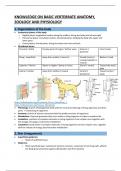
• Anatomical planes of the body:
o Sagittal plane: longitudinal section along the midline, diving the body into left and right
o Transversal plane: cross/axial-section, horizontal plane, dividing the body into upper and
lower parts
o Coronal plane: frontal plane, diving the body into front and back
• Directional terms:
Proximal / distal Closeby point of origin / further away Anterior / Front / back
posterior:
Deep / superficial Away from surface / closer to Caudal (rostra) / Bottom / head
cranial (cephalic or
rostral)
Superior / inferior Above or higher / below or lower Dorsal / ventral Toward the back /
belly
Lateral / medial Away from midline / toward Central / Toward center /
peripheral away
https://wikieducator.org/Directional_Terms_Worksheet_1
https://wikieducator.org/Tissues_Worksheet
• Physiology: branch of biology that deals with the normal functioning of living organisms and their
parts -> functioning of organisms
• Anatomy: branch of science concerned with the bodily structure of organisms
• Metabolism: chemical processes that occur within a living organism in order to maintain life
• Anabolism: synthesis of complex molecules in living organisms from simpler ones together with
the storage of energy; constructive metabolism
• Catabolism: break down of complex molecules in living organisms to form simpler ones, together
with the release of energy; deconstructive metabolism
2. Skin (Integument)
• Superficial epidermis
o Made of epithelial tissue
• Epidermis
o Most superficial layer: waterproof stratum corneum, comprised of not living cells, affords
the body great protection against dehydration and from bacteria
, o Deepest layer: stratum germinativum, with keratinocytes,
melanocytes, macrophages (migrate as dendrocytes from the
bone marrow), merkel cells (one of the many sensory receptors)
• Dermis
o Containing much connective tissue
o Blood capillaries, hair roots and several types of sensory
receptors which may be free nerve endings or encapsulated.
o Excocrine sweat and oil glands
• Hypodermis / Superficial fascia
o NOT being part of the skin
https://wikieducator.org/Skin_Worksheet
3. Motor system (skeleton, muscles)
• Skeletal system is divided into bones and joints, where bones meet and allow movement.
o Each bone is considered an organ an belongs to either:
▪ Axial skeleton, which includes skull, spine and rib cage
▪ Appendicular skeleton, which includes limbs and girdles
o Bones can be classified depending on their structure as either:
▪ Compact (dense), found in the shaft (diaphysis) of long bones and is composed of
osteons: lamellar structures with osteoscytes within lacunae that surround a central
canal that contains blood vessels, providing nutrients and oxygen to bone tissue and
removing waste.
▪ Spongy (cancellous), found in the ends (epiphyses) of long bones and is composed of
trabeculae. Marrow is found in the shaft of long bones and between the trabeculae of
spongy bone and produces red and white blood cells when active (haemopoiesis).
Yellow marrow is inactive.
o Bones store calcium and is continually being remodelled by osteoclasts (remove bone) and
osteoblasts (deposit bone); Ca is released or stored.
o Bones are connected to an adjacent bone at an articulation (joint) and they are bound to
each other by ligaments.
▪ All the joints in the appendicular skeleton are freely moveable (synovial) joints and
stabilized by tendons. Their free movement is produced when the muscles attached to
them contract and is ensured by the smooth hyaline cartilage that covers the
articulating bone surfaces and the lubricating synovial fluid within the joint capsule.
https://wikieducator.org/Skeleton_Worksheet
, • Muscles in conjunction with skeleton and joints makes movement possible
o Skeletal muscle: attached to skeleton, voluntarily controlled, long ‘fiber’ cells that are
multinucleate and striated
▪ Cells are called fibers, their plasma membrane sarcolemma, their cytoplasm
sarcoplasm, their endoplasmic reticulum sarcoplasmic reticum and their contracting
structures within a myofibril of a muscle cell are called sacromeres.
▪ Sacromere has bundels of thick and thin myofilaments and are joined end-to-end to
form a myofibril -> sarcolemma bundles many myofibrils together.
- Thick myofilaments are composed of myosin
- Thin myofilaments are composed of actin
- Troponin, tropomyosin along with calcium ions and ATP participate in the contraction
of a sarcomere
▪ Each cell/fiber is surrounded by endomysium (membrane) which overlies the
sarcolemma. The endomysium contains nerve axon and capillaries
▪ Bundle of muscle fibers is called a fascicle and is surround by perimysium, a connective
tissue membrane.
▪ A muscle is a bundle of fascicles and the membrane surrounding a muscle is called the
epimysium.
o There are also cardiac and smooth muscle cells
https://en.wikibooks.org/wiki/Anatomy_and_Physiology_of_Animals/Muscles#Test_Yourself
4. Respiratory system
• Respiratory system is made up of the trachea, bronchi, bronchioles, lungs, diaphragm,
ribs and muscles
• Route of air: air -> nostrils -> nasal cavity -> pharynx -> larynx -> glottis -> trachea ->
bronchi -> bronchioles -> alveoli
o In alveoli O2 diffuses through the membrane from the alveoli to the blood and
CO2 diffuse from the blood to the alveoli
ZOOLOGY AND PHYSIOLOGY
1. Organization of the body
• Anatomical planes of the body:
o Sagittal plane: longitudinal section along the midline, diving the body into left and right
o Transversal plane: cross/axial-section, horizontal plane, dividing the body into upper and
lower parts
o Coronal plane: frontal plane, diving the body into front and back
• Directional terms:
Proximal / distal Closeby point of origin / further away Anterior / Front / back
posterior:
Deep / superficial Away from surface / closer to Caudal (rostra) / Bottom / head
cranial (cephalic or
rostral)
Superior / inferior Above or higher / below or lower Dorsal / ventral Toward the back /
belly
Lateral / medial Away from midline / toward Central / Toward center /
peripheral away
https://wikieducator.org/Directional_Terms_Worksheet_1
https://wikieducator.org/Tissues_Worksheet
• Physiology: branch of biology that deals with the normal functioning of living organisms and their
parts -> functioning of organisms
• Anatomy: branch of science concerned with the bodily structure of organisms
• Metabolism: chemical processes that occur within a living organism in order to maintain life
• Anabolism: synthesis of complex molecules in living organisms from simpler ones together with
the storage of energy; constructive metabolism
• Catabolism: break down of complex molecules in living organisms to form simpler ones, together
with the release of energy; deconstructive metabolism
2. Skin (Integument)
• Superficial epidermis
o Made of epithelial tissue
• Epidermis
o Most superficial layer: waterproof stratum corneum, comprised of not living cells, affords
the body great protection against dehydration and from bacteria
, o Deepest layer: stratum germinativum, with keratinocytes,
melanocytes, macrophages (migrate as dendrocytes from the
bone marrow), merkel cells (one of the many sensory receptors)
• Dermis
o Containing much connective tissue
o Blood capillaries, hair roots and several types of sensory
receptors which may be free nerve endings or encapsulated.
o Excocrine sweat and oil glands
• Hypodermis / Superficial fascia
o NOT being part of the skin
https://wikieducator.org/Skin_Worksheet
3. Motor system (skeleton, muscles)
• Skeletal system is divided into bones and joints, where bones meet and allow movement.
o Each bone is considered an organ an belongs to either:
▪ Axial skeleton, which includes skull, spine and rib cage
▪ Appendicular skeleton, which includes limbs and girdles
o Bones can be classified depending on their structure as either:
▪ Compact (dense), found in the shaft (diaphysis) of long bones and is composed of
osteons: lamellar structures with osteoscytes within lacunae that surround a central
canal that contains blood vessels, providing nutrients and oxygen to bone tissue and
removing waste.
▪ Spongy (cancellous), found in the ends (epiphyses) of long bones and is composed of
trabeculae. Marrow is found in the shaft of long bones and between the trabeculae of
spongy bone and produces red and white blood cells when active (haemopoiesis).
Yellow marrow is inactive.
o Bones store calcium and is continually being remodelled by osteoclasts (remove bone) and
osteoblasts (deposit bone); Ca is released or stored.
o Bones are connected to an adjacent bone at an articulation (joint) and they are bound to
each other by ligaments.
▪ All the joints in the appendicular skeleton are freely moveable (synovial) joints and
stabilized by tendons. Their free movement is produced when the muscles attached to
them contract and is ensured by the smooth hyaline cartilage that covers the
articulating bone surfaces and the lubricating synovial fluid within the joint capsule.
https://wikieducator.org/Skeleton_Worksheet
, • Muscles in conjunction with skeleton and joints makes movement possible
o Skeletal muscle: attached to skeleton, voluntarily controlled, long ‘fiber’ cells that are
multinucleate and striated
▪ Cells are called fibers, their plasma membrane sarcolemma, their cytoplasm
sarcoplasm, their endoplasmic reticulum sarcoplasmic reticum and their contracting
structures within a myofibril of a muscle cell are called sacromeres.
▪ Sacromere has bundels of thick and thin myofilaments and are joined end-to-end to
form a myofibril -> sarcolemma bundles many myofibrils together.
- Thick myofilaments are composed of myosin
- Thin myofilaments are composed of actin
- Troponin, tropomyosin along with calcium ions and ATP participate in the contraction
of a sarcomere
▪ Each cell/fiber is surrounded by endomysium (membrane) which overlies the
sarcolemma. The endomysium contains nerve axon and capillaries
▪ Bundle of muscle fibers is called a fascicle and is surround by perimysium, a connective
tissue membrane.
▪ A muscle is a bundle of fascicles and the membrane surrounding a muscle is called the
epimysium.
o There are also cardiac and smooth muscle cells
https://en.wikibooks.org/wiki/Anatomy_and_Physiology_of_Animals/Muscles#Test_Yourself
4. Respiratory system
• Respiratory system is made up of the trachea, bronchi, bronchioles, lungs, diaphragm,
ribs and muscles
• Route of air: air -> nostrils -> nasal cavity -> pharynx -> larynx -> glottis -> trachea ->
bronchi -> bronchioles -> alveoli
o In alveoli O2 diffuses through the membrane from the alveoli to the blood and
CO2 diffuse from the blood to the alveoli