Summary
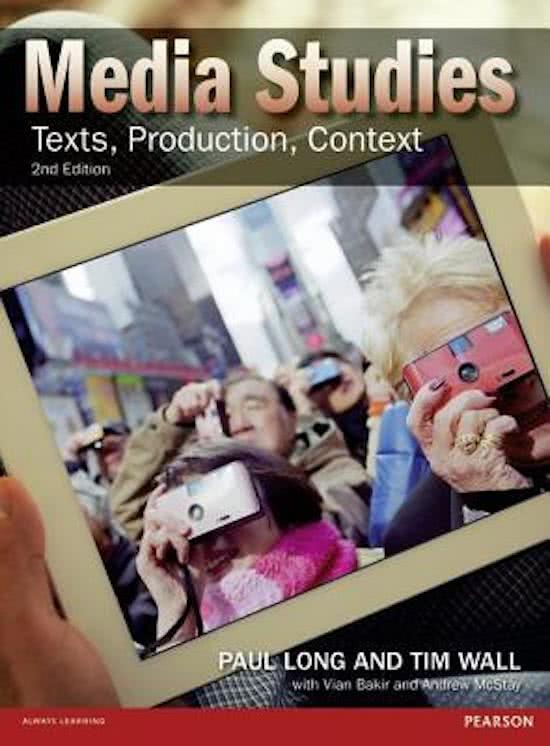
Media Studies: Text, Production and Context - Paul long and Tim Wall
For the course: Introduction to Media Studies I from BA1 Media Studies at the
University of Groningen.
(parts of) chapter 1, 2, 3, 10, 11 (according to the required literature for the course
Introduction to Media Studies I)
Table of Contents
Chapter 1: How do media make meaning?.........................................................................1
Chapter 2: Organizing meaning in media texts: genre and narrative..................................5
Chapter 3: Media Representations.....................................................................................9
Chapter 10: Media Power.................................................................................................11
Chapter 11: Conceptualizing mass society........................................................................14
,Chapter 1: How do media make meaning?
Labelling media output:
Output of the media has a physical form as an artefact
There is the economic value embodied in media output, in terms of commodity
status.
Media output as a site for the generation of meaning value.
Making meaning in 3 ways:
1. Work of reading and interpretation done by media producers
2. We media consumers do work that results from our upbringing and those wider
cultural, social and historical contexts we navigate in our lives
3. Main work is our regular acquaintance with their various forms
Texts and meanings are always contextualized
Analytical tool 1: Rhetoric
Rhetoric = the construction and manipulation of language by the creator of a text for
affective purposes.
Approaches media texts and their meanings as constructed out of the use of available
techniques, styles and conventions in any medium with the intention to position
audiences in particular ways in order to elicit emotional, psychological or physical
responses from them.
Aim of media is to get audiences to pay attention: aid cognition (requiring knowledge
and applying it).
Meaning is not mainly about information, but also the way we learn about that
information: its presentation and the particularities of the medium (McLuhan).
Language, rhetoric and meaning
Language = the material out of which a single instance of communication is created
Rhetoric = the way in which language is manipulated to a particular purpose ->
organization of vocabulary, focused on results. The act of manipulating responses.
Meaning = refers to the interpretation of messages by the reader of the text
Rhetorical techniques consist of a series of conventions that can be learned, practiced
and understood: each medium has particular rhetorical devices.
Identifying rhetorical media tools and techniques
1. Verbal rhetoric: refers to the word as written and spoken: choice of words ad
vocabulary used in media communication: to generate affects
Common verbal rhetorical devices: Alliteration (repetition of starting
letters), rhyme and allusion (make direct or indirect references), euphemism
(substation of more acceptable terms), metaphor (substitution of one idea for
another), metonym (refers to a part of something used to represent it as a
whole), ellipses (the omission of data), cliché (well-worn phrases)
2. Presentational rhetoric: how text is presented, e.g. how people speak, body-
language, mise en scène (all contents of the stage and their arrangement such as
setting, costume, make-up, lighting movement and acting).
1
Long, P., & Wall, T. (2014). Media studies: Texts, production, context (2nd ed.) Hoboken:
Taylor and Francis.
, 3. Photographical devices: use of composition, retouching, cropping, juxtaposition
(=the placing of one picture alongside another) and montage
4. Editorial rhetoric: refers to the organization of the moving image and the sound in
TV and film -> a sequence, 3 elements in which scenes work together to produce an
effect: the significance of the image presented, framing and editing
Analyze affect and meaning: think about implied rhetorical position for the audience: ‘How is
it asking me to respond?’
Not always direct correlation between appearance and audience.
Analytical tool 2: Semiology.
Semiology = the study of signs / the study of meaning and the different systems that make
meaning possible. Explaining the way in which meaning is created, explanation is found in
the interaction between text and reader.
Foundations of semiology
Key thinkers:
Ferdinand de Saussure:
Charles Sanders Peirce: the sign describes how something meant something to
someone, all communication is built upon the relation of the sign (icon, index,
symbol).
Core ideas:
Media texts are seen as constructions: texts are not natural occurrences but are
manufactured: the way in which meaning is produced has involved a set of choices.
o Constructed out of elements of language and existing meanings.
o One of the main aims of semiological research is to examine how media
conventions compare with written or spoken language, in order to generate
and deploy meaning
Meanings are the result of social convention, rather than any essential property
inherent in things themselves. Social conventions are the organization and rules of
language (de Saussure).
If texts are constructed from language, and the meaning of language is created by
social conventions, then the meaning of a text is as much the result of these
conventions as it is the intentions of the people who produced the texts. The
language we use will be interpreted in ways that go beyond individual intention
Sign, signifier and signified:
The basic unit of communication systems is the sign.
De Saussure: signs could be thought of as consisting of indivisible aspects: signifier and
signified.
Signifier refers to the physical properties or aspects of a sign that lead them to be
perceived in some way. In spoken language, this could be a spoken or written word.
2
Long, P., & Wall, T. (2014). Media studies: Texts, production, context (2nd ed.) Hoboken:
Taylor and Francis.
Media Studies: Text, Production and Context - Paul long and Tim Wall
For the course: Introduction to Media Studies I from BA1 Media Studies at the
University of Groningen.
(parts of) chapter 1, 2, 3, 10, 11 (according to the required literature for the course
Introduction to Media Studies I)
Table of Contents
Chapter 1: How do media make meaning?.........................................................................1
Chapter 2: Organizing meaning in media texts: genre and narrative..................................5
Chapter 3: Media Representations.....................................................................................9
Chapter 10: Media Power.................................................................................................11
Chapter 11: Conceptualizing mass society........................................................................14
,Chapter 1: How do media make meaning?
Labelling media output:
Output of the media has a physical form as an artefact
There is the economic value embodied in media output, in terms of commodity
status.
Media output as a site for the generation of meaning value.
Making meaning in 3 ways:
1. Work of reading and interpretation done by media producers
2. We media consumers do work that results from our upbringing and those wider
cultural, social and historical contexts we navigate in our lives
3. Main work is our regular acquaintance with their various forms
Texts and meanings are always contextualized
Analytical tool 1: Rhetoric
Rhetoric = the construction and manipulation of language by the creator of a text for
affective purposes.
Approaches media texts and their meanings as constructed out of the use of available
techniques, styles and conventions in any medium with the intention to position
audiences in particular ways in order to elicit emotional, psychological or physical
responses from them.
Aim of media is to get audiences to pay attention: aid cognition (requiring knowledge
and applying it).
Meaning is not mainly about information, but also the way we learn about that
information: its presentation and the particularities of the medium (McLuhan).
Language, rhetoric and meaning
Language = the material out of which a single instance of communication is created
Rhetoric = the way in which language is manipulated to a particular purpose ->
organization of vocabulary, focused on results. The act of manipulating responses.
Meaning = refers to the interpretation of messages by the reader of the text
Rhetorical techniques consist of a series of conventions that can be learned, practiced
and understood: each medium has particular rhetorical devices.
Identifying rhetorical media tools and techniques
1. Verbal rhetoric: refers to the word as written and spoken: choice of words ad
vocabulary used in media communication: to generate affects
Common verbal rhetorical devices: Alliteration (repetition of starting
letters), rhyme and allusion (make direct or indirect references), euphemism
(substation of more acceptable terms), metaphor (substitution of one idea for
another), metonym (refers to a part of something used to represent it as a
whole), ellipses (the omission of data), cliché (well-worn phrases)
2. Presentational rhetoric: how text is presented, e.g. how people speak, body-
language, mise en scène (all contents of the stage and their arrangement such as
setting, costume, make-up, lighting movement and acting).
1
Long, P., & Wall, T. (2014). Media studies: Texts, production, context (2nd ed.) Hoboken:
Taylor and Francis.
, 3. Photographical devices: use of composition, retouching, cropping, juxtaposition
(=the placing of one picture alongside another) and montage
4. Editorial rhetoric: refers to the organization of the moving image and the sound in
TV and film -> a sequence, 3 elements in which scenes work together to produce an
effect: the significance of the image presented, framing and editing
Analyze affect and meaning: think about implied rhetorical position for the audience: ‘How is
it asking me to respond?’
Not always direct correlation between appearance and audience.
Analytical tool 2: Semiology.
Semiology = the study of signs / the study of meaning and the different systems that make
meaning possible. Explaining the way in which meaning is created, explanation is found in
the interaction between text and reader.
Foundations of semiology
Key thinkers:
Ferdinand de Saussure:
Charles Sanders Peirce: the sign describes how something meant something to
someone, all communication is built upon the relation of the sign (icon, index,
symbol).
Core ideas:
Media texts are seen as constructions: texts are not natural occurrences but are
manufactured: the way in which meaning is produced has involved a set of choices.
o Constructed out of elements of language and existing meanings.
o One of the main aims of semiological research is to examine how media
conventions compare with written or spoken language, in order to generate
and deploy meaning
Meanings are the result of social convention, rather than any essential property
inherent in things themselves. Social conventions are the organization and rules of
language (de Saussure).
If texts are constructed from language, and the meaning of language is created by
social conventions, then the meaning of a text is as much the result of these
conventions as it is the intentions of the people who produced the texts. The
language we use will be interpreted in ways that go beyond individual intention
Sign, signifier and signified:
The basic unit of communication systems is the sign.
De Saussure: signs could be thought of as consisting of indivisible aspects: signifier and
signified.
Signifier refers to the physical properties or aspects of a sign that lead them to be
perceived in some way. In spoken language, this could be a spoken or written word.
2
Long, P., & Wall, T. (2014). Media studies: Texts, production, context (2nd ed.) Hoboken:
Taylor and Francis.