CLINICAL IMMUNOLOGY
TOPIC 3: HIV & CANCER
LECTURE 1: DC ROLES IN HIV Wednesday, 27/11/2019
Function of DC: sensing the virus by its PRR → mature → migrate through vessels
to Lnn → antigen presentation → IFN + cytokine responses & activation of T cells
→ CD4/CD8 immune response (adaptive)
Virus can mutate to escape immune response; HIV targets DC so the virus can
escape immunity
HIV infection is global epidemic:
a. Route of transmission: sexual intercourse (mucosal immune response),
maternal-fetal, blood transfusion, etc.
b. HIV transmission is not very efficient, unlike HPV (HPV has 100% chance
of manifestation)
c. Inflammation/co-infection with other diseases increases success of HIV
infection
a.
Importance of DC:
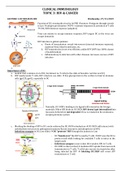
a. Genital tract contains a lot of DC, but almost no T cells (in the slide of foreskin: red dots are DC)
b. HIV needs/wants T cells, HIV structure see slide → has glycoprotein in the surface to bind to immune
cells (gp120, gp41), especially to DC
Normally, DC-SIGN’s binding to its ligand will internalize the foreign
materials. When HIV binds to DC-SIGN, HIV doesn’t get internalized into
lysosome & therefore not degraded. Virus is retained in the endosome,
escaping immune system
c. Blocking the binding of HIV to DC can be achieved by DC-SIGN introduction → DC-SIGN will interact with
carbohydrate structure in pathogens (mannose/fucose structures, including those in HIV)
Infectious synapse in DC: (see slide) → DC “protects” HIV through the journey to Lnn
- DC “hands over” the HIV to nearby T cells → HIV uses the DC to
protect itself while looking for available T cells to infect in the
lymph node
- Infectious synapse occurs when DC transfers HIV to T cells
- DC-SIGN is also involved, it mediates HIV uptake from mucosa &
transmission to T cells. T cells later secrete viral particles after
being infected by HIV → blocking DC-SIGN will revert HIV
transmission to T cells
DC-SIGN + DC layers are located in submucosa → require a break in
mucosal layer to reach the submucosa
, CLINICAL IMMUNOLOGY
TOPIC 3: HIV & CANCER
d. Langerhans cells in the foreskin epithelium (a type of DC):
- Mannan (from yeast) binds to lectin receptors with mannose specificity, including DC-SIGN →
introduction to mannan will block DC-SIGN
- Infection of LC is necessary for HIV transmission
Isolation of Langerhans cells (from abdominal surgery): split dermatomally → dispase introduction
→ split epidermis → trypsin digestion → separate Langerhans cells through Ficoll gradient/MACS
- LC DOES TRANSMIT HIV when it contains mannan or anti-langerin antibody 10E2 (vs. DC that can’t
transmit when blocked by mannan)
HOW THE FUCK DOES THIS HAPPEN?
“Langerin” can bind the virus & prevent its transmission to T cells, but
when Langerin is blocked (e.g. by mannan or anti-langerin Ab), HIV is
free to travel around LC
Langerin is like DC-SIGN specific for LC → induce the formation of
Birbeck granules (involved in the endocytic pathway), has
mannose/fucose/GlcNac specificity; thus, Langerin acts as HIV
receptor in LC
- When HIV is taken up by langerin & internalized into Birbeck granule → virus gets degraded
Example: Raji (transfected cell, wild type) → viral degradation is most prominent when Raji is
transfected by langerin, compared to the rate when it is transfected by DC-SIGN
- Why Langerin is necessary for HIV transmission & degradation?
C-type lectin receptor in langerin restrict HIV infection of LC →
expression of receptor determines the capacity of HIV to integrate
to LC & later transmitted to T cells
Silencing/blocking of langerin will facilitate HIV infection of LC;
introduction of any langerin receptor to random cells will protect
these cells from HIV infection (evident in U87 GBM cell line when
nude vs. langerin-enhanced)
How does langerin protects against HIV infection?
1. Degradation in Birbeck granule
2. Production of restriction factors such as TRIM5 at post-
fusion level (diagram see slide)
1. When TRIM5 alfa is silenced → HIV integrates to
LC
TRIM5 restricts transmission via autophagy
(degradation of all HIV organelles inside LC) →
diagram see slide
TRIM5 alfa function as restriction factor is only
evident in non-human primate, but in human LC
there is (probably) a different mechanism
2. Silencing of TRIM5 alfa by RNAi also facilitates
HIV transmission to T cells
*We can detect the langerin e.g. through its antibody →
when does it start to appear? can we detect this early? If we
can detect the antibodies early, we maybe can also develop
some sort of risk stratification for at-risk people → e.g.
more intense monitoring of CD4 levels, counseling, etc
, CLINICAL IMMUNOLOGY
TOPIC 3: HIV & CANCER
Pathway & function of TRIM5 alfa: EXAM
Conclusion: LC acts as innate anti-HIV defense → it
requires a lot of HIV viral load due to its high
clearance in LC; but when mucosa is disrupted, LC
level is depleted & HIV can easily reach the DC-
SIGN+ DC
Risk factors of HIV susceptibility:
a. Inhibition of langerin
Ectopic expression of langerin protects against HIV-1 infection (evidence: U87 cell line with wt langerin
→ no HIV-1 infection, independent of TRIM5 alfa activity)
b. High viral load
c. Fungi & HSV
d. Genital microbiome
e. Inflammation/co-infection
- Evidence ex vivo: incubate epidermal cells with the presence of pro-inflammatory cytokines & add
HIV-1 eGFP → epidermal LC infection (+ GFP expression), when more T cells added to the mix →
higher expression of GFP = transmission of HIV-1
- Presence of TNF alfa, PAM3CSK (a ligand like TLR) alter the physiology of LC → enhanced HIV
transmission; other agents such as LTA & LPS don’t seem to affect the HIV transmission significantly
- Other STDs abrogate the anti-HIV defense mech in LC → epithelia breaching, LC activation to fight
the other pathogens → reduced langerin expression for HIV → HIV can travel easier inside
submucosa & get in contact with DC-SIGN+ DC
Summary:
1. LC acts as innate barrier → langerin & TRIM5 alfa restricts transmission of HIV-1 mainly by autophagy
2. DC is essential in integration & transmission of HIV
3. In non-human primates, the defense mechanism is conserved & more robust compared to human → non-
human primates are less susceptible to HIV
4. Polymorphisms in langerin among individuals → predict susceptibility to HIV infection/transmission
TOPIC 3: HIV & CANCER
LECTURE 1: DC ROLES IN HIV Wednesday, 27/11/2019
Function of DC: sensing the virus by its PRR → mature → migrate through vessels
to Lnn → antigen presentation → IFN + cytokine responses & activation of T cells
→ CD4/CD8 immune response (adaptive)
Virus can mutate to escape immune response; HIV targets DC so the virus can
escape immunity
HIV infection is global epidemic:
a. Route of transmission: sexual intercourse (mucosal immune response),
maternal-fetal, blood transfusion, etc.
b. HIV transmission is not very efficient, unlike HPV (HPV has 100% chance
of manifestation)
c. Inflammation/co-infection with other diseases increases success of HIV
infection
a.
Importance of DC:
a. Genital tract contains a lot of DC, but almost no T cells (in the slide of foreskin: red dots are DC)
b. HIV needs/wants T cells, HIV structure see slide → has glycoprotein in the surface to bind to immune
cells (gp120, gp41), especially to DC
Normally, DC-SIGN’s binding to its ligand will internalize the foreign
materials. When HIV binds to DC-SIGN, HIV doesn’t get internalized into
lysosome & therefore not degraded. Virus is retained in the endosome,
escaping immune system
c. Blocking the binding of HIV to DC can be achieved by DC-SIGN introduction → DC-SIGN will interact with
carbohydrate structure in pathogens (mannose/fucose structures, including those in HIV)
Infectious synapse in DC: (see slide) → DC “protects” HIV through the journey to Lnn
- DC “hands over” the HIV to nearby T cells → HIV uses the DC to
protect itself while looking for available T cells to infect in the
lymph node
- Infectious synapse occurs when DC transfers HIV to T cells
- DC-SIGN is also involved, it mediates HIV uptake from mucosa &
transmission to T cells. T cells later secrete viral particles after
being infected by HIV → blocking DC-SIGN will revert HIV
transmission to T cells
DC-SIGN + DC layers are located in submucosa → require a break in
mucosal layer to reach the submucosa
, CLINICAL IMMUNOLOGY
TOPIC 3: HIV & CANCER
d. Langerhans cells in the foreskin epithelium (a type of DC):
- Mannan (from yeast) binds to lectin receptors with mannose specificity, including DC-SIGN →
introduction to mannan will block DC-SIGN
- Infection of LC is necessary for HIV transmission
Isolation of Langerhans cells (from abdominal surgery): split dermatomally → dispase introduction
→ split epidermis → trypsin digestion → separate Langerhans cells through Ficoll gradient/MACS
- LC DOES TRANSMIT HIV when it contains mannan or anti-langerin antibody 10E2 (vs. DC that can’t
transmit when blocked by mannan)
HOW THE FUCK DOES THIS HAPPEN?
“Langerin” can bind the virus & prevent its transmission to T cells, but
when Langerin is blocked (e.g. by mannan or anti-langerin Ab), HIV is
free to travel around LC
Langerin is like DC-SIGN specific for LC → induce the formation of
Birbeck granules (involved in the endocytic pathway), has
mannose/fucose/GlcNac specificity; thus, Langerin acts as HIV
receptor in LC
- When HIV is taken up by langerin & internalized into Birbeck granule → virus gets degraded
Example: Raji (transfected cell, wild type) → viral degradation is most prominent when Raji is
transfected by langerin, compared to the rate when it is transfected by DC-SIGN
- Why Langerin is necessary for HIV transmission & degradation?
C-type lectin receptor in langerin restrict HIV infection of LC →
expression of receptor determines the capacity of HIV to integrate
to LC & later transmitted to T cells
Silencing/blocking of langerin will facilitate HIV infection of LC;
introduction of any langerin receptor to random cells will protect
these cells from HIV infection (evident in U87 GBM cell line when
nude vs. langerin-enhanced)
How does langerin protects against HIV infection?
1. Degradation in Birbeck granule
2. Production of restriction factors such as TRIM5 at post-
fusion level (diagram see slide)
1. When TRIM5 alfa is silenced → HIV integrates to
LC
TRIM5 restricts transmission via autophagy
(degradation of all HIV organelles inside LC) →
diagram see slide
TRIM5 alfa function as restriction factor is only
evident in non-human primate, but in human LC
there is (probably) a different mechanism
2. Silencing of TRIM5 alfa by RNAi also facilitates
HIV transmission to T cells
*We can detect the langerin e.g. through its antibody →
when does it start to appear? can we detect this early? If we
can detect the antibodies early, we maybe can also develop
some sort of risk stratification for at-risk people → e.g.
more intense monitoring of CD4 levels, counseling, etc
, CLINICAL IMMUNOLOGY
TOPIC 3: HIV & CANCER
Pathway & function of TRIM5 alfa: EXAM
Conclusion: LC acts as innate anti-HIV defense → it
requires a lot of HIV viral load due to its high
clearance in LC; but when mucosa is disrupted, LC
level is depleted & HIV can easily reach the DC-
SIGN+ DC
Risk factors of HIV susceptibility:
a. Inhibition of langerin
Ectopic expression of langerin protects against HIV-1 infection (evidence: U87 cell line with wt langerin
→ no HIV-1 infection, independent of TRIM5 alfa activity)
b. High viral load
c. Fungi & HSV
d. Genital microbiome
e. Inflammation/co-infection
- Evidence ex vivo: incubate epidermal cells with the presence of pro-inflammatory cytokines & add
HIV-1 eGFP → epidermal LC infection (+ GFP expression), when more T cells added to the mix →
higher expression of GFP = transmission of HIV-1
- Presence of TNF alfa, PAM3CSK (a ligand like TLR) alter the physiology of LC → enhanced HIV
transmission; other agents such as LTA & LPS don’t seem to affect the HIV transmission significantly
- Other STDs abrogate the anti-HIV defense mech in LC → epithelia breaching, LC activation to fight
the other pathogens → reduced langerin expression for HIV → HIV can travel easier inside
submucosa & get in contact with DC-SIGN+ DC
Summary:
1. LC acts as innate barrier → langerin & TRIM5 alfa restricts transmission of HIV-1 mainly by autophagy
2. DC is essential in integration & transmission of HIV
3. In non-human primates, the defense mechanism is conserved & more robust compared to human → non-
human primates are less susceptible to HIV
4. Polymorphisms in langerin among individuals → predict susceptibility to HIV infection/transmission