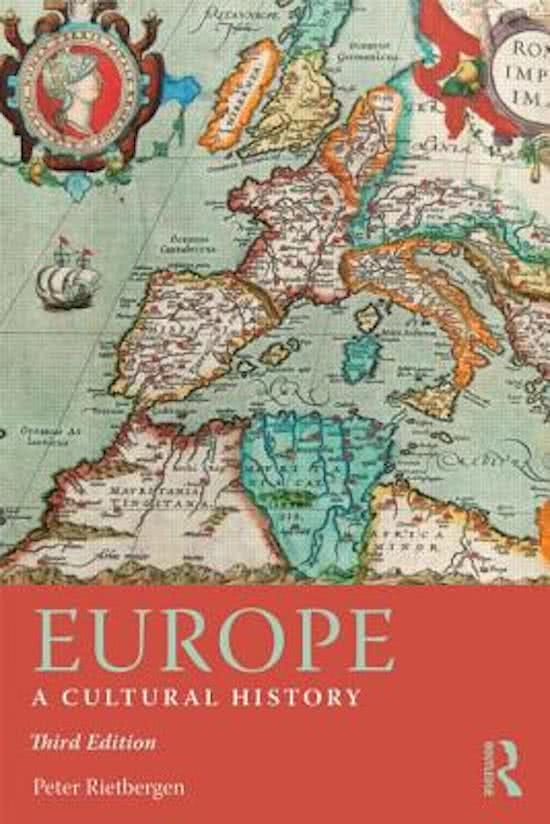
Europe:
A
Cultural
History
Summary
of
third
edition
by
Peter
Rietbergen
Sophie
2019/2020
,
Culture
is
“everything
that
people
have,
think
and
do
as
members
of
their
society”.
Have:
material
objects
Think:
ideas,
values,
attitudes
Do:
patterns
of
behaviour
There
is
culture
in
a
broad
and
a
narrow
sense.
Narrow
is
science/art
and
broad
is
all
collective
expressions
of
a
group
or
society.
Culture
is
a
combination
of
human
nature,
learned
culture
and
individual
personality.
Components
of
a
culture:
• Symbols,
things
with
a
meaning
that
are
recognised
best
by
those
who
share
the
culture
• Heroes,
models
for
behaviour
• Rituals,
behaviour
that
occurs
regularly
and
is
socially
essential
• Values,
social
norms
European
culture
is
based
on
the
enlightenment
based
on
rationality
(science
and
technology)
and
individuality
(freedom
and
democracy).
Modern
enlightenment
(Descartes,
Rousseau,
Kant)
was
rooted
in
Greek
enlightenment
(Socrates,
Plato,
Aristotle).
The
Greek
Worldview
Rietbergen
is
biased
towards
the
Romans
and
thinks
that
the
Romans
created
Europe
but
the
Greeks
influenced
almost
all
aspects
of
roman
culture.
The
Greeks
considered
the
Mediterranean
to
be
the
centre
of
Europe
or
even
the
centre
of
the
world.
Barbarians
were
everyone
who
didn’t
speak
Greek
and
therefore
weren’t
as
good.
There
was
a
big
feeling
of
them
and
us.
Hellas:
Hellas
is
the
name
for
Greece
in
ancient
times
including
its
colonies
and
islands.
But
Hellas
was
also
a
cultural
identity.
Greek
cities
differed
greatly
from
the
rest
of
Asia
because
of
Greek
freedom
versus
oriental
despotism.
Greece
was
a
cultural
community
of
independent
states.
The
small
Greek
city-‐
states
proved
not
to
be
strong
enough
to
resist
the
expansionist
politics
of
adjoining
states
in
the
long
run.
, The
Persians
greatly
helped
to
create
a
Greek
identity:
The
Greeks
were
made
up
of
a
number
of
city-‐states
such
as
Sparta
and
Athens.
Typically
these
city-‐states
fought
each
other,
but
they
united
to
fight
against
the
Persians.
The
Ionians
were
Greeks
that
lived
along
the
coast
of
Turkey.
The
Persians
conquered
them.
The
name
Europe
comes
from
a
mythical
story
about
a
Phoenician
princess
(Europa)
and
Zeus,
transformed
into
a
bull.
Greek
enlightenment
• 6th
century
BC;
first
philosophers
in
Asia
Minor
• Concepts/reasoning
instead
of
myths/storytelling
• Socrates,
Plato
and
Aristotle
transformed
the
way
of
thinking
towards
science
around
400
BCE
using
dialogue
to
explore
basic
concepts
like
justice
and
friendship
• Socrates
pupil
Plato
founded
the
akademeia
(387
BC);
the
first
philosophical
school
highlighting
opinion
versus
wisdom
(the
cave
allegory)
• He
talks
about
the
difference
between
the
world
of
the
senses
and
the
rational
world
• Plato’s
book:
politeia
Alexander
the
Great
(356-‐323
BC)
was
a
Macedonian
king
educated
by
Aristotle
with
a
huge
empire
which
defined
Hellenistic
culture.
This
transformed
the
polis
to
cosmopolis
such
as
Alexandria
which
was
an
international
port
focused
on
interculturalism
expressed
through
Museion
(Greek
name
for
temple
of
the
muses,
goddesses
of
art
and
knowledge).
Joris
Luyendijk:
Dutch
journalist
and
anthropologist
who
questioned
the
objectivity
of
journalism.
A
Cultural
History
Summary
of
third
edition
by
Peter
Rietbergen
Sophie
2019/2020
,
Culture
is
“everything
that
people
have,
think
and
do
as
members
of
their
society”.
Have:
material
objects
Think:
ideas,
values,
attitudes
Do:
patterns
of
behaviour
There
is
culture
in
a
broad
and
a
narrow
sense.
Narrow
is
science/art
and
broad
is
all
collective
expressions
of
a
group
or
society.
Culture
is
a
combination
of
human
nature,
learned
culture
and
individual
personality.
Components
of
a
culture:
• Symbols,
things
with
a
meaning
that
are
recognised
best
by
those
who
share
the
culture
• Heroes,
models
for
behaviour
• Rituals,
behaviour
that
occurs
regularly
and
is
socially
essential
• Values,
social
norms
European
culture
is
based
on
the
enlightenment
based
on
rationality
(science
and
technology)
and
individuality
(freedom
and
democracy).
Modern
enlightenment
(Descartes,
Rousseau,
Kant)
was
rooted
in
Greek
enlightenment
(Socrates,
Plato,
Aristotle).
The
Greek
Worldview
Rietbergen
is
biased
towards
the
Romans
and
thinks
that
the
Romans
created
Europe
but
the
Greeks
influenced
almost
all
aspects
of
roman
culture.
The
Greeks
considered
the
Mediterranean
to
be
the
centre
of
Europe
or
even
the
centre
of
the
world.
Barbarians
were
everyone
who
didn’t
speak
Greek
and
therefore
weren’t
as
good.
There
was
a
big
feeling
of
them
and
us.
Hellas:
Hellas
is
the
name
for
Greece
in
ancient
times
including
its
colonies
and
islands.
But
Hellas
was
also
a
cultural
identity.
Greek
cities
differed
greatly
from
the
rest
of
Asia
because
of
Greek
freedom
versus
oriental
despotism.
Greece
was
a
cultural
community
of
independent
states.
The
small
Greek
city-‐
states
proved
not
to
be
strong
enough
to
resist
the
expansionist
politics
of
adjoining
states
in
the
long
run.
, The
Persians
greatly
helped
to
create
a
Greek
identity:
The
Greeks
were
made
up
of
a
number
of
city-‐states
such
as
Sparta
and
Athens.
Typically
these
city-‐states
fought
each
other,
but
they
united
to
fight
against
the
Persians.
The
Ionians
were
Greeks
that
lived
along
the
coast
of
Turkey.
The
Persians
conquered
them.
The
name
Europe
comes
from
a
mythical
story
about
a
Phoenician
princess
(Europa)
and
Zeus,
transformed
into
a
bull.
Greek
enlightenment
• 6th
century
BC;
first
philosophers
in
Asia
Minor
• Concepts/reasoning
instead
of
myths/storytelling
• Socrates,
Plato
and
Aristotle
transformed
the
way
of
thinking
towards
science
around
400
BCE
using
dialogue
to
explore
basic
concepts
like
justice
and
friendship
• Socrates
pupil
Plato
founded
the
akademeia
(387
BC);
the
first
philosophical
school
highlighting
opinion
versus
wisdom
(the
cave
allegory)
• He
talks
about
the
difference
between
the
world
of
the
senses
and
the
rational
world
• Plato’s
book:
politeia
Alexander
the
Great
(356-‐323
BC)
was
a
Macedonian
king
educated
by
Aristotle
with
a
huge
empire
which
defined
Hellenistic
culture.
This
transformed
the
polis
to
cosmopolis
such
as
Alexandria
which
was
an
international
port
focused
on
interculturalism
expressed
through
Museion
(Greek
name
for
temple
of
the
muses,
goddesses
of
art
and
knowledge).
Joris
Luyendijk:
Dutch
journalist
and
anthropologist
who
questioned
the
objectivity
of
journalism.