Learninggoals case 1
Exam questions about this case (2018-2019):
- Draw a synovial joint and name all the components
- Which bones are in the ankle joint?
- Naming the movements of several pictures.
1. What are the parts of the muscoskeletal system?
The human musculoskeletal system is an organ system that gives humans the ability to
move using their muscular and skeletal systems. The musculoskeletal system provides form,
support, stability, and movement to the body.
Soft tissue muscle
Hard tissue skeletal
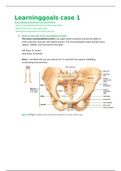
Pelvis = contribute the way you walk sit etc. It’s important for support, stabilizing,
coordinating and protection.
,2. What are the type of movements we can make? (flexion, extension, rotation etc.)
You always make combinations of movements, especially in the shoulder because you can
make every possible movement.
Knee flexion extions and a little rotation
Hip rotation, adduction abducntion and flexion and extension
Shoulder rotation, adduction abducntion and flexion and extension
Ankle dorsi flexion, platan flexion, enversion, inversion
Spine / lowback flex, extent, rotate
Pelvis (bekken) 3 joints but can’t move them, only when giving birth
Hip is the joint between pelvis and femur
- Gliding movements = occurs when one flat, or nearly flat, bone surface glides or slips over
another without appreciable angulation or rotation
,- Angular movements = increase or decrease the angle between two bones. These
movements may occur in any plane of the body
Flexion = is a bending movement, usually along the sagittal plane, that decreases the
angle of the joint and brings the articulating bones closer together.
Extension = is the reverse of flexion and occurs at the same joints. It involves
movement along the sagittal plane that increases the angle between the articulating
bones and typically straightens a flexed limb or body part.
, Abduction (moving away) = is movement of a limb away from the midline or median
plane of the body, along the frontal plane.
Adduction (moving toward)= is the opposite of abduction, so it is the movement of a
limb toward the body midline
Circumduction = is moving a limb so that it describes a cone in space. The distal end
of the limb moves in a circle, while the point of the cone (the shoulder or hip joint) is
more or less stationary.
- Rotation = is the turning of a bone around its own long axis. It is the only movement allowed
between the first two cervical vertebrae and is common at the hip and shoulder joints.
Exam questions about this case (2018-2019):
- Draw a synovial joint and name all the components
- Which bones are in the ankle joint?
- Naming the movements of several pictures.
1. What are the parts of the muscoskeletal system?
The human musculoskeletal system is an organ system that gives humans the ability to
move using their muscular and skeletal systems. The musculoskeletal system provides form,
support, stability, and movement to the body.
Soft tissue muscle
Hard tissue skeletal
Pelvis = contribute the way you walk sit etc. It’s important for support, stabilizing,
coordinating and protection.
,2. What are the type of movements we can make? (flexion, extension, rotation etc.)
You always make combinations of movements, especially in the shoulder because you can
make every possible movement.
Knee flexion extions and a little rotation
Hip rotation, adduction abducntion and flexion and extension
Shoulder rotation, adduction abducntion and flexion and extension
Ankle dorsi flexion, platan flexion, enversion, inversion
Spine / lowback flex, extent, rotate
Pelvis (bekken) 3 joints but can’t move them, only when giving birth
Hip is the joint between pelvis and femur
- Gliding movements = occurs when one flat, or nearly flat, bone surface glides or slips over
another without appreciable angulation or rotation
,- Angular movements = increase or decrease the angle between two bones. These
movements may occur in any plane of the body
Flexion = is a bending movement, usually along the sagittal plane, that decreases the
angle of the joint and brings the articulating bones closer together.
Extension = is the reverse of flexion and occurs at the same joints. It involves
movement along the sagittal plane that increases the angle between the articulating
bones and typically straightens a flexed limb or body part.
, Abduction (moving away) = is movement of a limb away from the midline or median
plane of the body, along the frontal plane.
Adduction (moving toward)= is the opposite of abduction, so it is the movement of a
limb toward the body midline
Circumduction = is moving a limb so that it describes a cone in space. The distal end
of the limb moves in a circle, while the point of the cone (the shoulder or hip joint) is
more or less stationary.
- Rotation = is the turning of a bone around its own long axis. It is the only movement allowed
between the first two cervical vertebrae and is common at the hip and shoulder joints.