Learninggoals case 9
Calculation of the confidence interval on exam!!
A.
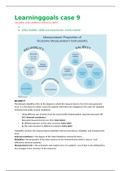
1. Define reliability, validity and responsiveness. (cosmin website)
RELIABILITY
The domain reliability refers to the degree to which the measurement is free from measurement
error. It is the extent to which scores for patients who have not changed are the same for repeated
measurement under several conditions;
- Using different sets of items from the same health related-patient reported outcomes HR-
PRO (internal consistency)
- Repeated measurements over time (test-retest)
- By different persons on the same occasion (inter-rater)
- By the same persons on different occasions (intra-rater)
Reliability contains the measurement properties internal consistency, reliability, and measurement
error.
Internal consistency = the degree of the interrelatedness among the items
Reliability = the proportion of the total variance in the measurements which is due to ‘ true’
differences between patients.
Measurement error = the systematic and random error of a patient’ s score that is not attributed to
true changes in the construct to be measured.
, VALIDITY
The domain validity refers to the degree to which an outcome measure measures the construct it
purports to measure.
Contains the measurement properties content validity (including face validity), construct validity
(including structural validity, hypotheses testing, and cross-cultural validity\measurement invariance)
and criterion validity.
Content validity = the degree to which the content of an HR-PRO instrument is an adequate
reflection of the construct to be measured.
- Face validity = the degree to which the items of an HR-PRO instrument indeed looks as
though they are an adequate reflection of the construct to be measured.
Construct validity = the degree to which the scores of an HR-PRI instrument are consistent with the
hypothesis (for instance with regard to internal relationships, relationships to scores of other
instruments, or differences between relevant groups) based on the assumption that the HR-PRO
instrument validity measures the construct to be measured. Don’t have to know exactly the types of
construct, criterion and content validity. You have to distinguish the three on the exams but not the
subtypes. KNOW AN EXAMPLE
- Structural validity = the degree to which the scores of an HR-PRO instrument are an
adequate reflection of the dimensionality of the construct to be measured.
- Hypothesis testing = the degree to which the scores of an HR-PRI instrument are consistent
with the hypothesis. Hypotheses are formulated and tested about the relationships of scores
on the instrument under study with scores on other instruments measuring similar or
dissimilar constructs, or differences in the instrument scores between subgroups of patients/
subjects. Expected correlations > 0.5-0.7 with other instruments measuring closely related
constructs are considered acceptable.
Convergent validity expected correlation between similar constructs, how closely
is a test related to another test of the same construct?
Discriminant validity lack of correlation between dissimilar constructs, the test
scores should not correlate with scores of an unrelated test
Discriminative validity expected differences between subgroups, look for
expected differences between subgroups. The test scores should not be the same
between two different groups! (body builders vs. elderly)
- Cross-cultural validity = the degree to which the performance of the items on a translated or
culturally adapted HR-PRO instrument are an adequate reflection of the performance of the
items of the original version of the HR-PRO instrument.
Criterion validity = the degree to which scores of an HR-PRO instrument are an adequate reflection
of a gold standard. To what extent do the values of skin fold measurements approach the values of a
MRI?
- Concurrent validity = consideration of both the score for the measurement instrument and
the score for the gold standard at the same time for evaluative, discriminative (diagnostic
purposes)
- Predictive validity = consideration of whether the measurement instrument predicts the
gold standard in the future for predictive purposes
RESPONSIVENESS
The domain responsiveness (contains only one measurement property, which is also called
responsiveness) refers to the ability of an outcome measure to detect change over time in the
Calculation of the confidence interval on exam!!
A.
1. Define reliability, validity and responsiveness. (cosmin website)
RELIABILITY
The domain reliability refers to the degree to which the measurement is free from measurement
error. It is the extent to which scores for patients who have not changed are the same for repeated
measurement under several conditions;
- Using different sets of items from the same health related-patient reported outcomes HR-
PRO (internal consistency)
- Repeated measurements over time (test-retest)
- By different persons on the same occasion (inter-rater)
- By the same persons on different occasions (intra-rater)
Reliability contains the measurement properties internal consistency, reliability, and measurement
error.
Internal consistency = the degree of the interrelatedness among the items
Reliability = the proportion of the total variance in the measurements which is due to ‘ true’
differences between patients.
Measurement error = the systematic and random error of a patient’ s score that is not attributed to
true changes in the construct to be measured.
, VALIDITY
The domain validity refers to the degree to which an outcome measure measures the construct it
purports to measure.
Contains the measurement properties content validity (including face validity), construct validity
(including structural validity, hypotheses testing, and cross-cultural validity\measurement invariance)
and criterion validity.
Content validity = the degree to which the content of an HR-PRO instrument is an adequate
reflection of the construct to be measured.
- Face validity = the degree to which the items of an HR-PRO instrument indeed looks as
though they are an adequate reflection of the construct to be measured.
Construct validity = the degree to which the scores of an HR-PRI instrument are consistent with the
hypothesis (for instance with regard to internal relationships, relationships to scores of other
instruments, or differences between relevant groups) based on the assumption that the HR-PRO
instrument validity measures the construct to be measured. Don’t have to know exactly the types of
construct, criterion and content validity. You have to distinguish the three on the exams but not the
subtypes. KNOW AN EXAMPLE
- Structural validity = the degree to which the scores of an HR-PRO instrument are an
adequate reflection of the dimensionality of the construct to be measured.
- Hypothesis testing = the degree to which the scores of an HR-PRI instrument are consistent
with the hypothesis. Hypotheses are formulated and tested about the relationships of scores
on the instrument under study with scores on other instruments measuring similar or
dissimilar constructs, or differences in the instrument scores between subgroups of patients/
subjects. Expected correlations > 0.5-0.7 with other instruments measuring closely related
constructs are considered acceptable.
Convergent validity expected correlation between similar constructs, how closely
is a test related to another test of the same construct?
Discriminant validity lack of correlation between dissimilar constructs, the test
scores should not correlate with scores of an unrelated test
Discriminative validity expected differences between subgroups, look for
expected differences between subgroups. The test scores should not be the same
between two different groups! (body builders vs. elderly)
- Cross-cultural validity = the degree to which the performance of the items on a translated or
culturally adapted HR-PRO instrument are an adequate reflection of the performance of the
items of the original version of the HR-PRO instrument.
Criterion validity = the degree to which scores of an HR-PRO instrument are an adequate reflection
of a gold standard. To what extent do the values of skin fold measurements approach the values of a
MRI?
- Concurrent validity = consideration of both the score for the measurement instrument and
the score for the gold standard at the same time for evaluative, discriminative (diagnostic
purposes)
- Predictive validity = consideration of whether the measurement instrument predicts the
gold standard in the future for predictive purposes
RESPONSIVENESS
The domain responsiveness (contains only one measurement property, which is also called
responsiveness) refers to the ability of an outcome measure to detect change over time in the