Interpersonal Relationships
(B): Extra information from the book Intimate Relationships
Lecture 1:
Why study relationships? Humans as social animals
Coyne et al., 2001; Heart-failure study
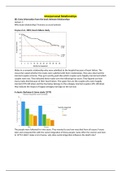
Males in a romantic relationship who were admitted to the hospital because of heart failure. The
researcher asked whether the males were satisfied with their relationships. They also observed the
married couples at home. They got a pretty good idea which couples were happily married and which
couples were not. They followed these males over the following four years. They figured out how
many males died because of their heart failure. The upper line are the couples who were happily
married (70% still alive) and the line below belongs to the unhappy married couples (45% still alive).
May indicate the impact of happy/unhappy marriage on the survival.
A classic: Berkman & Syme study (1979)
The people were followed for nine years. They wanted to see how may died from all causes 9 years
later and compared this with the social integration of these people. Same effect for women and men.
In 1979 it didn’t make a lot of sense, why does social integration influence the death rate?
,Relationships support the immune system
Cohen et al (1997): rhino-virus injection
He injected the rhino-virus (gives people a cold) into the subjects. You either get sick, or you don’t
get sick depending on your immune system. About 60% of people who were socially low integrated
got sick, while only 35% of people who were high socially integrated got sick.
Bowling alone: The higher the social integration, the lower the mortality rates.
Why study relationships?
The mortality risk due to smoking
and social relationships are equal.
WHY is social integration associated with both physical and psychological well-being?
Social integration social support health and well-being
Social support
Emotional support & Instrumental support. Strongly correlated and often ‘confounded’ (“go
shopping when ill”) Emotional is care for each other. Instrumental is doing things for you
when you need it. Often they are confounded: When someone cooks for you it’s
instrumental support, but you also consider it as care (emotional).
‘Visible’ and ‘invisible’ support (Bolger and colleagues) Invisible support works better in
promoting the well-being of the person, it’s subtle support. E.g. visible support: you look very
pale, are you ill? Can have negative effects.
,Social Support Health and well-being: How?
Cohen & Wils (1985): Direct effect-hypothesis (main effect hypothesis)
o E.g., social support makes people to take better care of themselves (less smoking;
more exercise; healthier diet, etc); social influence/norms
o Experience more positive affect (Kawachi & Berkman) = higher wellbeing
o If you lack social support, you are more likely to engage in negative behaviour.
Stress-buffering hypothesis
o Social support reduces stress under potentially stressful circumstances.
o Stress (e.g., cortisol) directly related to health via cardio-vascular and immune
system.
o Social support reduces the stress and buffers you from the negative effects of stress.
Lending a hand... (Coan et al, 2006) = Stress-buffering hypothesis
fMRI study; neurophysiological responses to anticipated pain When a red cross was
showed, there was a 80% change that the participant would get an electric shock. So, every
time a red cross showed up, the stress level of the participant got higher.
3 conditions: holding hand of romantic partner, stranger, or no hand holding, while
anticipating a hurtful electric shock
Less stress-related brain activity when hand is held, especially by the partner. In addition....
So: holding the hand buffers the stress. When the women was positive about her
relationship, than the hand worked better as a buffer. The quality of a relationship matters.
Strength and strain model of marriage and health (Slatcher, 2010; 2016)
A happy relationship will lead to e.g. social support, that has a direct effect on psychological
mechanisms (cognition, affect, health behaviour), which leads to bio mechanisms and health
outcomes.
However, a shitty relationship (conflict, criticism) has negative effects on psychological mechanisms,
bio mechanisms and health outcomes.
Outside stressors (e.g. at work, finances) can have negative consequences when in a marital strain,
because of stress intensifying. But, marital strength has a stress buffering function.
Anecdote (Diamond, 2008) : Social support is already seen in little twins. Two little sisters were put in
one incubator, and one who was not very healthy did survive against predictions.
, Thus...
Having an extensive social network strongly associated with people’s psychological and
physical well-being
Social support is the key; has a direct and indirect (stress-buffering) effect
Role of relationships on health and wellbeing underestimated, by laypeople and
psychologists alike
The Need to Belong
Baumeister & Leary, 1995: Need to belong
Evolved need to initiate and maintain relationships; critical for survival...
Similar to need for food and water
Alone in the wild: Human company was the main reason he stopped being alone.
Need to Belong-hypothesis: Two categories of support
1. Changes in ‘belongingness’ evoke strong effects
Inclusion/social integration = healthy and happy
Exclusion/loneliness = unhealthy and unhappy
2. Initiating social interactions seems innate + humans form social relationships really easily
Universal All across the globe, societies live in groups.
Minimal group research (e.g. Tajfel) If you divide a group of people in two groups based
on an arbitrary criterium, ingroup and outgroup decisions are easily made.
Mere proximity leads to relationships (more in lecture #3)
Attachment literature (more in lecture #6) We tend to form attachment for safety.
Innate focus on others (face perceptual system)
Category 2: The face perceptual system
Baby’s 30 minutes (!) old attend their gaze more to faces than other equally complex stimuli (Johnson
et al., 1991) Very strong focus on faces. We can also assign human emotions to non-real faces
(e.g. an clock or a face in coffee).
Category 1: Reactions to changes in belongingness: Social exclusion
Ball tossing game: Some people are tossing a ball and after a certain amount of time one person
doesn’t get the ball anymore.
Bus paradigm: The participant is being ignored by everyone.
Immediate reactions to ostracism
Ostracism threatens fundamental needs
o Lower sense of ‘belonging’,
o Loss of control
o Lower sense of meaningfulness
o Lower self-esteem (sociometer theory)
No matter what...! (e.g. Gonsalkorale & Williams, 2007; Van Beest & Williams, 2006) You
find these effect when people are excluded from ingroups, outgroups, etc.
o Gonsalkorale & Williams: Even when the people who are tossing the ball are from
the Ku Klux Klan, you still feel excluded.
o Van Beest & Williams: Even if it is financial beneficial to NOT get the ball, people still
feel excluded.
(B): Extra information from the book Intimate Relationships
Lecture 1:
Why study relationships? Humans as social animals
Coyne et al., 2001; Heart-failure study
Males in a romantic relationship who were admitted to the hospital because of heart failure. The
researcher asked whether the males were satisfied with their relationships. They also observed the
married couples at home. They got a pretty good idea which couples were happily married and which
couples were not. They followed these males over the following four years. They figured out how
many males died because of their heart failure. The upper line are the couples who were happily
married (70% still alive) and the line below belongs to the unhappy married couples (45% still alive).
May indicate the impact of happy/unhappy marriage on the survival.
A classic: Berkman & Syme study (1979)
The people were followed for nine years. They wanted to see how may died from all causes 9 years
later and compared this with the social integration of these people. Same effect for women and men.
In 1979 it didn’t make a lot of sense, why does social integration influence the death rate?
,Relationships support the immune system
Cohen et al (1997): rhino-virus injection
He injected the rhino-virus (gives people a cold) into the subjects. You either get sick, or you don’t
get sick depending on your immune system. About 60% of people who were socially low integrated
got sick, while only 35% of people who were high socially integrated got sick.
Bowling alone: The higher the social integration, the lower the mortality rates.
Why study relationships?
The mortality risk due to smoking
and social relationships are equal.
WHY is social integration associated with both physical and psychological well-being?
Social integration social support health and well-being
Social support
Emotional support & Instrumental support. Strongly correlated and often ‘confounded’ (“go
shopping when ill”) Emotional is care for each other. Instrumental is doing things for you
when you need it. Often they are confounded: When someone cooks for you it’s
instrumental support, but you also consider it as care (emotional).
‘Visible’ and ‘invisible’ support (Bolger and colleagues) Invisible support works better in
promoting the well-being of the person, it’s subtle support. E.g. visible support: you look very
pale, are you ill? Can have negative effects.
,Social Support Health and well-being: How?
Cohen & Wils (1985): Direct effect-hypothesis (main effect hypothesis)
o E.g., social support makes people to take better care of themselves (less smoking;
more exercise; healthier diet, etc); social influence/norms
o Experience more positive affect (Kawachi & Berkman) = higher wellbeing
o If you lack social support, you are more likely to engage in negative behaviour.
Stress-buffering hypothesis
o Social support reduces stress under potentially stressful circumstances.
o Stress (e.g., cortisol) directly related to health via cardio-vascular and immune
system.
o Social support reduces the stress and buffers you from the negative effects of stress.
Lending a hand... (Coan et al, 2006) = Stress-buffering hypothesis
fMRI study; neurophysiological responses to anticipated pain When a red cross was
showed, there was a 80% change that the participant would get an electric shock. So, every
time a red cross showed up, the stress level of the participant got higher.
3 conditions: holding hand of romantic partner, stranger, or no hand holding, while
anticipating a hurtful electric shock
Less stress-related brain activity when hand is held, especially by the partner. In addition....
So: holding the hand buffers the stress. When the women was positive about her
relationship, than the hand worked better as a buffer. The quality of a relationship matters.
Strength and strain model of marriage and health (Slatcher, 2010; 2016)
A happy relationship will lead to e.g. social support, that has a direct effect on psychological
mechanisms (cognition, affect, health behaviour), which leads to bio mechanisms and health
outcomes.
However, a shitty relationship (conflict, criticism) has negative effects on psychological mechanisms,
bio mechanisms and health outcomes.
Outside stressors (e.g. at work, finances) can have negative consequences when in a marital strain,
because of stress intensifying. But, marital strength has a stress buffering function.
Anecdote (Diamond, 2008) : Social support is already seen in little twins. Two little sisters were put in
one incubator, and one who was not very healthy did survive against predictions.
, Thus...
Having an extensive social network strongly associated with people’s psychological and
physical well-being
Social support is the key; has a direct and indirect (stress-buffering) effect
Role of relationships on health and wellbeing underestimated, by laypeople and
psychologists alike
The Need to Belong
Baumeister & Leary, 1995: Need to belong
Evolved need to initiate and maintain relationships; critical for survival...
Similar to need for food and water
Alone in the wild: Human company was the main reason he stopped being alone.
Need to Belong-hypothesis: Two categories of support
1. Changes in ‘belongingness’ evoke strong effects
Inclusion/social integration = healthy and happy
Exclusion/loneliness = unhealthy and unhappy
2. Initiating social interactions seems innate + humans form social relationships really easily
Universal All across the globe, societies live in groups.
Minimal group research (e.g. Tajfel) If you divide a group of people in two groups based
on an arbitrary criterium, ingroup and outgroup decisions are easily made.
Mere proximity leads to relationships (more in lecture #3)
Attachment literature (more in lecture #6) We tend to form attachment for safety.
Innate focus on others (face perceptual system)
Category 2: The face perceptual system
Baby’s 30 minutes (!) old attend their gaze more to faces than other equally complex stimuli (Johnson
et al., 1991) Very strong focus on faces. We can also assign human emotions to non-real faces
(e.g. an clock or a face in coffee).
Category 1: Reactions to changes in belongingness: Social exclusion
Ball tossing game: Some people are tossing a ball and after a certain amount of time one person
doesn’t get the ball anymore.
Bus paradigm: The participant is being ignored by everyone.
Immediate reactions to ostracism
Ostracism threatens fundamental needs
o Lower sense of ‘belonging’,
o Loss of control
o Lower sense of meaningfulness
o Lower self-esteem (sociometer theory)
No matter what...! (e.g. Gonsalkorale & Williams, 2007; Van Beest & Williams, 2006) You
find these effect when people are excluded from ingroups, outgroups, etc.
o Gonsalkorale & Williams: Even when the people who are tossing the ball are from
the Ku Klux Klan, you still feel excluded.
o Van Beest & Williams: Even if it is financial beneficial to NOT get the ball, people still
feel excluded.