National Thought in Europe
Hoorcolleges en aanvulling van het boek
Important terms
Lists
(Translation of difficult English words to Dutch)
Things about the exam itself
Additions of the book
Important people or things / I mportant year
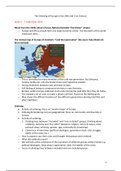
Hoorcollege 1 | 2 sep. 2019 Introduction (20-29)
19th century in this class = French revolution - World War 1
It is in the nineteenth century that nationalism emerges as such, as a specific and
recognizable ideology with a specific and recognizable political and cultural agenda.
We can see the development of nationalism affecting Europe as a whole.
Country’s changed a lot geographically. There are only a few ‘small little states’ left
from the 19th century like Lichtenstein.
Little states formed Nation States
The states and the people were most of all named after languages.
This is called the Typical Idea because it’s not always true.
For Example: In Ireland they speak English but they are Irish
The Typical Idea of a Nation State:
1. Name of State
2. Identity of the People
3. Language the people speak
4. Character
Political Identity = Citizenship
Cultural Identity = Nationality → What the book is about: A cultural history
National Thought (Ideas people have)
● “humankind is naturally divided into cultural
communities called nations”
● “one’s primary political loyalty is towards one’s
nation”
● “national concord is the state’s strongest
, foundation”
● “a state containing various nations is weak”
● “a nation divided over different states is
unnatural”
‘National Thought’ a wider and less specific than ‘Nationalism’
National Thought = A way of seeing human society primarily as consisting of
discrete, different nations, each with an obvious right to exist and to command
loyalty, each characterised and set apart unambiguously by its own separate identity
and culture.
National Thought is mobile → anyone who is affected by a certain idea may pass it
on to others (the traffic of ideas)
The word “nation” is much older than the word “nationalism”
Theory = Explaining why some things are more important than others
The question is if nationalism is something that has always existed. There were
elements of nationalism before 1800, but from 1800 these elements were mixed and
National Thought was born.
In the media and in politics we use the word ‘nationalism’ way to easy. In this class
we use the word in a technical sense.
Nation = A self defining nation = people who choose to call themselves a nation. = A
cultural and social community that people identify with and feel political loyalty
towards.
Ethnicity = A group of bonded intersubjectively by a chosen common
self-identification, involving a common sense of culture and historical continuity.
= The collective acceptance of a shared self-image
Ethnotypes = Commonplaces and stereotypes of how we identify, view and
characterize others as opposed to ourselves.
The word ‘Nation’ hovers between three poles:
1. Society
2. Culture
3. Race
,The words ‘nation’ and ‘state’ can be used interchangeably
Leerssen is not sure if a ‘nation’ is something that exists and not just something
people believe in.
Nationalism is a political ideology based on combination of these three assumptions:
Political agenda of Nationalism
● “There should be a 1-on-1 congruence between
nation and state:
1 state for each nation, 1 nation for each state”
● “state borders should be mapped onto cultural
(ethnolinguistic) frontiers”
● “ethnic conflict is to be solved by territorial
division”
State/Political borders :
1. Reflect political power
2. Sharp demarcations (borders and other things). No in-between. Belgium =
Belgium until the border of France.
3. Reflect changeable power relations
Cultural (/linguistic) frontiers :
1. Much more complex than state borders
2. Transitional zones. In-between. Around the border of germany a lot of
dutchies speak german and a lot of german speak dutch.
3. Reflect transgenerational private lifestyles
Centralism = the state attempts to “tame” cultural diversity
Separatism = the state’s control is challenged
Articulation = We order the world primarily by subdividing it, and the sense of
collective togetherness involves unavoidably a sense of collective separateness.
You can set borders to give nations a living place to prevent wars. However, if
people are all over the place this doesn’t work. There will be minority of people from
different states on ‘the wrong side of the border’.
Language frontiers doesn’t really change over time. Because if you don’t physically
remove speakers from a certain area the language will not die. The language will
survive.
, Nationalism is after all, a political ideology → One of the dominant ones of the two
last centuries.
Debates about what is nationalism and where is comes from. Example debate:
- “Modernist view” = nationalism is a side effect of modernization with its
shifting patterns of education and economic scale enlargement, driven largely
by intellectuals.
- “Societal model” = nationalism was an ideology born of the people rather than
by intellectuals
Debates brought the question: How ‘modern’ or recent is nationalism as a historical
phenomenon? O nly 1
9th century/ or earlier, and in what way? What is the origin of
nationalism?
The history of nationalism is far more complex than merely a pre-history of the
contemporary states. (which is often how nationalism studies are conducted). We
need to take into account the roads not taken, the ideals that were not realized.
Nation-building and state-formating differs from area to area around the world.
2 different vectors of Nationalism
➢ Vertical = Right of the nation within the state in relation to superiors and
rulers. “democratic”
➢ Horizontal = The identity and separateness of the nation in relation to
outsiders and neighbours “ethnocentric”
Hoorcollege 2 | 4 sep. 2019 Ancient patterns: Languages, religions (271-283)
Nationalism is a form of secondary ‘religion’.
Secularization = religion became less important and nationalism became more
important.
Even in a secularised world religion is a important factor.
The Roman empire became a christian state 2 years before the fall of the roman
empire. From the year 300 the christian states became important for the Roman
empire. They were called paitriac. Most of them were close to Jerusalem (the holy
land).
There was tension between Constantinople and Rome, which one was more
important
Hoorcolleges en aanvulling van het boek
Important terms
Lists
(Translation of difficult English words to Dutch)
Things about the exam itself
Additions of the book
Important people or things / I mportant year
Hoorcollege 1 | 2 sep. 2019 Introduction (20-29)
19th century in this class = French revolution - World War 1
It is in the nineteenth century that nationalism emerges as such, as a specific and
recognizable ideology with a specific and recognizable political and cultural agenda.
We can see the development of nationalism affecting Europe as a whole.
Country’s changed a lot geographically. There are only a few ‘small little states’ left
from the 19th century like Lichtenstein.
Little states formed Nation States
The states and the people were most of all named after languages.
This is called the Typical Idea because it’s not always true.
For Example: In Ireland they speak English but they are Irish
The Typical Idea of a Nation State:
1. Name of State
2. Identity of the People
3. Language the people speak
4. Character
Political Identity = Citizenship
Cultural Identity = Nationality → What the book is about: A cultural history
National Thought (Ideas people have)
● “humankind is naturally divided into cultural
communities called nations”
● “one’s primary political loyalty is towards one’s
nation”
● “national concord is the state’s strongest
, foundation”
● “a state containing various nations is weak”
● “a nation divided over different states is
unnatural”
‘National Thought’ a wider and less specific than ‘Nationalism’
National Thought = A way of seeing human society primarily as consisting of
discrete, different nations, each with an obvious right to exist and to command
loyalty, each characterised and set apart unambiguously by its own separate identity
and culture.
National Thought is mobile → anyone who is affected by a certain idea may pass it
on to others (the traffic of ideas)
The word “nation” is much older than the word “nationalism”
Theory = Explaining why some things are more important than others
The question is if nationalism is something that has always existed. There were
elements of nationalism before 1800, but from 1800 these elements were mixed and
National Thought was born.
In the media and in politics we use the word ‘nationalism’ way to easy. In this class
we use the word in a technical sense.
Nation = A self defining nation = people who choose to call themselves a nation. = A
cultural and social community that people identify with and feel political loyalty
towards.
Ethnicity = A group of bonded intersubjectively by a chosen common
self-identification, involving a common sense of culture and historical continuity.
= The collective acceptance of a shared self-image
Ethnotypes = Commonplaces and stereotypes of how we identify, view and
characterize others as opposed to ourselves.
The word ‘Nation’ hovers between three poles:
1. Society
2. Culture
3. Race
,The words ‘nation’ and ‘state’ can be used interchangeably
Leerssen is not sure if a ‘nation’ is something that exists and not just something
people believe in.
Nationalism is a political ideology based on combination of these three assumptions:
Political agenda of Nationalism
● “There should be a 1-on-1 congruence between
nation and state:
1 state for each nation, 1 nation for each state”
● “state borders should be mapped onto cultural
(ethnolinguistic) frontiers”
● “ethnic conflict is to be solved by territorial
division”
State/Political borders :
1. Reflect political power
2. Sharp demarcations (borders and other things). No in-between. Belgium =
Belgium until the border of France.
3. Reflect changeable power relations
Cultural (/linguistic) frontiers :
1. Much more complex than state borders
2. Transitional zones. In-between. Around the border of germany a lot of
dutchies speak german and a lot of german speak dutch.
3. Reflect transgenerational private lifestyles
Centralism = the state attempts to “tame” cultural diversity
Separatism = the state’s control is challenged
Articulation = We order the world primarily by subdividing it, and the sense of
collective togetherness involves unavoidably a sense of collective separateness.
You can set borders to give nations a living place to prevent wars. However, if
people are all over the place this doesn’t work. There will be minority of people from
different states on ‘the wrong side of the border’.
Language frontiers doesn’t really change over time. Because if you don’t physically
remove speakers from a certain area the language will not die. The language will
survive.
, Nationalism is after all, a political ideology → One of the dominant ones of the two
last centuries.
Debates about what is nationalism and where is comes from. Example debate:
- “Modernist view” = nationalism is a side effect of modernization with its
shifting patterns of education and economic scale enlargement, driven largely
by intellectuals.
- “Societal model” = nationalism was an ideology born of the people rather than
by intellectuals
Debates brought the question: How ‘modern’ or recent is nationalism as a historical
phenomenon? O nly 1
9th century/ or earlier, and in what way? What is the origin of
nationalism?
The history of nationalism is far more complex than merely a pre-history of the
contemporary states. (which is often how nationalism studies are conducted). We
need to take into account the roads not taken, the ideals that were not realized.
Nation-building and state-formating differs from area to area around the world.
2 different vectors of Nationalism
➢ Vertical = Right of the nation within the state in relation to superiors and
rulers. “democratic”
➢ Horizontal = The identity and separateness of the nation in relation to
outsiders and neighbours “ethnocentric”
Hoorcollege 2 | 4 sep. 2019 Ancient patterns: Languages, religions (271-283)
Nationalism is a form of secondary ‘religion’.
Secularization = religion became less important and nationalism became more
important.
Even in a secularised world religion is a important factor.
The Roman empire became a christian state 2 years before the fall of the roman
empire. From the year 300 the christian states became important for the Roman
empire. They were called paitriac. Most of them were close to Jerusalem (the holy
land).
There was tension between Constantinople and Rome, which one was more
important