Dieetleer
Samenvatting
Manual of dietetic practice
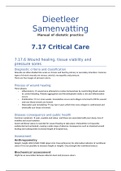
7.17 Critical Care
7.17.6 Wound healing, tissue viability and
pressure sores
Diagnostic criteria and classification
Wounds are often divided into acute or chronic and heal by primary or secondary intention. Common
types of chronic wounds are venous, arterial, neuropathic and pressure.
There are four stages of pressure ulcers.
Process of wound healing
Three phases:
- Inflammatory wound area attempts to restore homeostasis by constricting blood vessels
to control bleeding. Platelet aggregation and thromboplastin make a clot and inflammation
occurs.
- Proliferation 3 or more weeks. Granulation occurs and collagen is formed to fill the wound
and new blood vessels are formed
- Maturation and remodeling may last 2 years which time new collagen is synthesized and
eventually scar tissue is formed.
Disease consequence and public health
Common symptoms pain, exudate and odour, and these are associated with poor sleep, loss of
mobility and social isolation.
Good nutritional status is essential for wound healing to take place. Malnutrition is frequently
undetected and untreated, causing a wide range of adverse consequences such as impaired wound
healing and subsequently increased length of hospital stay.
Assessment
Anthropometry
Weight, height, BMI (MUAC (Mild Upper Arm Cirucumference) for alternative indicator of nutritional
status if it is not possible to measure height or weight). Grip strength (for nutritional status).
Biochemical assessment
Might be an association between albumin level and pressure ulcers.
,Clinical assessment
Waterlow pressure ulcer risk assessment tool scoring system and provides guidance associated
with levels of risk status.
Dietary assessment
Fundamental whether the patient has an optimum nutritional status to allow wound to heal.
Clinical investigation and management
An individual’s potential to develop pressure ulcers may be influenced by various factors:
- Reduced mobility or immobility
- Sensory impairment
- Acute illness
- Level of consciousness
- Extremes of age
- Vascular disease
- Severe chronic or terminal illness
- Previous history of pressure damage
- Malnutrition and dehydration
Nutritional management
Optimum nutrition is a key factor in maintaining all phases of wound healing. Protein energy
malnutrition (PEM) in the presence of a wound will lead to the loss of lean body tissue or protein
stores, which will impede the healing process.
Macronutrients
Metabolic or energy demand rise significantly in the presence of a wound. Energy 30-35kcal/kg of kcal/kg of
body weight/day.
Carbohydrates together with fats are the primary source of energy in the wound healing process. Fat
has a role in cell membrane structure and function. N-3 fatty acids role in increasing
proinflammatory cytokine production to affect wound healing during the inflammatory stage.
Protein malnutrition delays wound healing by impairing collagen synthesis and deposition, and
decreasing scar strength. High protein diet faster wound healing.
Micronutrients
Serve a vital role in wound healing and metabolic functions. Vitamins A, B 1, B2, B6 are vital to energy
production and collagen deposition. Copper, zinc, selenium role in immune function. Patients with
total body surface area burns of 30% or greater should be given intravenous supplementation for the
first 8 days.
Vitamin C collagen formation and critical for wound healing. Stage III and IV ma ybenefit from
supplementation with 5kcal/kg of 00mg twice daily for 14 days. Vitamin C supplementation in non-deficient
patients has not been shown to accelerate wound healing.
Vitamin A influence the body’s therapeutic inflammatory response to wounds. Plays a role in cell
division, cell differentiation and immune system function.
Zinc wound healing. Often supplementation recommended 25kcal/kg of mg/day and 20-25kcal/kg of mg/day for
larger non-healing wounds but should be limited to 14 days. Excess zinc has been shown to induce
both copper and iron deficient anaemia, which could result in decreased oxygen delivery to the
wound.
,Iron
Necessary for the formation of collagen and to support tissue oxygenation at the wound site.
Fluid
Required to maintain good skin tone and blood flow to wounded tissues, which is critical for the
prevention of skin breakdown. 30-35kcal/kg of ml/kg body weight/day recommended. Dehydration is major
risk factor for the development of pressure sores as the skin becomes inelastic, fragile and more
susceptible to breakdown.
Drug-nutrient interactions
Corticosteroids inhibit fibroplasia and the formation of granulation tissue.
Antiplatelet drugs (including aspirin and other steroidal anti-inflammatory drugs) dose dependant
effect as they act as inflammatory mediators.
Anticoagulations (warfarin, heparin) inhibit proper coagulation and adversely affect wounds.
Drugs such as prostacyclin can be used to promote healing in arterial and vasculitic ulcers.
Calcium antagonists can help improve blood flow.
, 7.1 Respiratory disease
7.1 Respiratory disease
Chronic respiratory disease Chronic obstructive pulmonary disease (COPD) or asthma. A number
of local symptoms that result from respiratory disease can affect nutritional intake and nutritional
status. All respiratory disease affect lung function to varying degrees but some, particularly COPD and
tuberculosis (TB), are also associated with chronic systemic inflammation that can have profound
effects on skeletal muscle (sarcopenia and cachexia) and bone (osteoporosis).
Chronic obstructive pulmonary disease
Emphysema, bronchitis or combination of both. Patients usually present with a history of increasing
dyspnea over several years, chronic cough, muscle weakness and poor exercise tolerance secondary
to muscle wasting.
Diagnostic criteria and classification
Medical history, symptoms, post bronchodilator spirometry to establish lung function (forced
expiratory volume in one second (FEV1) and forced vital capacity (FVC)). Lung function results are
compared with age and gender.
Global Initiative for Chronic Obstructive Lung Disease (GOLD) classification:
Disease processes
While cigarette smoking and air pollution are the most important factors in the development of
COPD, genetic predispositions also play a role. It may result in pulmonary hypertension and cor
pulmonale.
Samenvatting
Manual of dietetic practice
7.17 Critical Care
7.17.6 Wound healing, tissue viability and
pressure sores
Diagnostic criteria and classification
Wounds are often divided into acute or chronic and heal by primary or secondary intention. Common
types of chronic wounds are venous, arterial, neuropathic and pressure.
There are four stages of pressure ulcers.
Process of wound healing
Three phases:
- Inflammatory wound area attempts to restore homeostasis by constricting blood vessels
to control bleeding. Platelet aggregation and thromboplastin make a clot and inflammation
occurs.
- Proliferation 3 or more weeks. Granulation occurs and collagen is formed to fill the wound
and new blood vessels are formed
- Maturation and remodeling may last 2 years which time new collagen is synthesized and
eventually scar tissue is formed.
Disease consequence and public health
Common symptoms pain, exudate and odour, and these are associated with poor sleep, loss of
mobility and social isolation.
Good nutritional status is essential for wound healing to take place. Malnutrition is frequently
undetected and untreated, causing a wide range of adverse consequences such as impaired wound
healing and subsequently increased length of hospital stay.
Assessment
Anthropometry
Weight, height, BMI (MUAC (Mild Upper Arm Cirucumference) for alternative indicator of nutritional
status if it is not possible to measure height or weight). Grip strength (for nutritional status).
Biochemical assessment
Might be an association between albumin level and pressure ulcers.
,Clinical assessment
Waterlow pressure ulcer risk assessment tool scoring system and provides guidance associated
with levels of risk status.
Dietary assessment
Fundamental whether the patient has an optimum nutritional status to allow wound to heal.
Clinical investigation and management
An individual’s potential to develop pressure ulcers may be influenced by various factors:
- Reduced mobility or immobility
- Sensory impairment
- Acute illness
- Level of consciousness
- Extremes of age
- Vascular disease
- Severe chronic or terminal illness
- Previous history of pressure damage
- Malnutrition and dehydration
Nutritional management
Optimum nutrition is a key factor in maintaining all phases of wound healing. Protein energy
malnutrition (PEM) in the presence of a wound will lead to the loss of lean body tissue or protein
stores, which will impede the healing process.
Macronutrients
Metabolic or energy demand rise significantly in the presence of a wound. Energy 30-35kcal/kg of kcal/kg of
body weight/day.
Carbohydrates together with fats are the primary source of energy in the wound healing process. Fat
has a role in cell membrane structure and function. N-3 fatty acids role in increasing
proinflammatory cytokine production to affect wound healing during the inflammatory stage.
Protein malnutrition delays wound healing by impairing collagen synthesis and deposition, and
decreasing scar strength. High protein diet faster wound healing.
Micronutrients
Serve a vital role in wound healing and metabolic functions. Vitamins A, B 1, B2, B6 are vital to energy
production and collagen deposition. Copper, zinc, selenium role in immune function. Patients with
total body surface area burns of 30% or greater should be given intravenous supplementation for the
first 8 days.
Vitamin C collagen formation and critical for wound healing. Stage III and IV ma ybenefit from
supplementation with 5kcal/kg of 00mg twice daily for 14 days. Vitamin C supplementation in non-deficient
patients has not been shown to accelerate wound healing.
Vitamin A influence the body’s therapeutic inflammatory response to wounds. Plays a role in cell
division, cell differentiation and immune system function.
Zinc wound healing. Often supplementation recommended 25kcal/kg of mg/day and 20-25kcal/kg of mg/day for
larger non-healing wounds but should be limited to 14 days. Excess zinc has been shown to induce
both copper and iron deficient anaemia, which could result in decreased oxygen delivery to the
wound.
,Iron
Necessary for the formation of collagen and to support tissue oxygenation at the wound site.
Fluid
Required to maintain good skin tone and blood flow to wounded tissues, which is critical for the
prevention of skin breakdown. 30-35kcal/kg of ml/kg body weight/day recommended. Dehydration is major
risk factor for the development of pressure sores as the skin becomes inelastic, fragile and more
susceptible to breakdown.
Drug-nutrient interactions
Corticosteroids inhibit fibroplasia and the formation of granulation tissue.
Antiplatelet drugs (including aspirin and other steroidal anti-inflammatory drugs) dose dependant
effect as they act as inflammatory mediators.
Anticoagulations (warfarin, heparin) inhibit proper coagulation and adversely affect wounds.
Drugs such as prostacyclin can be used to promote healing in arterial and vasculitic ulcers.
Calcium antagonists can help improve blood flow.
, 7.1 Respiratory disease
7.1 Respiratory disease
Chronic respiratory disease Chronic obstructive pulmonary disease (COPD) or asthma. A number
of local symptoms that result from respiratory disease can affect nutritional intake and nutritional
status. All respiratory disease affect lung function to varying degrees but some, particularly COPD and
tuberculosis (TB), are also associated with chronic systemic inflammation that can have profound
effects on skeletal muscle (sarcopenia and cachexia) and bone (osteoporosis).
Chronic obstructive pulmonary disease
Emphysema, bronchitis or combination of both. Patients usually present with a history of increasing
dyspnea over several years, chronic cough, muscle weakness and poor exercise tolerance secondary
to muscle wasting.
Diagnostic criteria and classification
Medical history, symptoms, post bronchodilator spirometry to establish lung function (forced
expiratory volume in one second (FEV1) and forced vital capacity (FVC)). Lung function results are
compared with age and gender.
Global Initiative for Chronic Obstructive Lung Disease (GOLD) classification:
Disease processes
While cigarette smoking and air pollution are the most important factors in the development of
COPD, genetic predispositions also play a role. It may result in pulmonary hypertension and cor
pulmonale.