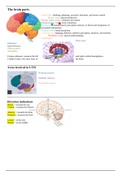
The brain parts
Frontal lobe: thinking, planning, executive functions, and motor control.
Broca’s area: speech production.
Primary motor cortex: voluntary movement
Somatosensory cortex: body sensations
Parietal lobe: somatosensory perception (sensory to brain) and integration of
perceptual information.
Occipital lobe: visual perception.
Temporal lobe: language function, auditory perception, memory, and emotion.
Wernicke’s area: speech understanding.
Cerebellum:
Brain stem:
Thalamus:
Hypothalamus:
Hippocampus:
Amygdala:
Corpus callosum: connects the left and right cerebral hemispheres.
Cerebral cortex: the outer layer of the brain.
Areas involved in LTM
Working memory
Semantic memory
Procedural memory
Direction indications
Dorsal = towards the top
Ventral = towards the bottom
Anterior = towards the front
Posterior = towards the back
Lateral = at the side
Medial = in the middle
,Chapter 1
Introduction
What is cognitive psychology?
[4] Cognitive psychology
Seeks to answer how we process information by studying how information is acquired, stored in memory, retrieved,
and used to reach goals. Mainly looks at mental representations.
Cognitive psychology = the scientific study of how people and animals process information.
Mental representations = inner representations, such as an image or a verbal concept, of some external reality.
History and approaches
[9] Approaches to cognitive psychology (early)
Earlier approaches are associationism, introspectionism and behaviorism.
Associationism (Locke): empiric approach; all knowledge comes from experience, and ideas and memories are
linked by associations. Associationists relied on their own intuitions and introspections for their theories and did
not experiment on others.
Introspectionism (Wundt): focused on the nature of conscious experience and tried to analyze normal perceptions
(a table) into simpler sensations (brownness, straight lines, textures) which combined to give the perception. The
most favored method was classical introspection (self-observation) in which trained participants gave a verbal
account of their sensations.
Limitations: extensive training was required, no application to all groups, task may be interrupted.
Behaviorism (Watson): abandoned the attempt to look inside the mind and took only observable behavior as data.
Focus on learning and on how behavioral responses can be predicted from rewards and punishments.
Limitations: less applicable to complex mental phenomena, such as reasoning and problem solving.
[Box 1.5] Cognitive maps (Tolman)
The possibility of animals having goals and using mental maps was studied by exposing rats to a maze task. This
showed that learning could occur in the absence of reinforcement and supporting the idea of mental maps. The rats
that received no reinforcement for the first 10 days showed a sudden decrease in errors once the food reward was
introduced. This suggest that latent learning had occurred. Also it was argued that a mental map had been acquired.
Latent learning = learning occurs but is not immediately demonstrated in performance.
Mental map = an abstract mental representation of spatial layout (the maze).
[13] Information processing approach
The dominant approach today; derives from analogies with computers and computer programs: the brain is the
hardware on which cognitive software runs. Attempts to explain performance in cognitive tasks by using concepts of
internal representations which are transformed by mental operations using long-term and working memories.
Mental operations = inner actions manipulating mental representations.
[14] Computer programs
When programming computers there is a distinction between simulation and artificial intelligence.
Simulation = programming computers to solve problems in a similar way to humans.
Artificial intelligence = the attempt to program computers to carry out complex tasks as effectively as possible.
[Box 1.6] Human factors and cognitive psychology
The field of human factors is concerned with how human capacities and limitations influence performance when
interacting with technology, for example in radar operations. The radar operator’s task was to detect enemy aircraft. A
number of factors influenced the accuracy of detection by the operator. Cognitive psychology helps us understand
how reliable performance in important decision tasks might be supported.
[16] Connectionism
Alternative style of information processing modelling that can be explored through simulation. States that cognition is
best understood in terms of networks of simple neuron-like units organized into input, output and internal units. They
are connected by excitatory or inhibitory (hidden) links through which activation flows.
Backwards propagation = a way of modifying weights on the links between units in a connectionist network, in
response to errors, to obtain the desired output.
, Cognitive neuroscience
[19] Neurons
All the structures in the brain are composed of neurons that
exchange information by transmitting electrical impulses.
Dendrites receive electrical signals and axons transmit signals to other neurons
by chemical transmission.
Neurons = the basic units of the nervous system, consisting of a cell, axon and dendrites.
[20] Cognitive neuropsychology
Examines the effects of brain damage on behavior, with a view to identifying how psychological functions are
organized in the brain.
Localization = the view that specific mental functions are tied to specific brain areas.
Phrenology = an early form of localization that attempted to link psychological functions to bumps in the skull.
Double dissociation
Cases of double dissociation are of particular interest for neuropsychologists because this suggests separate functions
and can provide information about localization.
Double dissociation = two tasks are said to be doubly dissociated when, following brain injury, some people do well
on task A and bad on B, while others with different injuries show the opposite pattern.
[21] 2 main brain imaging categories
There are 2 main categories of brain scanning/imaging:
Structural imaging: shows static brain anatomy; dominant method is MRI.
Functional imaging: detects brain activity; methods include EEG, ERPs, PET, and fMRI.
MRI = Magnetic Resonance Imaging; high-definition method using strong magnetic fields.
EEG = Electroencephalography; shows waves of electrical activity from scalp recorders.
ERPs = Event-related potentials; records electrical activity during repeated stimulus presentations.
PET = Positron Emission Tomography; uses positron emissions from radioactive glucose, administered in the blood,
to indicate areas of increased blood flow.
fMRI = Functional MRI; uses oxygenation levels of blood flow, with active neurons using more oxygen, and has good
temporal and spatial resolution.
Chapter 2
Perception
Introduction
[29] Perception
Organizes sensory experience into and understanding of our surrounding world, it gives us insight into how properties
of the physical world are transformed into our mental world. Perception is between sensation and cognition.
Perception = our sensory experience of the world.
Sensation = the processes by which physical properties are converted to neural signals.
[30] Accuracy of perception
Perception is not always accurate, as it is not just exact representations, it’s how one
person experiences it.
This is for example shown in illusions, such as the Muller-Lyer or the Ponzo illusion.
Fundamental concepts
[31] The inverse problem
Perception does not guarantee us a faithful representation of the physical world, there can be a loss of information as
the physical world is transformed into a mental representation.
Different (3D) shapes can produce the same (2D) image in the eye.
[33] Bottom-up vs. top-down processing
Bottom-up processing = data-driven; the original sensory input is uninterruptedly transformed into a
representation.
Black dots on a white background are perceived.
Top-down processing = concept-driven; transformation from sensory input into a representation is influenced by
cognitive factors, such as knowledge or expectations.
Frontal lobe: thinking, planning, executive functions, and motor control.
Broca’s area: speech production.
Primary motor cortex: voluntary movement
Somatosensory cortex: body sensations
Parietal lobe: somatosensory perception (sensory to brain) and integration of
perceptual information.
Occipital lobe: visual perception.
Temporal lobe: language function, auditory perception, memory, and emotion.
Wernicke’s area: speech understanding.
Cerebellum:
Brain stem:
Thalamus:
Hypothalamus:
Hippocampus:
Amygdala:
Corpus callosum: connects the left and right cerebral hemispheres.
Cerebral cortex: the outer layer of the brain.
Areas involved in LTM
Working memory
Semantic memory
Procedural memory
Direction indications
Dorsal = towards the top
Ventral = towards the bottom
Anterior = towards the front
Posterior = towards the back
Lateral = at the side
Medial = in the middle
,Chapter 1
Introduction
What is cognitive psychology?
[4] Cognitive psychology
Seeks to answer how we process information by studying how information is acquired, stored in memory, retrieved,
and used to reach goals. Mainly looks at mental representations.
Cognitive psychology = the scientific study of how people and animals process information.
Mental representations = inner representations, such as an image or a verbal concept, of some external reality.
History and approaches
[9] Approaches to cognitive psychology (early)
Earlier approaches are associationism, introspectionism and behaviorism.
Associationism (Locke): empiric approach; all knowledge comes from experience, and ideas and memories are
linked by associations. Associationists relied on their own intuitions and introspections for their theories and did
not experiment on others.
Introspectionism (Wundt): focused on the nature of conscious experience and tried to analyze normal perceptions
(a table) into simpler sensations (brownness, straight lines, textures) which combined to give the perception. The
most favored method was classical introspection (self-observation) in which trained participants gave a verbal
account of their sensations.
Limitations: extensive training was required, no application to all groups, task may be interrupted.
Behaviorism (Watson): abandoned the attempt to look inside the mind and took only observable behavior as data.
Focus on learning and on how behavioral responses can be predicted from rewards and punishments.
Limitations: less applicable to complex mental phenomena, such as reasoning and problem solving.
[Box 1.5] Cognitive maps (Tolman)
The possibility of animals having goals and using mental maps was studied by exposing rats to a maze task. This
showed that learning could occur in the absence of reinforcement and supporting the idea of mental maps. The rats
that received no reinforcement for the first 10 days showed a sudden decrease in errors once the food reward was
introduced. This suggest that latent learning had occurred. Also it was argued that a mental map had been acquired.
Latent learning = learning occurs but is not immediately demonstrated in performance.
Mental map = an abstract mental representation of spatial layout (the maze).
[13] Information processing approach
The dominant approach today; derives from analogies with computers and computer programs: the brain is the
hardware on which cognitive software runs. Attempts to explain performance in cognitive tasks by using concepts of
internal representations which are transformed by mental operations using long-term and working memories.
Mental operations = inner actions manipulating mental representations.
[14] Computer programs
When programming computers there is a distinction between simulation and artificial intelligence.
Simulation = programming computers to solve problems in a similar way to humans.
Artificial intelligence = the attempt to program computers to carry out complex tasks as effectively as possible.
[Box 1.6] Human factors and cognitive psychology
The field of human factors is concerned with how human capacities and limitations influence performance when
interacting with technology, for example in radar operations. The radar operator’s task was to detect enemy aircraft. A
number of factors influenced the accuracy of detection by the operator. Cognitive psychology helps us understand
how reliable performance in important decision tasks might be supported.
[16] Connectionism
Alternative style of information processing modelling that can be explored through simulation. States that cognition is
best understood in terms of networks of simple neuron-like units organized into input, output and internal units. They
are connected by excitatory or inhibitory (hidden) links through which activation flows.
Backwards propagation = a way of modifying weights on the links between units in a connectionist network, in
response to errors, to obtain the desired output.
, Cognitive neuroscience
[19] Neurons
All the structures in the brain are composed of neurons that
exchange information by transmitting electrical impulses.
Dendrites receive electrical signals and axons transmit signals to other neurons
by chemical transmission.
Neurons = the basic units of the nervous system, consisting of a cell, axon and dendrites.
[20] Cognitive neuropsychology
Examines the effects of brain damage on behavior, with a view to identifying how psychological functions are
organized in the brain.
Localization = the view that specific mental functions are tied to specific brain areas.
Phrenology = an early form of localization that attempted to link psychological functions to bumps in the skull.
Double dissociation
Cases of double dissociation are of particular interest for neuropsychologists because this suggests separate functions
and can provide information about localization.
Double dissociation = two tasks are said to be doubly dissociated when, following brain injury, some people do well
on task A and bad on B, while others with different injuries show the opposite pattern.
[21] 2 main brain imaging categories
There are 2 main categories of brain scanning/imaging:
Structural imaging: shows static brain anatomy; dominant method is MRI.
Functional imaging: detects brain activity; methods include EEG, ERPs, PET, and fMRI.
MRI = Magnetic Resonance Imaging; high-definition method using strong magnetic fields.
EEG = Electroencephalography; shows waves of electrical activity from scalp recorders.
ERPs = Event-related potentials; records electrical activity during repeated stimulus presentations.
PET = Positron Emission Tomography; uses positron emissions from radioactive glucose, administered in the blood,
to indicate areas of increased blood flow.
fMRI = Functional MRI; uses oxygenation levels of blood flow, with active neurons using more oxygen, and has good
temporal and spatial resolution.
Chapter 2
Perception
Introduction
[29] Perception
Organizes sensory experience into and understanding of our surrounding world, it gives us insight into how properties
of the physical world are transformed into our mental world. Perception is between sensation and cognition.
Perception = our sensory experience of the world.
Sensation = the processes by which physical properties are converted to neural signals.
[30] Accuracy of perception
Perception is not always accurate, as it is not just exact representations, it’s how one
person experiences it.
This is for example shown in illusions, such as the Muller-Lyer or the Ponzo illusion.
Fundamental concepts
[31] The inverse problem
Perception does not guarantee us a faithful representation of the physical world, there can be a loss of information as
the physical world is transformed into a mental representation.
Different (3D) shapes can produce the same (2D) image in the eye.
[33] Bottom-up vs. top-down processing
Bottom-up processing = data-driven; the original sensory input is uninterruptedly transformed into a
representation.
Black dots on a white background are perceived.
Top-down processing = concept-driven; transformation from sensory input into a representation is influenced by
cognitive factors, such as knowledge or expectations.