

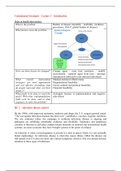
Containment Strategies – Lecture 1 – introduction
Steps in health intervention:
What is the problem Burden of disease (mortality / morbidity, incidence /
prevalence, DALY, global burden of disease)
What factors cause the problem
How can these factors be changed? Change agent / raise host resistance / modify
environment / separate agent from host / interrupt
transmission (infected to non-infected individual)
What overall intervention Medical-technical effectiveness
strategies are most appropriate Organisational feasibility
and cost effective (including what Social, cultural and political feasibility
do people want and what are their Financial feasibility
needs?)?
What needs to be done to reach the Anticipate barriers to implementation and negative
goals? With what (sub)populations side effects
shall work be done, and in what
sequence, to solve the problem?
HC 2 – Infectious disease control
By the 1960s, with improved sanitation, medicine and drugs, the U.S. surgeon general stated:
“The war against infectious diseases has been won”. (antibiotics, vaccines, hygiene, nutrition)
The war continues today: the campaign to eradicate infectious disease is ongoing and
pathogens are exhibiting remarkable resilience and flexibility. Epidemics and pandemics
continue to threaten us and place sudden intense demands on national and international health
systems; on some occasions they have brought systems to the point of collapse.
An infection is when a microorganism is present in a host in places where it is not normally
found (replicating). An infectious disease is when this causes illness. Often the disease can
still spread even if it does not show any clinical symptoms, which is why you should still pay
attention to these types of infections.
,Agents:
Bacteria Cholera TB E. coli
Viruses HIV HPV Hepatitis
Protozoa Malaria Giardia
Multicellular Helminths Fungi Algae
External organisms Fleas
Nonliving Prions Mad cow disease, scrapie, JCD
Definitions:
Endemic disease - Disease constantly present in a population
Epidemic disease - Disease acquired by many hosts in given area in short time (outbreak)
Pandemic disease - Worldwide epidemic
Transmission
Direct Indirect Exposure
Skin-skin (herpes type 1) Food-borne (salmonella) Relevant contact
Mucous-mucous (STI) Water-borne (hepatitis A) (depends on agent – skin,
Across placenta (toxoplasmosis Vector-borne (malaria) sexual intercourse, water
Through breast milk (HIV) Air-borne (chickenpox) contact etc..)
Sneeze-cough (influenza)
After exposure, multiple things can happen: no infection, clinical manifestation, sub-clinical
manifestation or carrier. When you were clinically or sub-clinically infected you can die,
become a carrier, gain immunity or gain no immunity.
When you get infected, you always start with an incubation period, during the latent period.
When you get your infectious period, you will get sick, which can be clinically or sub-
clinically. You do not recover until you have entered the non-infectious period.
There are different types of cases in the dynamics of infectious diseases. The index case is the
first case identified. The primary case is the case that brings the infection into a population.
The secondary case is infected by a primary case and the tertiary case is infected by a
secondary case; and so on. This is dependent on the reproductive rate (R0) – measures the
average number of subsequent cases of an infection from a single case in an unlimited, wholly
susceptible population. A quick reproductive rate would be (R0=2): every infected individual
infects two other individuals. If R0 <1 - the infection slowly dies.
, - Herd immunity (collective permanent immunity)
- Critical population (the theoretical minimum host population size required to maintain
an infecting agent) if the population is less than the critical size, then regular
epidemics will occur at intervals
related to the population size.
From the point of first exposure it can take time to see the cases. If it takes some time, there a
peak, and then it dies again there is a point source outbreak with no propagation. You can
calculate the exposure time if you know the minimum incubation period (exposure to first
case), the average incubation period (exposure to median case) and the maximum incubation
period (exposure to last case).
A continuing source outbreak keeps having new cases as long as the exposure is still
there. A disseminated outbreak originating from an index case with propagated spread
would have an index case infecting other cases, then the other cases infecting more
cases.
If you have the Odds Ratios for exposure to food you can calculate what food is the causative
agent of an infection (doen voor tentamen: OR berekenen en oorzaak vinden).
Epidemiological Triangle
Agent infectivity = ability to infect (number infected / number susceptible) x100
pathogenicity = ability to (number with clinical disease / number infected)
cause disease x100
, virulence = ability to cause (number of deaths / number with disease) x100
death
Host - demographic characteristics
- biological characteristics
- socioeconomic characteristics
Environment - physical environment
- biological environment
- social environment
For there to be an adequate chain of transmission, there needs to be a source for the agent, a
portal of exit, a mode of transmission and a portal of entry. Because of the necessity this
means that interrupting one of these things would interrupt the ability of transmission.
You could for example: 1) Eliminate or reduce animal reservoirs , 2) Take environmental
measures, 3) Block transmission or 4) Isolate the host
Endemic – disease constantly present in a population
Epidemic – disease acquired by many hosts in a given are in a short time. Outbreak
Pandemic – worldwide epidemic
There are three levels of limiting infectious diseases:
Control Reduction of disease incidence, prevalence, mortality and morbidity
Elimination Reduction to zero of the incidence of infections caused by a specific agent
Eradication Permanent reduction of the incidence of infections worldwide
The term disease control describes ongoing operations aimed at reducing:
- The incidence of disease
- The duration of disease and consequently the risk of transmission
- The effects of infection, including both the physical and psychosocial complications
- The financial burden to the community
The essential steps include problem definition, proposal development and assessment of
success of implementation, economic assessment, societal relevance, policy development,
professional and public acceptance, political decision.
Implementation of containment measures require a clear understanding of public health roles
at local, state, and federal levels. Also cooperation between public and private healthcare
sectors, well-understood legal authorities at each level & trust.
Public health surveillance – the systematic collection, analysis and interpretation of health
data on an ongoing basis and its timely distribution to those who need to know and
subsequent use of the data. The goal is to prevent or control the diseases within a population,
by knowing and timely action.
The main objectives of surveillance are:
- To provide information about new and changing trends in the health status of a
population, e.g. morbidity, mortality, nutritional status or other indicators and
environmental hazards, health practices and other factors that may affect health
- To provide feedback which may be expected to modify the policy and the system itself
and lead to redefinition of objectives
Steps in health intervention:
What is the problem Burden of disease (mortality / morbidity, incidence /
prevalence, DALY, global burden of disease)
What factors cause the problem
How can these factors be changed? Change agent / raise host resistance / modify
environment / separate agent from host / interrupt
transmission (infected to non-infected individual)
What overall intervention Medical-technical effectiveness
strategies are most appropriate Organisational feasibility
and cost effective (including what Social, cultural and political feasibility
do people want and what are their Financial feasibility
needs?)?
What needs to be done to reach the Anticipate barriers to implementation and negative
goals? With what (sub)populations side effects
shall work be done, and in what
sequence, to solve the problem?
HC 2 – Infectious disease control
By the 1960s, with improved sanitation, medicine and drugs, the U.S. surgeon general stated:
“The war against infectious diseases has been won”. (antibiotics, vaccines, hygiene, nutrition)
The war continues today: the campaign to eradicate infectious disease is ongoing and
pathogens are exhibiting remarkable resilience and flexibility. Epidemics and pandemics
continue to threaten us and place sudden intense demands on national and international health
systems; on some occasions they have brought systems to the point of collapse.
An infection is when a microorganism is present in a host in places where it is not normally
found (replicating). An infectious disease is when this causes illness. Often the disease can
still spread even if it does not show any clinical symptoms, which is why you should still pay
attention to these types of infections.
,Agents:
Bacteria Cholera TB E. coli
Viruses HIV HPV Hepatitis
Protozoa Malaria Giardia
Multicellular Helminths Fungi Algae
External organisms Fleas
Nonliving Prions Mad cow disease, scrapie, JCD
Definitions:
Endemic disease - Disease constantly present in a population
Epidemic disease - Disease acquired by many hosts in given area in short time (outbreak)
Pandemic disease - Worldwide epidemic
Transmission
Direct Indirect Exposure
Skin-skin (herpes type 1) Food-borne (salmonella) Relevant contact
Mucous-mucous (STI) Water-borne (hepatitis A) (depends on agent – skin,
Across placenta (toxoplasmosis Vector-borne (malaria) sexual intercourse, water
Through breast milk (HIV) Air-borne (chickenpox) contact etc..)
Sneeze-cough (influenza)
After exposure, multiple things can happen: no infection, clinical manifestation, sub-clinical
manifestation or carrier. When you were clinically or sub-clinically infected you can die,
become a carrier, gain immunity or gain no immunity.
When you get infected, you always start with an incubation period, during the latent period.
When you get your infectious period, you will get sick, which can be clinically or sub-
clinically. You do not recover until you have entered the non-infectious period.
There are different types of cases in the dynamics of infectious diseases. The index case is the
first case identified. The primary case is the case that brings the infection into a population.
The secondary case is infected by a primary case and the tertiary case is infected by a
secondary case; and so on. This is dependent on the reproductive rate (R0) – measures the
average number of subsequent cases of an infection from a single case in an unlimited, wholly
susceptible population. A quick reproductive rate would be (R0=2): every infected individual
infects two other individuals. If R0 <1 - the infection slowly dies.
, - Herd immunity (collective permanent immunity)
- Critical population (the theoretical minimum host population size required to maintain
an infecting agent) if the population is less than the critical size, then regular
epidemics will occur at intervals
related to the population size.
From the point of first exposure it can take time to see the cases. If it takes some time, there a
peak, and then it dies again there is a point source outbreak with no propagation. You can
calculate the exposure time if you know the minimum incubation period (exposure to first
case), the average incubation period (exposure to median case) and the maximum incubation
period (exposure to last case).
A continuing source outbreak keeps having new cases as long as the exposure is still
there. A disseminated outbreak originating from an index case with propagated spread
would have an index case infecting other cases, then the other cases infecting more
cases.
If you have the Odds Ratios for exposure to food you can calculate what food is the causative
agent of an infection (doen voor tentamen: OR berekenen en oorzaak vinden).
Epidemiological Triangle
Agent infectivity = ability to infect (number infected / number susceptible) x100
pathogenicity = ability to (number with clinical disease / number infected)
cause disease x100
, virulence = ability to cause (number of deaths / number with disease) x100
death
Host - demographic characteristics
- biological characteristics
- socioeconomic characteristics
Environment - physical environment
- biological environment
- social environment
For there to be an adequate chain of transmission, there needs to be a source for the agent, a
portal of exit, a mode of transmission and a portal of entry. Because of the necessity this
means that interrupting one of these things would interrupt the ability of transmission.
You could for example: 1) Eliminate or reduce animal reservoirs , 2) Take environmental
measures, 3) Block transmission or 4) Isolate the host
Endemic – disease constantly present in a population
Epidemic – disease acquired by many hosts in a given are in a short time. Outbreak
Pandemic – worldwide epidemic
There are three levels of limiting infectious diseases:
Control Reduction of disease incidence, prevalence, mortality and morbidity
Elimination Reduction to zero of the incidence of infections caused by a specific agent
Eradication Permanent reduction of the incidence of infections worldwide
The term disease control describes ongoing operations aimed at reducing:
- The incidence of disease
- The duration of disease and consequently the risk of transmission
- The effects of infection, including both the physical and psychosocial complications
- The financial burden to the community
The essential steps include problem definition, proposal development and assessment of
success of implementation, economic assessment, societal relevance, policy development,
professional and public acceptance, political decision.
Implementation of containment measures require a clear understanding of public health roles
at local, state, and federal levels. Also cooperation between public and private healthcare
sectors, well-understood legal authorities at each level & trust.
Public health surveillance – the systematic collection, analysis and interpretation of health
data on an ongoing basis and its timely distribution to those who need to know and
subsequent use of the data. The goal is to prevent or control the diseases within a population,
by knowing and timely action.
The main objectives of surveillance are:
- To provide information about new and changing trends in the health status of a
population, e.g. morbidity, mortality, nutritional status or other indicators and
environmental hazards, health practices and other factors that may affect health
- To provide feedback which may be expected to modify the policy and the system itself
and lead to redefinition of objectives



