CSD 201--Midterm Study Guide || Guaranteed Pass!!!
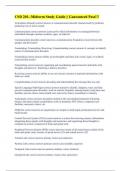
Articulation Disorder correct answers a communication disorder characterized by problems producing one or more sounds Communication correct answers a process by which information is exchanged between individuals through common symbols, signs, or behavior Communication disorder correct answers a communication breakdown exists between the speaker and the listener Formulating, Transmitting, Receiving, Comprehending correct answers 4 concepts to identify nature of communication disorders Formulating correct answers ability to put thoughts and ideas into words, signs, or symbols (can't put into words) Transmitting correct answers organizing and coordinating speech muscles and limbs with thoughts and ideas (ex. Stuttering-a fluency disorder) Receiving correct answers ability to use our sensory systems to transmit information to the brain (ex. deaf) Comprehending correct answers decoding and understanding the message that was sent Speech Language Pathologist correct answers trained to identify, diagnose, treat, and help prevent communication disorders; work in schools, hospitals, nursing homes, long-term care facilities, private clinics, home health care, university clinics, consultants to industry Audiologist correct answers specialists trained in the non-medical treatment of hearing, balance and other related ear problems; work in hospitals, ENT offices, outpatient care facilities, university clinics, etc. NSSLHA correct answers an organization on campus to help begin professional service and build resume Central Nervous System (CNS) correct answers a system for receiving sensory information, integrating these signals with thoughts and memories, and organizing these thoughts to complete an action; comprised of brain and spinal cord Peripheral Nervous System (PNS) correct answers consist of all neural tissue outside of the brain and spinal cord; consists of spinal nerves (31) and cranial nerves (12) Frontal Lobe correct answers primary motor area (anterior) Parietal Lobe correct answers primary sensory area (middle, superior) Temporal Lobe correct answers primary auditory cortex (inferior) Occipital Lobe correct answers primary visual cortex (posterior)

Geschreven voor
- Instelling
- CSD 201
- Vak
- CSD 201
Documentinformatie
- Geüpload op
- 1 augustus 2024
- Aantal pagina's
- 4
- Geschreven in
- 2024/2025
- Type
- Tentamen (uitwerkingen)
- Bevat
- Vragen en antwoorden
Onderwerpen
-
articulation disorder

Ook beschikbaar in voordeelbundel