
31 Jan 2023
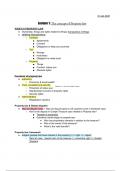
Lecture 1: The concept of Property law
WHAT IS PROPERTY LAW
● Ownership, things and rights related to things; transactions of things
● Defining characteristics:
○ Contract
■ Agreements
■ Consent
■ Obligations to keep your promise
○ Tort
■ Wrongs
■ involuntary
■ Obligation to make hood
○ Property
■ Things
■ Consent, status quo
■ Absolute rights
Functions of property law
● autonomy
○ Economic & social wealth
● Trust, consistency & security Status quo —) the current state of things
○ Protection of status quo
○ Standardised consent of property rights
○ Security rights
● Administration
○ Registration systems
Property law & Global disputes
● Nazi art dispute case -> Nazi art dispute goes to US supreme court in landmark case
○ How is the dispute in Guelph Treasure case related to Property law?
■ Transfer of ownership
■ Questions centre-stage in property law:
● Who has proprietary interests in relation to the treasure?
● Who is the owner of the treasure?
● What is the valid transfer?
Property law: framework
● subject (people that have interest in the property) >>> right >>> object
○ Nazi art case: Jewish heirs of the treasure >> ownership right >> Guelph
Treasure
, ■ Problem: whether the art was stolen or not - especially because of the
period when the transaction took place (Nazis and Jews are involved) >>
if there was a normal and valid transaction then its ok; if the property was
stolen then its problematic
How is the dispute in Guelph Treasure case releated to Property law?
- the following Qs are centre-stage in property law:
● who has proprietary interests in relation to the treasure?
● Who is the owner of the treasure?
● Was there a valid transfer?
Interplay between Property law & other fields of law in the Guelph treasure case
● connected to all: The nazi art case relates to property based on different aspects. 1. Title and
ownership: establishing the original ownership of art looted by the nazis is
○ contract law crucial as many pieces were stolen or sold under duress. 2. Statutes of
limitations: legal systems often have time limits for reclaiming stolen property,
○ succession law but special exceptions are sometimes made for nazi-looted art. 3. Restitution
○ law of limitations & prescription and repatriation: legal and ethical frameworks, including international
conventions, guide the return of stole act to rightful owners. 4. Provenance
○ procedural law & evidence research: detailed historical research is needed to trace the ownership
history of artworks. 5. Litigation and settlements: many disputes are resolved
○ conflict of laws through court cases or settlements, balancing legal ownership and ethical
considerations. These elements highlight the intersection of historical justice
■ Lex rei sitae; and property law principles In addressing the restitution of nazi-looted art.
■ 1976 Foreign Sovereign Immunities Act (private international law)
What does this case law show us?
- property law may be at the center of global disputes
- But it is (almost) always grounded in a local jurisdiction
- No subject to many unifying or harmonizing efforts by formal supranational regulation or
informal methods
Property law in global setting
- property law may be at the center of global disputes, but law applicable by courts are
laws where the object is situated >> lex rei sitae
- Property law traditionally national law Lex rei sitae is a
legal principle in
- National property law systems are very closed: large part mandatory law with little party property law that
autonomy as it involves the interests of 3rd parties determines that th
law governing the
ownership and
transfer of propert
Property right: global…but grounded in a local jurisdiction (further example) is the law of the
place where the
● Jurisdiction in cross-border claims (EU) property is located
It further dictates
○ Brussels I-bis Regulation (Regulation 1215/2012) — Art 24: Exclusive jurisdiction that the legal rules
applicable to real
■ “The following courts of a MS shall have exclusive jurisdiction, regardless property (real
estate) are those o
of the domicile of the parties: the jurisdiction in
which the property
● (1) in proceedings which have as their object rights in rem in is located.
immovable property or tenancies of immovable property, the
courts of the MS in which the property is situated“
● Applicable law in cross-border claims (EU)
, ○ Rome I Regulation (Regulation 593/2008) — Art 4(1): Applicable law in case of
absence of choice
■ “(C) a contract relating to a right in rem in immovable property or to a
tenancy of immovable property shall be governed by the law of the
country where the property is situated“ >> lex rei sitae
Draft Common frame of reference — proposed Common European Rules
- project covering mostly matters of law of obligations and contract law — insight into what
European private law rules could look like — soft law instrument — ‘toolbox’ for future
legislation
- Some aspects of Property law: transfer of ownership of movable, personal property
security rights & trust (Book VIII, IX, X)
- Book VIII — introduces a system of transfer of ownership of movable objects
(does not deal with immovables or land)
- Book IX — unitary model of security rights; creates a new type of limited property
rights (European Security Right)
- Book X — civil law trust mainly of contractual nature; significantly influenced by
English law, but adapted to function in more civil law-oriented systems;
intermediate version between German & French mechanism (Treuhand &
Fiducie)
Movable or immovable object of property law
- How about a statue or a piece of art?
- Is it an immovable or movable object for Property Law?
- FR:
- Art 571 CC: things (biens) are immovable, by their nature, buy their purpose, or
through the object to which they apply
- Art 527 CC: things are movable by their nature or by operation of the law
- Art 525 CC: the owner is deemed to have attached to his property movable
effects for perpetual residence, when they are sealed therein with plaster or
lime or cement, or when they cannot be detached without being fractured or
damaged, or without breaking or damaging the part of the fund to which they are
attached
- The mirrors of an apartment are supposed to be put in perpetual
residence when the floor on which they are attached becomes one with
the woodwork
- The same applies to paintings and other ornaments
- as for the statutes, they are immovable when they are places in a niche
made expressly to receive them, although they can be removed without
fracture or deterioration
- GER:
- S 93 BGB - Essential part of a thing: Parts of a thing that cannot be separated
without one or the other being destroyed or undergoing a change of nature
(essential parts) cannot be the subject of separate rights
, - S 94(2) - essential parts of a plot of land or a building: the essential parts of a
building include the things inserted in order to construct the building
- S 95(2) - merely temporary purpose: things that are inserted into a building for a
temporary purpose are not parts of the building
- S 97(1) - accessories: accessories are movable things that, without being parts of
the main thing, are intended to serve the economic purpose of the main thing and
are in a spatial relationship to it that corresponds to this intention. A thing is not
an accessory if it is not regarded as an accessory in business dealings
- NL:
- Art 3:3 BW:
(1) Immovable are the land (…)as well as the buildings and construction that
are permanently connected to the land, either directly or through
combination with other buildings or constructions
(2) Movable are all objects that are not immovable
- Art 3:4 BW:
(1) All that according to common opinion constitutes part of an object, is
component of that object
(2) An object that is connected with a principal object in such a way that
it cannot be separated without significant damage being done to one of
the objects, becomes a component part of the principal object
- Art 5:3: (…) owner of an object is the owner of all its components
- Art 5:14:
(1) ownership of a movable object that becomes a component of another
movable object that can be regarded as the principal object, passes to the
owner of the principal object
- Art 5:20: (1) ownership of the land includes (…)
- (e) buildings and constructions that are permanently connected to the
S
land, either directly, or through incorporation with other building and
constructions
- ENG:
- Property >> land
- What objects does the property rights include?
- Land, house & objects viewed as part of the land >> Elitestone Ltd v Morris
(1997) 1 WLR 687, HL
- Chattel (something independent of the land ⇒ not covered by property
right in the land)
- Fixture (something attached to the land ⇒ covered by property right in the
land)
- Part & parcel of the land itself (e.g. house)
- Sculpture: Tower Hamlets LBC v Bromley LBC (2015) EWHC 1954 ⇒ Norris
J: “Sculpture is an entire object in itself. It rested by its own weight upon the
ground and could be (and was) removed without damage and without diminishing
its inherent beauty. It might adorn or beautify a location, but it was not in any real
sense dependent upon that location“
Lecture 1: The concept of Property law
WHAT IS PROPERTY LAW
● Ownership, things and rights related to things; transactions of things
● Defining characteristics:
○ Contract
■ Agreements
■ Consent
■ Obligations to keep your promise
○ Tort
■ Wrongs
■ involuntary
■ Obligation to make hood
○ Property
■ Things
■ Consent, status quo
■ Absolute rights
Functions of property law
● autonomy
○ Economic & social wealth
● Trust, consistency & security Status quo —) the current state of things
○ Protection of status quo
○ Standardised consent of property rights
○ Security rights
● Administration
○ Registration systems
Property law & Global disputes
● Nazi art dispute case -> Nazi art dispute goes to US supreme court in landmark case
○ How is the dispute in Guelph Treasure case related to Property law?
■ Transfer of ownership
■ Questions centre-stage in property law:
● Who has proprietary interests in relation to the treasure?
● Who is the owner of the treasure?
● What is the valid transfer?
Property law: framework
● subject (people that have interest in the property) >>> right >>> object
○ Nazi art case: Jewish heirs of the treasure >> ownership right >> Guelph
Treasure
, ■ Problem: whether the art was stolen or not - especially because of the
period when the transaction took place (Nazis and Jews are involved) >>
if there was a normal and valid transaction then its ok; if the property was
stolen then its problematic
How is the dispute in Guelph Treasure case releated to Property law?
- the following Qs are centre-stage in property law:
● who has proprietary interests in relation to the treasure?
● Who is the owner of the treasure?
● Was there a valid transfer?
Interplay between Property law & other fields of law in the Guelph treasure case
● connected to all: The nazi art case relates to property based on different aspects. 1. Title and
ownership: establishing the original ownership of art looted by the nazis is
○ contract law crucial as many pieces were stolen or sold under duress. 2. Statutes of
limitations: legal systems often have time limits for reclaiming stolen property,
○ succession law but special exceptions are sometimes made for nazi-looted art. 3. Restitution
○ law of limitations & prescription and repatriation: legal and ethical frameworks, including international
conventions, guide the return of stole act to rightful owners. 4. Provenance
○ procedural law & evidence research: detailed historical research is needed to trace the ownership
history of artworks. 5. Litigation and settlements: many disputes are resolved
○ conflict of laws through court cases or settlements, balancing legal ownership and ethical
considerations. These elements highlight the intersection of historical justice
■ Lex rei sitae; and property law principles In addressing the restitution of nazi-looted art.
■ 1976 Foreign Sovereign Immunities Act (private international law)
What does this case law show us?
- property law may be at the center of global disputes
- But it is (almost) always grounded in a local jurisdiction
- No subject to many unifying or harmonizing efforts by formal supranational regulation or
informal methods
Property law in global setting
- property law may be at the center of global disputes, but law applicable by courts are
laws where the object is situated >> lex rei sitae
- Property law traditionally national law Lex rei sitae is a
legal principle in
- National property law systems are very closed: large part mandatory law with little party property law that
autonomy as it involves the interests of 3rd parties determines that th
law governing the
ownership and
transfer of propert
Property right: global…but grounded in a local jurisdiction (further example) is the law of the
place where the
● Jurisdiction in cross-border claims (EU) property is located
It further dictates
○ Brussels I-bis Regulation (Regulation 1215/2012) — Art 24: Exclusive jurisdiction that the legal rules
applicable to real
■ “The following courts of a MS shall have exclusive jurisdiction, regardless property (real
estate) are those o
of the domicile of the parties: the jurisdiction in
which the property
● (1) in proceedings which have as their object rights in rem in is located.
immovable property or tenancies of immovable property, the
courts of the MS in which the property is situated“
● Applicable law in cross-border claims (EU)
, ○ Rome I Regulation (Regulation 593/2008) — Art 4(1): Applicable law in case of
absence of choice
■ “(C) a contract relating to a right in rem in immovable property or to a
tenancy of immovable property shall be governed by the law of the
country where the property is situated“ >> lex rei sitae
Draft Common frame of reference — proposed Common European Rules
- project covering mostly matters of law of obligations and contract law — insight into what
European private law rules could look like — soft law instrument — ‘toolbox’ for future
legislation
- Some aspects of Property law: transfer of ownership of movable, personal property
security rights & trust (Book VIII, IX, X)
- Book VIII — introduces a system of transfer of ownership of movable objects
(does not deal with immovables or land)
- Book IX — unitary model of security rights; creates a new type of limited property
rights (European Security Right)
- Book X — civil law trust mainly of contractual nature; significantly influenced by
English law, but adapted to function in more civil law-oriented systems;
intermediate version between German & French mechanism (Treuhand &
Fiducie)
Movable or immovable object of property law
- How about a statue or a piece of art?
- Is it an immovable or movable object for Property Law?
- FR:
- Art 571 CC: things (biens) are immovable, by their nature, buy their purpose, or
through the object to which they apply
- Art 527 CC: things are movable by their nature or by operation of the law
- Art 525 CC: the owner is deemed to have attached to his property movable
effects for perpetual residence, when they are sealed therein with plaster or
lime or cement, or when they cannot be detached without being fractured or
damaged, or without breaking or damaging the part of the fund to which they are
attached
- The mirrors of an apartment are supposed to be put in perpetual
residence when the floor on which they are attached becomes one with
the woodwork
- The same applies to paintings and other ornaments
- as for the statutes, they are immovable when they are places in a niche
made expressly to receive them, although they can be removed without
fracture or deterioration
- GER:
- S 93 BGB - Essential part of a thing: Parts of a thing that cannot be separated
without one or the other being destroyed or undergoing a change of nature
(essential parts) cannot be the subject of separate rights
, - S 94(2) - essential parts of a plot of land or a building: the essential parts of a
building include the things inserted in order to construct the building
- S 95(2) - merely temporary purpose: things that are inserted into a building for a
temporary purpose are not parts of the building
- S 97(1) - accessories: accessories are movable things that, without being parts of
the main thing, are intended to serve the economic purpose of the main thing and
are in a spatial relationship to it that corresponds to this intention. A thing is not
an accessory if it is not regarded as an accessory in business dealings
- NL:
- Art 3:3 BW:
(1) Immovable are the land (…)as well as the buildings and construction that
are permanently connected to the land, either directly or through
combination with other buildings or constructions
(2) Movable are all objects that are not immovable
- Art 3:4 BW:
(1) All that according to common opinion constitutes part of an object, is
component of that object
(2) An object that is connected with a principal object in such a way that
it cannot be separated without significant damage being done to one of
the objects, becomes a component part of the principal object
- Art 5:3: (…) owner of an object is the owner of all its components
- Art 5:14:
(1) ownership of a movable object that becomes a component of another
movable object that can be regarded as the principal object, passes to the
owner of the principal object
- Art 5:20: (1) ownership of the land includes (…)
- (e) buildings and constructions that are permanently connected to the
S
land, either directly, or through incorporation with other building and
constructions
- ENG:
- Property >> land
- What objects does the property rights include?
- Land, house & objects viewed as part of the land >> Elitestone Ltd v Morris
(1997) 1 WLR 687, HL
- Chattel (something independent of the land ⇒ not covered by property
right in the land)
- Fixture (something attached to the land ⇒ covered by property right in the
land)
- Part & parcel of the land itself (e.g. house)
- Sculpture: Tower Hamlets LBC v Bromley LBC (2015) EWHC 1954 ⇒ Norris
J: “Sculpture is an entire object in itself. It rested by its own weight upon the
ground and could be (and was) removed without damage and without diminishing
its inherent beauty. It might adorn or beautify a location, but it was not in any real
sense dependent upon that location“



