Principles and practice of Human Pathology – Lecture 16 + 17 (21-6-2018):
Tissue preparation & techniques
Specimen handling is necessary, in order to maintain the morphology and in order for
the following techniques to work.
Identification and interpretation:
Macroscopic features = the outside, looking at an organ, describing what can be
seen
Microscopic features = taking a piece out of the tissue and analyze it under the
microscope
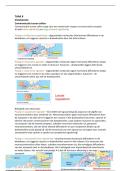
When there is proteinuria, the line of bowman’s capsule (around the glomerulus)
increases in thickness.
Distal tubule: flat cells, lumen is bigger
Proximal tubule: high and active cells, lumen is occupied with microvilli (brush
borders).
Interstitium: the space/environment between the tubuli and the glomeruli.
The TBM’s (tubular basement membranes) are very thick, but they need to be thin.
The line is very thick, meaning that there has been inflammation, which will
eventually result in scar tissue.
A biopsy will be taken out of the cortex of the kidney, otherwise you will never see the
glomerulus.
Orientation: how a tissue is cut on macroscopical level. In the skin orientation is very
important. If you cut into a kidney or liver, no matter how you cut it, you will always
see the same characteristic structures.
When you have a stained slide, the condenser should be up.
When you have an unstained slide, the condenser should be down.
Köhleren is very important when looking at microscopical slides.
Resolution LM vs. EM:
LM: 0,1um
EM: 0,1nm
The average cell in the human body is 7um.
Differences TBM and GBM – under microscope:
Tubular basement membrane and glomerular basement membrane
In the TBM there is a lamina rara interna + densa
In the GBM there is also a lamina interna (collagen IV 1-2), densa (collagen IV 3-4) +
an extra layer lamina externa (collagen IV 5-6), thus the GBM is thicker, because it
consists out of 3 layers.
, Every technique has its own problems and creates its own artefacts! You always
have to ask yourself what the right answer is. The fixative causes shrinkage of the
endothelial fenestration artefact.
Critical point drying (CPD) cells will not shrink, because the fixative will not go
through the critical point.
With use of immunohistochemistry (localization), you can easily recognize where in
the slide, different cells are with use of antibodies.
If you want to look at the activity of cells, you can use enzymehistochemistry
(activity).
Due to suction during biopsy of the kidney, it is possible to have the glomerulus being
sucked into the tubule artefact.
3D reconstruction:
Parietal epithelial cells (PECs) are proliferating and penetrate into the tuft, and
podocytes are disappearing. ??
4th dimension is very important during experiments. different experiments/different
time points/different mice/biopsy at different time points
Morphology and resolution:
Necrosis: cell death in the body!!
Autolysis: cell death out of the body!! E.g. in a biopsy.
Why do you get autolysis of a biopsy? Oxygen delivery stops, non-oxidative
phosphorylation occurs acid lactate pH drops disfunctioning of organelles
membranes of all the organelles will be damaged and the peroxisomes will come into
the cytoplasm, destructing everything.
How to stop this? by freezing everything (physical fixation) or by using alcohol, etc
(chemical fixation).
Tissue preparation & techniques
Specimen handling is necessary, in order to maintain the morphology and in order for
the following techniques to work.
Identification and interpretation:
Macroscopic features = the outside, looking at an organ, describing what can be
seen
Microscopic features = taking a piece out of the tissue and analyze it under the
microscope
When there is proteinuria, the line of bowman’s capsule (around the glomerulus)
increases in thickness.
Distal tubule: flat cells, lumen is bigger
Proximal tubule: high and active cells, lumen is occupied with microvilli (brush
borders).
Interstitium: the space/environment between the tubuli and the glomeruli.
The TBM’s (tubular basement membranes) are very thick, but they need to be thin.
The line is very thick, meaning that there has been inflammation, which will
eventually result in scar tissue.
A biopsy will be taken out of the cortex of the kidney, otherwise you will never see the
glomerulus.
Orientation: how a tissue is cut on macroscopical level. In the skin orientation is very
important. If you cut into a kidney or liver, no matter how you cut it, you will always
see the same characteristic structures.
When you have a stained slide, the condenser should be up.
When you have an unstained slide, the condenser should be down.
Köhleren is very important when looking at microscopical slides.
Resolution LM vs. EM:
LM: 0,1um
EM: 0,1nm
The average cell in the human body is 7um.
Differences TBM and GBM – under microscope:
Tubular basement membrane and glomerular basement membrane
In the TBM there is a lamina rara interna + densa
In the GBM there is also a lamina interna (collagen IV 1-2), densa (collagen IV 3-4) +
an extra layer lamina externa (collagen IV 5-6), thus the GBM is thicker, because it
consists out of 3 layers.
, Every technique has its own problems and creates its own artefacts! You always
have to ask yourself what the right answer is. The fixative causes shrinkage of the
endothelial fenestration artefact.
Critical point drying (CPD) cells will not shrink, because the fixative will not go
through the critical point.
With use of immunohistochemistry (localization), you can easily recognize where in
the slide, different cells are with use of antibodies.
If you want to look at the activity of cells, you can use enzymehistochemistry
(activity).
Due to suction during biopsy of the kidney, it is possible to have the glomerulus being
sucked into the tubule artefact.
3D reconstruction:
Parietal epithelial cells (PECs) are proliferating and penetrate into the tuft, and
podocytes are disappearing. ??
4th dimension is very important during experiments. different experiments/different
time points/different mice/biopsy at different time points
Morphology and resolution:
Necrosis: cell death in the body!!
Autolysis: cell death out of the body!! E.g. in a biopsy.
Why do you get autolysis of a biopsy? Oxygen delivery stops, non-oxidative
phosphorylation occurs acid lactate pH drops disfunctioning of organelles
membranes of all the organelles will be damaged and the peroxisomes will come into
the cytoplasm, destructing everything.
How to stop this? by freezing everything (physical fixation) or by using alcohol, etc
(chemical fixation).