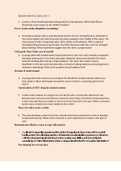
Homolegeous mixture Moles & Particles
A
• uniform composition & properties throughout Ideal Gas equation Titrations
• ex; air, bronze particles • to determine the concentration of unknown solution
Heterogenous mixture
•
•
non-uniform composition, properties are not the same throughout
ex; concrete, orange juice
-Te constant
· •
•
equipment: graduated pipettes, volumetric pipettes,
brunette (± 0.05 cm^3)
EQUIVALENCE POINT: when the 2 solutions have
I
Gas law relationships reacted completely
Separating mixtures
• air —-> fractional dissipation Moles & Mass
Smaa 2
• salt & sand —-> solution & filtration ·
P Pat
• pigments in food colours —-> paper chromatography
• sulfur & iron —-> use a magnet ~
moles
1
Ionic equations 1 gmol- V T
• shows only the ions or other particles taking part in a reaction, without spectator
ions
Excess & Limiting reactants Temp
State changes
• excess of one or more reactant (excess)
·
vaporising
melting
#
GAS
D
·
Fiening
concensin
• LIMITING REACTANT: not excess reactant
e
• Calculating limiting reactant: number of moles of
reactants, ration of reactants in the equation p
Deposition
The Mole Percentage Yield Real gases
• Avogadro’s constant (Na or L): number of particles equivalent to the percentage -
actual yield
-100
-
relative atomic mass or molecular mass (in grams) yield yield A
theoretical 200k
~
- = 6.02 x 10^23 g/mol Avogadro's law
• Molar mass: the mass of a substance with this number of particles • STP = 273 K, 100 kPa
• 1 mole = atoms in 12.00g of nC • 1 mole (STP) of gas = 22.7 dm^3 I 500k
-
- 6.02 x 10^23 of 12-C = mass of 12.00g • units: dm^3/mol K
Relative mass Molar Gas volume -100
e
----------- ideal
RELATIVE ATOMIC MASS:
-
gas
• weighted average mass of one atom compared to 1/12 of 12-C
• Determined by weighted average mass of isotopes
moles Te Pressure
Heightedaverage massofono ↳
er is
Ar =
&d high pressure
,
at low temp
RELATIVE ISOTOPIC MASS: Concentrations of Solutions
• mass of a particular atom of an atom compared to 1/12 mass of 12-C real gases deviate significantly
·
• ISOTOPES: atoms of the same element with a different neutron number
Relative
from ideal gas
Elisotope abundances relative isotopic mas o
atomic =
100
RELATIVE MOLECULAR MASS, Mr
• weighted average mass of a molecule compared to 1/12 mass of 12-C tration X solution
(dm3)
Mr
weighted average mass of one molecule (g/dm3))
I
=
Ye mass of one atom of "C
A
• uniform composition & properties throughout Ideal Gas equation Titrations
• ex; air, bronze particles • to determine the concentration of unknown solution
Heterogenous mixture
•
•
non-uniform composition, properties are not the same throughout
ex; concrete, orange juice
-Te constant
· •
•
equipment: graduated pipettes, volumetric pipettes,
brunette (± 0.05 cm^3)
EQUIVALENCE POINT: when the 2 solutions have
I
Gas law relationships reacted completely
Separating mixtures
• air —-> fractional dissipation Moles & Mass
Smaa 2
• salt & sand —-> solution & filtration ·
P Pat
• pigments in food colours —-> paper chromatography
• sulfur & iron —-> use a magnet ~
moles
1
Ionic equations 1 gmol- V T
• shows only the ions or other particles taking part in a reaction, without spectator
ions
Excess & Limiting reactants Temp
State changes
• excess of one or more reactant (excess)
·
vaporising
melting
#
GAS
D
·
Fiening
concensin
• LIMITING REACTANT: not excess reactant
e
• Calculating limiting reactant: number of moles of
reactants, ration of reactants in the equation p
Deposition
The Mole Percentage Yield Real gases
• Avogadro’s constant (Na or L): number of particles equivalent to the percentage -
actual yield
-100
-
relative atomic mass or molecular mass (in grams) yield yield A
theoretical 200k
~
- = 6.02 x 10^23 g/mol Avogadro's law
• Molar mass: the mass of a substance with this number of particles • STP = 273 K, 100 kPa
• 1 mole = atoms in 12.00g of nC • 1 mole (STP) of gas = 22.7 dm^3 I 500k
-
- 6.02 x 10^23 of 12-C = mass of 12.00g • units: dm^3/mol K
Relative mass Molar Gas volume -100
e
----------- ideal
RELATIVE ATOMIC MASS:
-
gas
• weighted average mass of one atom compared to 1/12 of 12-C
• Determined by weighted average mass of isotopes
moles Te Pressure
Heightedaverage massofono ↳
er is
Ar =
&d high pressure
,
at low temp
RELATIVE ISOTOPIC MASS: Concentrations of Solutions
• mass of a particular atom of an atom compared to 1/12 mass of 12-C real gases deviate significantly
·
• ISOTOPES: atoms of the same element with a different neutron number
Relative
from ideal gas
Elisotope abundances relative isotopic mas o
atomic =
100
RELATIVE MOLECULAR MASS, Mr
• weighted average mass of a molecule compared to 1/12 mass of 12-C tration X solution
(dm3)
Mr
weighted average mass of one molecule (g/dm3))
I
=
Ye mass of one atom of "C