
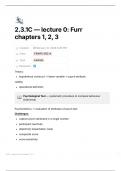
2.3.1C — lecture 0: Furr
chapters 1, 2, 3
Created February 12, 2024 826 PM
Class FSWP2052A
Type Lecture
Reviewed
Theory:
hypothetical construct → latent variable → psych attribute
validity
operational definition
Psychological Test — systematic procedure to compare behaviour
(inter/intra)
Psychometrics → evaluation of attributes of psych test
Challenges:
capture psych attributes in a single number
participant reactivity
objectivity (expectation, bias)
composite score
score sensitivity
2.3.1C lecture 0 Furr chapters 1, 2, 3 1
, lack of awareness of psych info
Scaling
amount of smth
Psychological Measurement — process through which numbers are
assigned to represent quantities of psychological attributes.
Scaling — the way numerical values are assigned to psychological attributes.
Numbers:
label
identical
mutually exclusive
exhaustive — everyone in one category
order
quantity
arbitrary 0 just a value on a scale
absolute 0 doesnʼt exist
0 on a test 0 WM capacity
Scales:
nominal → little info
ordinal
interval — arbitrary 0
ratio — absolute 0 more info
Psychological attributes usually only arbitrary in unit size!
2.3.1C lecture 0 Furr chapters 1, 2, 3 2
, Issues with numbers in social sciences:
Do “measurement unitsˮ correspond to equal amounts of an attribute
(additivity)?
We want our measure to be affected by only one attribute of what we are
measuring, regardless of the conditions that exist at the time or place of
measurement.
Paradox: we want to translate the amount of a psychological attribute onto a
set of numbers in order to measure the attribute. But we do not know how
much of the attribute actually exists, because we cannot observe the
psychological attribute directly (how large is the difference between “very
goodˮ and “perfectˮ?
Variability
individual differences
heart of research
intraindividual differences
Central tendency:
mean
median
mode
Variability — how much scores spread around the mean.
variance
2.3.1C lecture 0 Furr chapters 1, 2, 3 3
, standerd deviation
Size of the variance depends on:
degree to which scores in the distribution differ
metric of the scores in the distribution
Covariance — info about the direction of the association between 2
factors
Correlation — info about direction and magnitude of association
Variance-covariance matrix
Persentile rank:
percentile rank → z-score → normalised score
2.3.1C lecture 0 Furr chapters 1, 2, 3 4
, 2.3.1C — lecture 2: Furr chapter
4
Created February 14, 2024 142 PM
Class FSWP2052A
Type Tutorial group meeting
Reviewed
TEST DIMENSIONALITY AND
FACTOR ANALYSIS
Dimensionality — how many factors are there on the test →
fundamental consideration in test development, evaluation, and use →
there are at least three fundamental psychometric questions regarding
the dimensionality of a test.
2.3.1C lecture 2 Furr chapter 4 1
chapters 1, 2, 3
Created February 12, 2024 826 PM
Class FSWP2052A
Type Lecture
Reviewed
Theory:
hypothetical construct → latent variable → psych attribute
validity
operational definition
Psychological Test — systematic procedure to compare behaviour
(inter/intra)
Psychometrics → evaluation of attributes of psych test
Challenges:
capture psych attributes in a single number
participant reactivity
objectivity (expectation, bias)
composite score
score sensitivity
2.3.1C lecture 0 Furr chapters 1, 2, 3 1
, lack of awareness of psych info
Scaling
amount of smth
Psychological Measurement — process through which numbers are
assigned to represent quantities of psychological attributes.
Scaling — the way numerical values are assigned to psychological attributes.
Numbers:
label
identical
mutually exclusive
exhaustive — everyone in one category
order
quantity
arbitrary 0 just a value on a scale
absolute 0 doesnʼt exist
0 on a test 0 WM capacity
Scales:
nominal → little info
ordinal
interval — arbitrary 0
ratio — absolute 0 more info
Psychological attributes usually only arbitrary in unit size!
2.3.1C lecture 0 Furr chapters 1, 2, 3 2
, Issues with numbers in social sciences:
Do “measurement unitsˮ correspond to equal amounts of an attribute
(additivity)?
We want our measure to be affected by only one attribute of what we are
measuring, regardless of the conditions that exist at the time or place of
measurement.
Paradox: we want to translate the amount of a psychological attribute onto a
set of numbers in order to measure the attribute. But we do not know how
much of the attribute actually exists, because we cannot observe the
psychological attribute directly (how large is the difference between “very
goodˮ and “perfectˮ?
Variability
individual differences
heart of research
intraindividual differences
Central tendency:
mean
median
mode
Variability — how much scores spread around the mean.
variance
2.3.1C lecture 0 Furr chapters 1, 2, 3 3
, standerd deviation
Size of the variance depends on:
degree to which scores in the distribution differ
metric of the scores in the distribution
Covariance — info about the direction of the association between 2
factors
Correlation — info about direction and magnitude of association
Variance-covariance matrix
Persentile rank:
percentile rank → z-score → normalised score
2.3.1C lecture 0 Furr chapters 1, 2, 3 4
, 2.3.1C — lecture 2: Furr chapter
4
Created February 14, 2024 142 PM
Class FSWP2052A
Type Tutorial group meeting
Reviewed
TEST DIMENSIONALITY AND
FACTOR ANALYSIS
Dimensionality — how many factors are there on the test →
fundamental consideration in test development, evaluation, and use →
there are at least three fundamental psychometric questions regarding
the dimensionality of a test.
2.3.1C lecture 2 Furr chapter 4 1



