Summary #7 Night, night
Theories of sleep
o Recuperative theories
= during wakefulness homeostasis is interrupted. Sleep is necessary to reestablish
homeostasis
Reset energy levels
Clear brain/body from toxins to prevent accumulation
Criticism
Sloth’s do not spend much energy, but sleep a lot
No ‘catching up’ after sleep deprivation
o Adaptation theories
= animals are programmed to sleep (internal timing mechanism)
Human sleeping pattern is caused by danger of activity during the night, rather
save energy for the day
Sleep has no physiological function
Criticism
Risk life for some sleep must have physiological benefit
If sleep wasn’t crucial it would have died out (natural selection)
Recuperative theories predict serious health/performance disturbance as consequence of
sleep deprivation
However, despite the strong urge to sleep the consequences are variable, mild & selective
(mainly stressed in Pinel)
This point is especially proven in studies who focused on selecting healthy (no stressed)
individuals.
Some consequences
Increased sleepiness microsleeps (2-3 sec of decreased responsiveness)
Negative affect on mood
Poor performance in tests of attention
Increasing evidence for
decreased performance on
executive functioning
(innovative, insightful,
creative thinking)
Negative effect on blood
pressure & immune
functioning not necessarily
serious health consequences
Stages of sleep
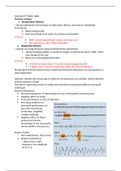
o Alert wakefulness: beta waves
o Relaxed wakefulness
= alpha waves, high
frequency, low amplitude
8-12 Hz
, 1. Theta waves, some alpha waves, high frequency & low voltage, slower than (relaxed)
wakefulness.
3.5-7.5 Hz
2. Increasing voltage & decreasing frequency
o K complex
= upward and downward deflection
o Sleep spindle
= burst of 9-15 Hz waves (0.5-3 sec)
Sleep spindles play a role in consolidation of memories,
+ sleep spindles are correlated with + scores on tests of intelligence
3. Largest and slowest waves with some delta waves (1-2 Hz)
Relaxation/hard to wake up
4. Largest and slowest waves with delta waves more than 50% of the time (1-2 Hz)
Heart/blood/breathing/temperature lowest
Gradually progress from stage 1 to 4 by increase amplitude & decreasing frequency. Once
stage 4 is reached the progression back to phase 1 starts. (this cycle takes 90 mins & go
through it 4/5 times)
Stage 3&4 = slow wave sleep (SWS)
Falling asleep initial phase 1
After reaching phase 4 returning to phase 1:
emergent phase 1
= accompanied by
o Rapid Eye Movements (REM)
o loss of muscle tone
o activity of autonomic nervous system
o muscle twitches
o cerebral activity (resembles wakefulness)
o erections
o activity in pons, limbic, parietal, temporal
o brief periods wakefulness (often not remembered)
Approach morning more REM sleep
controversy surrounding REM sleep
o REM to oxygenate eyes?
o REM and memory (but they can be dissociated)
o Default theory
= staying in NREM is hard, thus revisit REM (close to wakefulness/alertness)
o REM and dreams
REM deprivation
o Initiate REM sequence more often
o REM rebound (catching up of REM sleep) REM serves purpose (default, close
to/prepares for wakefulness, defensing)
o REM may be substituted by 15 minutes of wakefulness
Theories of sleep
o Recuperative theories
= during wakefulness homeostasis is interrupted. Sleep is necessary to reestablish
homeostasis
Reset energy levels
Clear brain/body from toxins to prevent accumulation
Criticism
Sloth’s do not spend much energy, but sleep a lot
No ‘catching up’ after sleep deprivation
o Adaptation theories
= animals are programmed to sleep (internal timing mechanism)
Human sleeping pattern is caused by danger of activity during the night, rather
save energy for the day
Sleep has no physiological function
Criticism
Risk life for some sleep must have physiological benefit
If sleep wasn’t crucial it would have died out (natural selection)
Recuperative theories predict serious health/performance disturbance as consequence of
sleep deprivation
However, despite the strong urge to sleep the consequences are variable, mild & selective
(mainly stressed in Pinel)
This point is especially proven in studies who focused on selecting healthy (no stressed)
individuals.
Some consequences
Increased sleepiness microsleeps (2-3 sec of decreased responsiveness)
Negative affect on mood
Poor performance in tests of attention
Increasing evidence for
decreased performance on
executive functioning
(innovative, insightful,
creative thinking)
Negative effect on blood
pressure & immune
functioning not necessarily
serious health consequences
Stages of sleep
o Alert wakefulness: beta waves
o Relaxed wakefulness
= alpha waves, high
frequency, low amplitude
8-12 Hz
, 1. Theta waves, some alpha waves, high frequency & low voltage, slower than (relaxed)
wakefulness.
3.5-7.5 Hz
2. Increasing voltage & decreasing frequency
o K complex
= upward and downward deflection
o Sleep spindle
= burst of 9-15 Hz waves (0.5-3 sec)
Sleep spindles play a role in consolidation of memories,
+ sleep spindles are correlated with + scores on tests of intelligence
3. Largest and slowest waves with some delta waves (1-2 Hz)
Relaxation/hard to wake up
4. Largest and slowest waves with delta waves more than 50% of the time (1-2 Hz)
Heart/blood/breathing/temperature lowest
Gradually progress from stage 1 to 4 by increase amplitude & decreasing frequency. Once
stage 4 is reached the progression back to phase 1 starts. (this cycle takes 90 mins & go
through it 4/5 times)
Stage 3&4 = slow wave sleep (SWS)
Falling asleep initial phase 1
After reaching phase 4 returning to phase 1:
emergent phase 1
= accompanied by
o Rapid Eye Movements (REM)
o loss of muscle tone
o activity of autonomic nervous system
o muscle twitches
o cerebral activity (resembles wakefulness)
o erections
o activity in pons, limbic, parietal, temporal
o brief periods wakefulness (often not remembered)
Approach morning more REM sleep
controversy surrounding REM sleep
o REM to oxygenate eyes?
o REM and memory (but they can be dissociated)
o Default theory
= staying in NREM is hard, thus revisit REM (close to wakefulness/alertness)
o REM and dreams
REM deprivation
o Initiate REM sequence more often
o REM rebound (catching up of REM sleep) REM serves purpose (default, close
to/prepares for wakefulness, defensing)
o REM may be substituted by 15 minutes of wakefulness