Summary #2 emotions
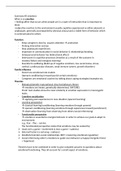
What is an emotion
= feeling/affect that occurs when people are in a state of interaction that is important to
them
=subjective reaction to the environment usually cognitive experienced as either pleasant or
unpleasant, generally accompanied by physical arousal and a visible form of behavior which
is communicated to others
Function
- Keep caregivers close by, acquire attention protection
- Prolong interaction and joy
- Stop unpleasant experiences
- Important in communication in social behavior & relationships/bonding
(interpersonal behavior has bidirectional effect)
- Interwoven in cognitive processes (emotion as a result of the outcome in
mastery/failure and energizes learning)
- Essential to wellbeing (Build-up of negative emotions, low social status, stress,
cortisol, cardiovascular diseases, weak immune system, growth disorders)
Family influence
- Parent are emotional role models
- Operant conditioning (reward/punish certain emotions)
- Caregivers are emotional coaches by talking about coping strategies/examples etc.
Theories
- Biological/genetic-maturational view/evolutionary theory
emotions are innate, genetically determined. (NATURE)
Proof: twin studies show the most similarity in emotion expression in monozygotic
twins.
- Cognitive socialization
applying past experiences to new situation (operant learning)
- Learning perspective
classical learning/conditioning (learning emotions through parents)
operant conditioning (learning emotions through experience/reward/punishment)
observation (learning from observing from others/social referencing)
- Functionalist perspective
emotion is essential to energize behavior in order to achieve our goals & adapt to
environment
e.g.; fear – flee – survive
The functionalist perspective states that emotions may be evoked by:
Goals (win a game = excitement & lose a game = sadness)
External factors (a sad song = sadness)
Establish/maintain social relationships (KEY= mastering emotional regulation)
Social referencing other’s emotions to guide own behavior (a happy/energetic friend
= happiness)
Theories have to be combined in order to give complete answers to questions about
emotional functioning. They all account for a small aspect of emotions.
, Expressing emotion
Primary/basic emotions
= emotions that are innate and present from birth onwards. They do not require any
form of introspection. Cross-culturally observed.
Contentment
Disgust present from birth onward, cross cultural, interpreted in same manner
Interest
Distress
Anger
Fear
Happiness/joy present 2-7 months after birth (in healthy babies)
Sadness
Surprise
Function of basic emotions:
- Reach a desired goal (survival, attention, soothing, bonding)
- Communicate with parents
Special developments:
- Reflexive smile, shown during REM sleep, caused by internal stimuli, adaptive value
to keep caregiver close by.
- Social smile (develops in week 6-10) & laughter (3-4 months) to external stimuli
- Smile and laugh most with caregiver + bonding
- Crying as physiological reaction (lungs fill with air) later as communicative measure
Basic cry (hunger)
Angry cry
Pain cry
Fear
- Appears at 6 months (3 months in abusive households) keeps exploration in check
- Peaks at 18 months
- Stranger anxiety
= fear of strangers (9-12 months), which is influenced by social referencing,
appearance/behavior of stranger (child or adult), context (at home or in novel
environment), previous experience, presence of mom (secure base), number of
caregivers (kids raised in communal society have less stranger anxiety), thus also
culturally dependent, how much a child can control/predict the situation.
- Separation protest
= distress that is experienced when caregiver leaved the infant (peaks at 15 months),
stable across cultures.
Happiness
- 6-10 weeks : social smiling
- 3-4 months : laughter
- 10-12 months: different types of laughter (varies with context)
What is an emotion
= feeling/affect that occurs when people are in a state of interaction that is important to
them
=subjective reaction to the environment usually cognitive experienced as either pleasant or
unpleasant, generally accompanied by physical arousal and a visible form of behavior which
is communicated to others
Function
- Keep caregivers close by, acquire attention protection
- Prolong interaction and joy
- Stop unpleasant experiences
- Important in communication in social behavior & relationships/bonding
(interpersonal behavior has bidirectional effect)
- Interwoven in cognitive processes (emotion as a result of the outcome in
mastery/failure and energizes learning)
- Essential to wellbeing (Build-up of negative emotions, low social status, stress,
cortisol, cardiovascular diseases, weak immune system, growth disorders)
Family influence
- Parent are emotional role models
- Operant conditioning (reward/punish certain emotions)
- Caregivers are emotional coaches by talking about coping strategies/examples etc.
Theories
- Biological/genetic-maturational view/evolutionary theory
emotions are innate, genetically determined. (NATURE)
Proof: twin studies show the most similarity in emotion expression in monozygotic
twins.
- Cognitive socialization
applying past experiences to new situation (operant learning)
- Learning perspective
classical learning/conditioning (learning emotions through parents)
operant conditioning (learning emotions through experience/reward/punishment)
observation (learning from observing from others/social referencing)
- Functionalist perspective
emotion is essential to energize behavior in order to achieve our goals & adapt to
environment
e.g.; fear – flee – survive
The functionalist perspective states that emotions may be evoked by:
Goals (win a game = excitement & lose a game = sadness)
External factors (a sad song = sadness)
Establish/maintain social relationships (KEY= mastering emotional regulation)
Social referencing other’s emotions to guide own behavior (a happy/energetic friend
= happiness)
Theories have to be combined in order to give complete answers to questions about
emotional functioning. They all account for a small aspect of emotions.
, Expressing emotion
Primary/basic emotions
= emotions that are innate and present from birth onwards. They do not require any
form of introspection. Cross-culturally observed.
Contentment
Disgust present from birth onward, cross cultural, interpreted in same manner
Interest
Distress
Anger
Fear
Happiness/joy present 2-7 months after birth (in healthy babies)
Sadness
Surprise
Function of basic emotions:
- Reach a desired goal (survival, attention, soothing, bonding)
- Communicate with parents
Special developments:
- Reflexive smile, shown during REM sleep, caused by internal stimuli, adaptive value
to keep caregiver close by.
- Social smile (develops in week 6-10) & laughter (3-4 months) to external stimuli
- Smile and laugh most with caregiver + bonding
- Crying as physiological reaction (lungs fill with air) later as communicative measure
Basic cry (hunger)
Angry cry
Pain cry
Fear
- Appears at 6 months (3 months in abusive households) keeps exploration in check
- Peaks at 18 months
- Stranger anxiety
= fear of strangers (9-12 months), which is influenced by social referencing,
appearance/behavior of stranger (child or adult), context (at home or in novel
environment), previous experience, presence of mom (secure base), number of
caregivers (kids raised in communal society have less stranger anxiety), thus also
culturally dependent, how much a child can control/predict the situation.
- Separation protest
= distress that is experienced when caregiver leaved the infant (peaks at 15 months),
stable across cultures.
Happiness
- 6-10 weeks : social smiling
- 3-4 months : laughter
- 10-12 months: different types of laughter (varies with context)