Brain, hormones & metabolism.
Lecture 1 Cellular and anatomical structure nervous system.
Major anatomical structures.
• Horizontal plane
• Sagittal plane
• Coronal plane (connection between left and right hemisphere is visible → how parts
communicate with each other)
• Continuous communication among cortical lobes: corpus callosum (axons which go from one
part of the brain to another)
• Cortex:
- Exterior dark gray matter (cell bodies, dendrites, blood vessels)
- Underneath white matter (axons with myelin sheets)
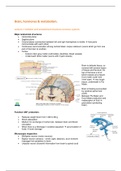
Brain is delicate tissue, so
covered with several layers
of tissue and the skull. On
top of the bone a lot of
blood vessels are present.
Dura mater (outer and
inner layer) → very tough
tissue, underneath is Pia
Mater.
Brain is floating surrounded
by cerebral spinal fluid
(CSF).
Between Pia Mater and
Dura Mater production and
reabsorption of fluid →
granulation (protecting
brain).
Function CSF: protection.
• Reduces weight brain from 1400 to 80 g
• Shock absorption
• Medium for exchange of nutrient etc. between brain and blood
circulation.
• When there is a blockage in cerebral aquaduct → accumulation of
fluids → brain damage
Microscopic inspection.
• Multipolar neuron (motor neurons)
• Bipolar neuron (sensory – smell, sight, balance), axon transmit
message from periphery to brain
• Unipolar neuron (transmit information from brain to spinal cord)
,Overview of the synaptic connections between neurons.
• Most neurons have one axon, but axon divides into several branches: axon collaterals.
• Configuration of synapses on dendrite changes continuously as dendrites change shape,
synapses come and go: neural plasticity (contact between dendrite and cell body is never
fixed!)
• Axons make contact with dendrites via terminal buttons.
• Dendrites can also make synaptic connections with other dendrites.
• As most axons divide and branch many times.
• Neuron receives thus information from many other neurons, which receive input again from
other neurons.
Glucose usage brain.
Brain is only organ that does not depend on insulin for glucose uptake.
During the day the brain is continuously active, but the amount of glucose intake fluctuates. In order to
have a steady amount of glucose present, insulin is not needed. It is immediately taken up.
Neurones cannot store glucose in the form of glycogen.
Supporting cells – central nervous system (neuroglia).
Astrocytes.
• = modified neurons
• Phagocytosis (dispose of remnants of dead synapses)
• Nourishment (glucose, lactate, glycogen storage)
• Nerve glue, involved in formation new synapses and pruning surplus synapses → remove
synapses that are no longer necessary/functional)
, • Control composition neuronal extracellular fluid: role in epilepsy (changed neuronal
excitability)
• Surround synapses – limiting dispersion neurotransmitter
• Communication between neurons
• Swelling in case of brain damage – edema
• 17% of brains glial cells
Microglia.
• Phagocytosis, migrate to site of injury.
• Key component in neural pain system.
• Maintentance of synapses; interference with this function is related to Alzheimer and other
dementias – target for treatment Alzheimer
• 7% of brains glial cells
Oligodendrocytes.
• Produce myelin sheets (for multiple axons of multiple neurons)
• Myelin = 80% lipid, 20% protein
• Node of Ranvier: places where no myelin sheets are present (one oligodendrocyte stops
producing myelin sheets and another has to take over).
• Defect in myelination – e.g. MS
• Loss in oligodendrocytes – linked to onset schizophrenia
• Not all axons are lined by myelin sheets
• 75% of brains glial cells
Supporting cells central nervous system – integration.
Ependymal cells: produce cerebral spinal fluid
(cover the walls of the ventricles)
Supporting cells – peripheral nervous system.
Schwann cells.
• Myelin from one node of Ranvier to other
• Re-growth axon
• Support non-myelinated axons
• Difference from oligodendrocytes:
- Schwann cells only support one axon → multiple layers of plasma membrane
(condensed, packed layer)
• Play an important role in regrowth of axons, better than oligodendrocytes (tubes are more
straight forward, because only one Schwann cell is involved)
, Comparison supporting cells CNS and PNS.
Clinical application characteristics.
Facial transplants and regeneration of PNS: regrowth of peripheral axons.
Anatomy of the brain.
Human brain – cortex.
• Gyri = brain tissue itself
• Sulci = surroundings of brain areas
→ Increase in cortex volume
• Cortex seat of complex cognition
Lecture 1 Cellular and anatomical structure nervous system.
Major anatomical structures.
• Horizontal plane
• Sagittal plane
• Coronal plane (connection between left and right hemisphere is visible → how parts
communicate with each other)
• Continuous communication among cortical lobes: corpus callosum (axons which go from one
part of the brain to another)
• Cortex:
- Exterior dark gray matter (cell bodies, dendrites, blood vessels)
- Underneath white matter (axons with myelin sheets)
Brain is delicate tissue, so
covered with several layers
of tissue and the skull. On
top of the bone a lot of
blood vessels are present.
Dura mater (outer and
inner layer) → very tough
tissue, underneath is Pia
Mater.
Brain is floating surrounded
by cerebral spinal fluid
(CSF).
Between Pia Mater and
Dura Mater production and
reabsorption of fluid →
granulation (protecting
brain).
Function CSF: protection.
• Reduces weight brain from 1400 to 80 g
• Shock absorption
• Medium for exchange of nutrient etc. between brain and blood
circulation.
• When there is a blockage in cerebral aquaduct → accumulation of
fluids → brain damage
Microscopic inspection.
• Multipolar neuron (motor neurons)
• Bipolar neuron (sensory – smell, sight, balance), axon transmit
message from periphery to brain
• Unipolar neuron (transmit information from brain to spinal cord)
,Overview of the synaptic connections between neurons.
• Most neurons have one axon, but axon divides into several branches: axon collaterals.
• Configuration of synapses on dendrite changes continuously as dendrites change shape,
synapses come and go: neural plasticity (contact between dendrite and cell body is never
fixed!)
• Axons make contact with dendrites via terminal buttons.
• Dendrites can also make synaptic connections with other dendrites.
• As most axons divide and branch many times.
• Neuron receives thus information from many other neurons, which receive input again from
other neurons.
Glucose usage brain.
Brain is only organ that does not depend on insulin for glucose uptake.
During the day the brain is continuously active, but the amount of glucose intake fluctuates. In order to
have a steady amount of glucose present, insulin is not needed. It is immediately taken up.
Neurones cannot store glucose in the form of glycogen.
Supporting cells – central nervous system (neuroglia).
Astrocytes.
• = modified neurons
• Phagocytosis (dispose of remnants of dead synapses)
• Nourishment (glucose, lactate, glycogen storage)
• Nerve glue, involved in formation new synapses and pruning surplus synapses → remove
synapses that are no longer necessary/functional)
, • Control composition neuronal extracellular fluid: role in epilepsy (changed neuronal
excitability)
• Surround synapses – limiting dispersion neurotransmitter
• Communication between neurons
• Swelling in case of brain damage – edema
• 17% of brains glial cells
Microglia.
• Phagocytosis, migrate to site of injury.
• Key component in neural pain system.
• Maintentance of synapses; interference with this function is related to Alzheimer and other
dementias – target for treatment Alzheimer
• 7% of brains glial cells
Oligodendrocytes.
• Produce myelin sheets (for multiple axons of multiple neurons)
• Myelin = 80% lipid, 20% protein
• Node of Ranvier: places where no myelin sheets are present (one oligodendrocyte stops
producing myelin sheets and another has to take over).
• Defect in myelination – e.g. MS
• Loss in oligodendrocytes – linked to onset schizophrenia
• Not all axons are lined by myelin sheets
• 75% of brains glial cells
Supporting cells central nervous system – integration.
Ependymal cells: produce cerebral spinal fluid
(cover the walls of the ventricles)
Supporting cells – peripheral nervous system.
Schwann cells.
• Myelin from one node of Ranvier to other
• Re-growth axon
• Support non-myelinated axons
• Difference from oligodendrocytes:
- Schwann cells only support one axon → multiple layers of plasma membrane
(condensed, packed layer)
• Play an important role in regrowth of axons, better than oligodendrocytes (tubes are more
straight forward, because only one Schwann cell is involved)
, Comparison supporting cells CNS and PNS.
Clinical application characteristics.
Facial transplants and regeneration of PNS: regrowth of peripheral axons.
Anatomy of the brain.
Human brain – cortex.
• Gyri = brain tissue itself
• Sulci = surroundings of brain areas
→ Increase in cortex volume
• Cortex seat of complex cognition