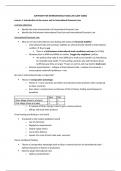
SUMMARY FOR INTERNATIONAL FOOD LAW (LAW-31806)
Lecture 1: Introduction to the course and to International Economic Law
Learning objectives
Identify the main characteristics of International Economic Law
Identify the link between International Food Law and International Economic Law
International Economic Law
Why do we have international rules dealing with trade and financial stability?
o International trade and monetary stability are almost directly related to international
conflicts thus to war
There is a link between international trade conditions and wars (in 1940s)
o Situation prior to WWI and WWII are similar, ‘beggar thy neighbour’ policies
Are policies that make it more difficult to trade across borders, by introducing
for example trade tariffs surrounding countries also will introduce these
tariffs because they are angry goes on and on and may lead to trade wars
o Extreme protectionism = collapse of international trade = collapse of economies +
some popular nationalist politicians = war
But why is international trade so important?
Theory of comparative advantage:
o Theory is = some countries are better at producing certain products when compared
to other countries
o Even when a country loses out because of this in theory trading would always be
beneficial
Deer Fish
Deer village (close to a forest) 2 4
Fish village (close to a lake) 4 2
o #: amount of time/ energy/ costs to get a certain products
o Will go and trade their products
From hunting and fishing to real world
Translated to the modern globalised world
o Use of chemicals
o Regulatory requirements
o Global supply chains
o Just in time delivery
o Impact of a crisis (Covid, trade wars, real war)
Classic neoliberal thinking
Theory of comparative advantage leads to idea to remove barriers to international trade –
optimal allocation of factors of production
Need to adopt international rules
o Address protectionism
, o Address diversity in standards
o Prevent race to the bottom
Trade agreements
Trade agreements target the reactions by states to transnational problems associated with
free trade
o Global: the WTO
o Bilateral (two States only): CETA, EU – Vietnam, etc.
o Regional: EU, USMCA, TPP, ASEAN, etc.
o Super-regional: Regional Comprehensive Economic Partnership (China, Australia,
New Zealand, Republic of Korea, possibly India) and TTIP (EU and US, not agreed
upon)
How does that translate to trade in agricultural products?
Agricultural products are sensitive
In 1947 no one was thinking about the environment
In 1990 still no one was thinking about the environment
Consequence, WTO law (most recent update in the 1990’s) inadequately deals with the
interaction between trade and the environment (exception ground)
o System is outdated
This is in my opinion one of the great challenges that need to be solved
Summary International Economic Law
What is International Economic Law?
o It stands for a complex regulatory framework flowing from different of law
governing international economic relations and economic conduct by States,
International Organizations and private actors
o It deals with economic relations between States, not within a State
o A series of rules which are binding for subjects, i.e. sanctions for non-compliance
(hard law)
States are sovereign: cannot dictate them what to do if states sign a
Treaty (= hard law) they have to adhere to those in international law it is
actually hard to ‘bind’ States but they usually adhere
o There is an emerging set of rules that are not binding but where exist advantages to
comply with (soft law)
E.g. guidelines/ recommendations
International economic law is hard to pin point there are a lot of branches in law that
interact with each other
o E.g. States can be bind by treaties regarding environmental law and treaties related
to international economic law
o Problem: sometimes these treaties do not match Which one proceeds the other
one? complex regulatory framework
,International Economic Law and interactions with other areas of law
Various sectors of international economic law, in particular international trade law and
investment law, stand in close interaction with other legal regimes
International rules on economic transactions may overlap/conflict with other rules that aim
at different purpose like:
o the protection of the environment
o the promotion of sustainable development
o the achievement of consumers' health International Economic Law
Under customary International law States are free to opt for or against economic relations
with other countries. As the International Court of Justice (ICJ) put it in the Military and
Paramilitary Activities in and against Nicaragua Case (Nicaragua v United States) [1986]
A State is not bound to continue particular trade relations longer than it sees fit to do so, in
the absence of a treaty commitment or other specific legal obligation (para. 276)
Therefore, bilateral and multilateral treaties are the primary sources of international law
governing transboundary movement of persons in the context of economic activities
Actors of International Economic Law
States (as subjects of law and as subjects of the economy)
International Organizations and other forms of Intergovernmental Cooperation (IMF, World
Bank, WTO, OECD, EU, ILO, FAO)
Non-Governmental Organizations (NGOs) (International) Chamber of Commerce (ICC), the
International Air Transport Association (IATA))
Transnational Corporations
WTO and Domestic Law
There are a number of legal issues about the relationship of
international law to domestic law, and the broader landscape
of these issues can be quite complex. For example, consider
how a State internally allocates its power regarding treaty-
making, how it manages treaty implementing, and how it
treats treaties in its domestic law.
The European Union generally provides a structure for treaty negotiation, ratification, and
implementation that is much more complex than that of many of WTO member States.
Lecture 2: Institutional aspects and dispute settlement of the WTO
, Learning objectives
Identify the most important aspects of the WTO as an international organisation
Understand the main purposes of the WTO
Understand the relevance of the WTO settlement mechanism
Institutional vs substantive law
Institutional law: Organs needed to ensure ga substantive law is enforced (Dutch
government/ parliament making the law
o e.g. How the WTO is set up? (its organs etc.)
Substantive law: The law (rules/ norms) that need to be followed (criminal code)
o e.g. The actual rules in WTO law
1. The creation and functions of the WTO
The international community failed to establish an international organisation for trade at
the end of the 1940s:
o Charter establishing an International Trade Organisation (1948) never came into
force (refusal US senate, because it would hurt their sovereignty)
o World Bank (1944) and International Monetary Fund (1945)
General Agreement on Tariffs and Trade 1947 (GATT 1947)
o Treaty that tries to lower trade barriers!
o Multilateral agreement for the reduction of tariffs and other trade barriers was
applied provisionally
o De facto international organisation for trade for nearly 50 years – power based
GATT was very power based (dominant States dictated)
WTO is more rules based (dispute settlement dictate the rules)
o Reduction of custom duties = tariffs (especially for industrial products)
For most products became 0
o THEREFORE non-tariffs barriers to trade became problem (not particularly regulated)
Prime example is (zero) quota
E.g. in Belgian round butter containers in Netherlands square butter
containers FBO has to have 2 machines, cost Monet these types of
non-tariff barriers (packaging) could become a problem
o Need for an organisation to regulate complex trade relations!
Creation WTO
Established under the WTO Agreement signed on 15 April 1994 in Marrakesh (Marocco) as a
result of the Uruguay Round of multilateral trade negotiations (1986-1993)
WTO operational since 1 January 1995 young organisation, nut among the most influential
international intergovernmental organisations
o GATT falls under he WTO Agreement
WTO Agreement Preamble (= introduction)
Lecture 1: Introduction to the course and to International Economic Law
Learning objectives
Identify the main characteristics of International Economic Law
Identify the link between International Food Law and International Economic Law
International Economic Law
Why do we have international rules dealing with trade and financial stability?
o International trade and monetary stability are almost directly related to international
conflicts thus to war
There is a link between international trade conditions and wars (in 1940s)
o Situation prior to WWI and WWII are similar, ‘beggar thy neighbour’ policies
Are policies that make it more difficult to trade across borders, by introducing
for example trade tariffs surrounding countries also will introduce these
tariffs because they are angry goes on and on and may lead to trade wars
o Extreme protectionism = collapse of international trade = collapse of economies +
some popular nationalist politicians = war
But why is international trade so important?
Theory of comparative advantage:
o Theory is = some countries are better at producing certain products when compared
to other countries
o Even when a country loses out because of this in theory trading would always be
beneficial
Deer Fish
Deer village (close to a forest) 2 4
Fish village (close to a lake) 4 2
o #: amount of time/ energy/ costs to get a certain products
o Will go and trade their products
From hunting and fishing to real world
Translated to the modern globalised world
o Use of chemicals
o Regulatory requirements
o Global supply chains
o Just in time delivery
o Impact of a crisis (Covid, trade wars, real war)
Classic neoliberal thinking
Theory of comparative advantage leads to idea to remove barriers to international trade –
optimal allocation of factors of production
Need to adopt international rules
o Address protectionism
, o Address diversity in standards
o Prevent race to the bottom
Trade agreements
Trade agreements target the reactions by states to transnational problems associated with
free trade
o Global: the WTO
o Bilateral (two States only): CETA, EU – Vietnam, etc.
o Regional: EU, USMCA, TPP, ASEAN, etc.
o Super-regional: Regional Comprehensive Economic Partnership (China, Australia,
New Zealand, Republic of Korea, possibly India) and TTIP (EU and US, not agreed
upon)
How does that translate to trade in agricultural products?
Agricultural products are sensitive
In 1947 no one was thinking about the environment
In 1990 still no one was thinking about the environment
Consequence, WTO law (most recent update in the 1990’s) inadequately deals with the
interaction between trade and the environment (exception ground)
o System is outdated
This is in my opinion one of the great challenges that need to be solved
Summary International Economic Law
What is International Economic Law?
o It stands for a complex regulatory framework flowing from different of law
governing international economic relations and economic conduct by States,
International Organizations and private actors
o It deals with economic relations between States, not within a State
o A series of rules which are binding for subjects, i.e. sanctions for non-compliance
(hard law)
States are sovereign: cannot dictate them what to do if states sign a
Treaty (= hard law) they have to adhere to those in international law it is
actually hard to ‘bind’ States but they usually adhere
o There is an emerging set of rules that are not binding but where exist advantages to
comply with (soft law)
E.g. guidelines/ recommendations
International economic law is hard to pin point there are a lot of branches in law that
interact with each other
o E.g. States can be bind by treaties regarding environmental law and treaties related
to international economic law
o Problem: sometimes these treaties do not match Which one proceeds the other
one? complex regulatory framework
,International Economic Law and interactions with other areas of law
Various sectors of international economic law, in particular international trade law and
investment law, stand in close interaction with other legal regimes
International rules on economic transactions may overlap/conflict with other rules that aim
at different purpose like:
o the protection of the environment
o the promotion of sustainable development
o the achievement of consumers' health International Economic Law
Under customary International law States are free to opt for or against economic relations
with other countries. As the International Court of Justice (ICJ) put it in the Military and
Paramilitary Activities in and against Nicaragua Case (Nicaragua v United States) [1986]
A State is not bound to continue particular trade relations longer than it sees fit to do so, in
the absence of a treaty commitment or other specific legal obligation (para. 276)
Therefore, bilateral and multilateral treaties are the primary sources of international law
governing transboundary movement of persons in the context of economic activities
Actors of International Economic Law
States (as subjects of law and as subjects of the economy)
International Organizations and other forms of Intergovernmental Cooperation (IMF, World
Bank, WTO, OECD, EU, ILO, FAO)
Non-Governmental Organizations (NGOs) (International) Chamber of Commerce (ICC), the
International Air Transport Association (IATA))
Transnational Corporations
WTO and Domestic Law
There are a number of legal issues about the relationship of
international law to domestic law, and the broader landscape
of these issues can be quite complex. For example, consider
how a State internally allocates its power regarding treaty-
making, how it manages treaty implementing, and how it
treats treaties in its domestic law.
The European Union generally provides a structure for treaty negotiation, ratification, and
implementation that is much more complex than that of many of WTO member States.
Lecture 2: Institutional aspects and dispute settlement of the WTO
, Learning objectives
Identify the most important aspects of the WTO as an international organisation
Understand the main purposes of the WTO
Understand the relevance of the WTO settlement mechanism
Institutional vs substantive law
Institutional law: Organs needed to ensure ga substantive law is enforced (Dutch
government/ parliament making the law
o e.g. How the WTO is set up? (its organs etc.)
Substantive law: The law (rules/ norms) that need to be followed (criminal code)
o e.g. The actual rules in WTO law
1. The creation and functions of the WTO
The international community failed to establish an international organisation for trade at
the end of the 1940s:
o Charter establishing an International Trade Organisation (1948) never came into
force (refusal US senate, because it would hurt their sovereignty)
o World Bank (1944) and International Monetary Fund (1945)
General Agreement on Tariffs and Trade 1947 (GATT 1947)
o Treaty that tries to lower trade barriers!
o Multilateral agreement for the reduction of tariffs and other trade barriers was
applied provisionally
o De facto international organisation for trade for nearly 50 years – power based
GATT was very power based (dominant States dictated)
WTO is more rules based (dispute settlement dictate the rules)
o Reduction of custom duties = tariffs (especially for industrial products)
For most products became 0
o THEREFORE non-tariffs barriers to trade became problem (not particularly regulated)
Prime example is (zero) quota
E.g. in Belgian round butter containers in Netherlands square butter
containers FBO has to have 2 machines, cost Monet these types of
non-tariff barriers (packaging) could become a problem
o Need for an organisation to regulate complex trade relations!
Creation WTO
Established under the WTO Agreement signed on 15 April 1994 in Marrakesh (Marocco) as a
result of the Uruguay Round of multilateral trade negotiations (1986-1993)
WTO operational since 1 January 1995 young organisation, nut among the most influential
international intergovernmental organisations
o GATT falls under he WTO Agreement
WTO Agreement Preamble (= introduction)