

Summary: 3.4 A&ective Disorders
Lectures
Depression I
Major Depressive Disorder
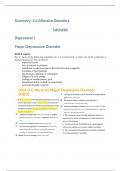
DSM-5 criteria
five or more of the following symptoms for a 2-week period; at least one of the symptoms is
depressed mood or loss of interest
- depressed mood
- loss of interest or pleasure
- significant weight loss/gain or decrease/increase in appetite
- insomnia or hypersomnia
- psychomotor agitation or retardation
- fatigue of loss of energy
- feelings of worthlessness, guilt
- diminished ability to think or concentrate
- recurrent thoughts of death
,Persistent Depressive Disorder
- the chronic but less intense version of depression
- depressed mood for at least 2 years
beware of the wording differences between DSM-5 criteria for MDD and Persistent Depressive
Disorder (intensity is important)
Comparison b/w MDD and PDD
à Duration of Symptoms
• MDD: at least 2 weeks
• Dysthymia: at least 2 years
à Severity
• MDD: more severe, stronger impact on a person’s life
• Dysthymia: chronic but milder form, less impact on a person’s life (but still significant)
à Pattern/Course
• MDD: distinct periods without symptoms
• Dysthymia: can fluctuate in intensity but are consistently present
à Episodes
• MDD: may experience recurrent episodes throughout life
• Dysthymia + periods of more severe symptoms that meet the criteria for MDD à
“double depression”
Theories on Depression
Contemporary Integrative Interpersonal Theory (CIIT)
• Humans are social creatures
o interpersonal aspect of our lives
• grounded in personality theory
• many forms of psychopathology are associated with interpersonal impairment, not
only depression
, • seeks to explain the emergence, expression, and maintenance of interpersonal
functioning and dysfunction
• the field of psychopathology is shifting towards understanding psychopathology using
dimensions
o don’t need discrete categories, i.e., diagnoses
• therapeutic alliance (TA) and therapeutic outcome – can be explained through CIIT
Assumptions of CIIT:
1. the most important expressions of personality occur in interpersonal situations
2. interpersonal functioning can be divided into two dimensions – agency and
communion
3. the interpersonal circumplex model organises interpersonal functioning across three
different levels of experience
• motives – do I want to be in control? do I want to have a loving relationship with
others?
• traits – dominant/nurture?
• behaviour – predicted by motives and traits
4. satisfying agentic and communal motives drives interpersonal behaviour
Learning Goals for Weeks 1 and 2:
• Identify the characteristics of Major Depressive Disorder (MDD)
• Distinguish between depressive symptoms and other emotional states
• Identify various etiologies (causes) of MDD
• Compare and distinguish different features of MDD including:
o Prevalence and development of MDD
o Risk and prognostic factors in MDD
o Culture- and sex-/gender-related diagnostic issues in MDD
• Apply knowledge to clinical examples of MDD
• Evaluate, compare and distinguish various theoretical models explaining MDD
• Evaluate, compare and distinguish various treatment models for MDD
serotonin theory à know the theory + main pro/against arguments
Lectures
Depression I
Major Depressive Disorder
DSM-5 criteria
five or more of the following symptoms for a 2-week period; at least one of the symptoms is
depressed mood or loss of interest
- depressed mood
- loss of interest or pleasure
- significant weight loss/gain or decrease/increase in appetite
- insomnia or hypersomnia
- psychomotor agitation or retardation
- fatigue of loss of energy
- feelings of worthlessness, guilt
- diminished ability to think or concentrate
- recurrent thoughts of death
,Persistent Depressive Disorder
- the chronic but less intense version of depression
- depressed mood for at least 2 years
beware of the wording differences between DSM-5 criteria for MDD and Persistent Depressive
Disorder (intensity is important)
Comparison b/w MDD and PDD
à Duration of Symptoms
• MDD: at least 2 weeks
• Dysthymia: at least 2 years
à Severity
• MDD: more severe, stronger impact on a person’s life
• Dysthymia: chronic but milder form, less impact on a person’s life (but still significant)
à Pattern/Course
• MDD: distinct periods without symptoms
• Dysthymia: can fluctuate in intensity but are consistently present
à Episodes
• MDD: may experience recurrent episodes throughout life
• Dysthymia + periods of more severe symptoms that meet the criteria for MDD à
“double depression”
Theories on Depression
Contemporary Integrative Interpersonal Theory (CIIT)
• Humans are social creatures
o interpersonal aspect of our lives
• grounded in personality theory
• many forms of psychopathology are associated with interpersonal impairment, not
only depression
, • seeks to explain the emergence, expression, and maintenance of interpersonal
functioning and dysfunction
• the field of psychopathology is shifting towards understanding psychopathology using
dimensions
o don’t need discrete categories, i.e., diagnoses
• therapeutic alliance (TA) and therapeutic outcome – can be explained through CIIT
Assumptions of CIIT:
1. the most important expressions of personality occur in interpersonal situations
2. interpersonal functioning can be divided into two dimensions – agency and
communion
3. the interpersonal circumplex model organises interpersonal functioning across three
different levels of experience
• motives – do I want to be in control? do I want to have a loving relationship with
others?
• traits – dominant/nurture?
• behaviour – predicted by motives and traits
4. satisfying agentic and communal motives drives interpersonal behaviour
Learning Goals for Weeks 1 and 2:
• Identify the characteristics of Major Depressive Disorder (MDD)
• Distinguish between depressive symptoms and other emotional states
• Identify various etiologies (causes) of MDD
• Compare and distinguish different features of MDD including:
o Prevalence and development of MDD
o Risk and prognostic factors in MDD
o Culture- and sex-/gender-related diagnostic issues in MDD
• Apply knowledge to clinical examples of MDD
• Evaluate, compare and distinguish various theoretical models explaining MDD
• Evaluate, compare and distinguish various treatment models for MDD
serotonin theory à know the theory + main pro/against arguments



