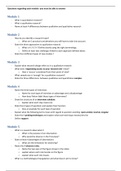
Questions regarding each module- you must be able to answer
Module 1
- What is quantitative research?
- What is qualitative research?
- Name at least 4 differences between qualitative and quatitative research
Module 2
- How do you identify a research topic?
o What are 2 practical considerations you will have to take into account.
- State the three approaches to qualitative research.
o What is X / X / X ? Define clearly using the right terminology.
o Define at least two challenges linked to each approach defined above.
- State the 4 different types of case studies ?
Module 3
- Explain what research design refers to in a qualitative research.
- What does ‘negotiating access to your research site’ mean?
o How is ‘access’ considered from their point of view?
- What sample size is ‘enough’ for a qualitative research?
- State the three differences between qualitative and quantitative samples
Module 4
- Name the three types of interviews
o Name for each type of interview an advantage and a disadvantage
o How does Patton label these types of interviews?
- Draw the structure of an interview schedule
o Explain what each step means (4)
- State the 6 types of questions and explain their function
o Give an example for each type of question
- Explain what the following terms mean with regard to question wording: open-ended, neutral, singular
- State the 4 probing techniques and explain what each technique means/aims for
- Define rapport
Module 5
- What is a research observation?
o What is the purpose of an observation.
o Why would be observe in the first place?
- State at least 4 advantages of observations
o What are the limitations for observing?
- Name the 4 observer roles.
o Name the two axes of the figure shown in the slides
o explain where each role locates on the figure
o explain what each role means.
- What is a methodological trangulation and what does it aim to show?
Module 1
- What is quantitative research?
- What is qualitative research?
- Name at least 4 differences between qualitative and quatitative research
Module 2
- How do you identify a research topic?
o What are 2 practical considerations you will have to take into account.
- State the three approaches to qualitative research.
o What is X / X / X ? Define clearly using the right terminology.
o Define at least two challenges linked to each approach defined above.
- State the 4 different types of case studies ?
Module 3
- Explain what research design refers to in a qualitative research.
- What does ‘negotiating access to your research site’ mean?
o How is ‘access’ considered from their point of view?
- What sample size is ‘enough’ for a qualitative research?
- State the three differences between qualitative and quantitative samples
Module 4
- Name the three types of interviews
o Name for each type of interview an advantage and a disadvantage
o How does Patton label these types of interviews?
- Draw the structure of an interview schedule
o Explain what each step means (4)
- State the 6 types of questions and explain their function
o Give an example for each type of question
- Explain what the following terms mean with regard to question wording: open-ended, neutral, singular
- State the 4 probing techniques and explain what each technique means/aims for
- Define rapport
Module 5
- What is a research observation?
o What is the purpose of an observation.
o Why would be observe in the first place?
- State at least 4 advantages of observations
o What are the limitations for observing?
- Name the 4 observer roles.
o Name the two axes of the figure shown in the slides
o explain where each role locates on the figure
o explain what each role means.
- What is a methodological trangulation and what does it aim to show?