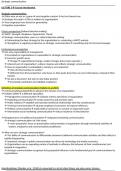
ST4 Exam Concepts List
Week 1: The Durkheimian Legacy: Culture as a Classification
Classification systems: a way in which people try to order their social world through
categories
Symbolic boundaries: conceptual distinctions made by social actors to categorise
objects, people, practices and even time and space
o This is what we call cultural boundaries
Culture: as classification systems and symbolic boundaries
Structure: as distribution of resources, social networks, institutions and material
environment.
Totemism: as belief and practice whereby groups identify themselves with a certain
“sacred” object
o The totem has a moral force over them (it is special and it should be treated
as such)
o Totem plays a double function:
Emblem of a group (the sacred object is a representation of the
collective)
Symbol of the sacred (concrete symbolisation of the abstract force of
society)
o The totem loads up the collective effervescence (becomes a reminder of the
collective energy)
Durkheim’s argument:
o Where do our fundamental categories of understanding come from?
They are learned and are necessary because these are social concepts,
collective representations. They are imprinted on us through our
social being, which we cannot escape.
Cognition of individuals is a reflection of their structure of social being
The ways we organise groups reflect the way we think
o Characteristics of group structure (social structure) -> characteristics of
classification system (culture)
o Example: Lamont’s Reading about the different cultural boundaries between
the US and France that are reflected upon their perception and legitimization
of “intellectuality”
British Structuralism (Radcliff Brown): social structure as observable, actual existing
relations
o Durkheimian conception focused on the structural aspect
o Disregarded ‘culture’ because, according to them, it is not a ‘concrete’ reality
French Structuralism (Levi-Strauss): Social structures as the realisation of cultural
codes or mental models
o Social structure cannot cause cultural classification
o Social structure (group division) is already a classification system (us/them)
, The relation between the 2 is not a causal one but a
metaphorical/analogical one.
Week 2: Structuralism and Semiotics
Clifford Geertz:
o Thick description: a way to analyse the context of an action in order to be
able to uncover the meaning behind it.
o it doesn’t look at the action as an empirical event but instead focuses on the
context as interpreted by the actor performing it.
Meaning emerges only in relation to the context of the action
That is why culture is ‘public’ because it happens in relation to one
another (it’s a social thing)
E.g., the winking example and the different interpretations of it
Jeffrey Alexander:
o Civil sphere: civil society is a sphere of solidarity in which individual rights
and collective obligations are tensely intertwined. (a moral, democratic and
utopian world)
Both a normative and ‘real’ concept.
For Alexander, in a civil society exists a socially established
consciousness, a network of understandings creating structures of
feelings that permeate social life
To study this subjective dimension, we need to focus on the
distinctive symbolic codes
o Binary codes: the discourse of the civil sphere
It is a ‘code’, a set of binary oppositions, a discursive structure that is
used to legitimate friends and delegitimate opponents
Establishes the sacred and profane, the democratic and
undemocratic
Allows people to understand what is good ONLY IN CONTRAST
to what is bad (De Saussure’s relationality of meaning)
o “A sign has meaning not because of its relation to the
world but because of its relation to other signs”
o “meaning is constituted through its differences with
the rest within a symbolic system.”
o The binary code is abstract and schematic but becomes concrete in stories,
myths, discourses, etc.
E.g., Wright’s analysis of Western narratives
o The binary discourse occurs at three levels:
Motives: What kind of people are necessary for viable democracies to
form?
Relations: Illegitimate or legitimate based on: How do such civil and
uncivil people get along?
Week 1: The Durkheimian Legacy: Culture as a Classification
Classification systems: a way in which people try to order their social world through
categories
Symbolic boundaries: conceptual distinctions made by social actors to categorise
objects, people, practices and even time and space
o This is what we call cultural boundaries
Culture: as classification systems and symbolic boundaries
Structure: as distribution of resources, social networks, institutions and material
environment.
Totemism: as belief and practice whereby groups identify themselves with a certain
“sacred” object
o The totem has a moral force over them (it is special and it should be treated
as such)
o Totem plays a double function:
Emblem of a group (the sacred object is a representation of the
collective)
Symbol of the sacred (concrete symbolisation of the abstract force of
society)
o The totem loads up the collective effervescence (becomes a reminder of the
collective energy)
Durkheim’s argument:
o Where do our fundamental categories of understanding come from?
They are learned and are necessary because these are social concepts,
collective representations. They are imprinted on us through our
social being, which we cannot escape.
Cognition of individuals is a reflection of their structure of social being
The ways we organise groups reflect the way we think
o Characteristics of group structure (social structure) -> characteristics of
classification system (culture)
o Example: Lamont’s Reading about the different cultural boundaries between
the US and France that are reflected upon their perception and legitimization
of “intellectuality”
British Structuralism (Radcliff Brown): social structure as observable, actual existing
relations
o Durkheimian conception focused on the structural aspect
o Disregarded ‘culture’ because, according to them, it is not a ‘concrete’ reality
French Structuralism (Levi-Strauss): Social structures as the realisation of cultural
codes or mental models
o Social structure cannot cause cultural classification
o Social structure (group division) is already a classification system (us/them)
, The relation between the 2 is not a causal one but a
metaphorical/analogical one.
Week 2: Structuralism and Semiotics
Clifford Geertz:
o Thick description: a way to analyse the context of an action in order to be
able to uncover the meaning behind it.
o it doesn’t look at the action as an empirical event but instead focuses on the
context as interpreted by the actor performing it.
Meaning emerges only in relation to the context of the action
That is why culture is ‘public’ because it happens in relation to one
another (it’s a social thing)
E.g., the winking example and the different interpretations of it
Jeffrey Alexander:
o Civil sphere: civil society is a sphere of solidarity in which individual rights
and collective obligations are tensely intertwined. (a moral, democratic and
utopian world)
Both a normative and ‘real’ concept.
For Alexander, in a civil society exists a socially established
consciousness, a network of understandings creating structures of
feelings that permeate social life
To study this subjective dimension, we need to focus on the
distinctive symbolic codes
o Binary codes: the discourse of the civil sphere
It is a ‘code’, a set of binary oppositions, a discursive structure that is
used to legitimate friends and delegitimate opponents
Establishes the sacred and profane, the democratic and
undemocratic
Allows people to understand what is good ONLY IN CONTRAST
to what is bad (De Saussure’s relationality of meaning)
o “A sign has meaning not because of its relation to the
world but because of its relation to other signs”
o “meaning is constituted through its differences with
the rest within a symbolic system.”
o The binary code is abstract and schematic but becomes concrete in stories,
myths, discourses, etc.
E.g., Wright’s analysis of Western narratives
o The binary discourse occurs at three levels:
Motives: What kind of people are necessary for viable democracies to
form?
Relations: Illegitimate or legitimate based on: How do such civil and
uncivil people get along?