EDF 6223 100% SOLUTION
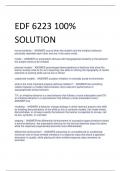
EDF 6223 100% SOLUTION formal similarity - ANSWER occurs when the model's and the imitator's behavior physically resemble each other and are in the same mode model - ANSWER an antecedent stimulus with topographical similarity to the behavior the analyst wants to be imitated planned models - ANSWER prearranged demonstrations of behavior that show the learner exactly what to do, be it acquiring new skills or refining the topography of certain elements of existing skills-can be live or filmed unplanned models - ANSWER occasion imitation in everyday social environments what is the most important property defining imitation? - ANSWER the controlling relation between a model's demonstration and a learner's performance of topographically similar behavior T/F: an imitative behavior is a new behavior that follows a novel antecedent eventT/F: an imitative behavior is a new behavior that follows a novel antecedent event - ANSWER true modeling - ANSWER a behavior change strategy in which learners acquire new skills by imitating demonstrations of the skills by live or symbolic models. the model shows, demonstrates, or conveys exactly the behavior the learner is expected to convey. can be live, symbolic, or recorded shaping - ANSWER the differential reinforcement of successive approximations toward a terminal behavior. the antecedent stimulus for the terminal behavior stays the same, while the response progressively becomes more differentiated differential reinforcement - ANSWER presenting an unconditioned or conditioned reinforcer only to those emitted members of a response class that share a specified dimension or quality, while placing all other emitted response class members on extinction performance dimensions that can be shaped - ANSWER 1. topography: refining motor movements 2. rate: increasing number of correct responses 3. latency: decreasing compliance time between a directive 4. duration: increasing time spent on task 5. IRT: reducing rapid eating 6. magnitude: increasing projected voice volume shaping guidelines - ANSWER 1. select the terminal behavior and define it precisely 2. determine the criterion for success 3. assess the response repertoire 4. identify behaviors to reinforce 5. eliminate interfering or extraneous stimuli 6. proceed gradually 7. limit the number of approximation at each level 8. continue to reinforce when terminal behavior is achieved behavior chain - ANSWER a linked sequence of responses leading to a terminal outcome. each response produces a stimulus change that functions as conditioned reinforcement for that response and as a discriminative stimulus for the next response in the chain. reinforcement for the last response in a chain maintains the reinforcing effectiveness of the stimulus changes produced by all previous responses in the chain 3 characteristics of behavior chains - ANSWER it involves the performance of a specific series of discrete responses; the performance of each behavior in the sequence produces a stimulus change in the environment in such a way that it yields conditioned reinforcement for the preceding response, and serves as an Sd for the next response; the responses within the chain must be performed in a specific sequence, and in close temporal succession behavior chain with a limited hold - ANSWER a chain that must be completed within a specified time to produce reinforcement. characterized by performance that is accurate and proficient (e.g., an assembly task on a production line). person must not only have the prerequisite behaviors in his/her repertoire, but also must emit those behaviors in close temporal succession to obtain reinforcement chaining - ANSWER refers to various methods for linking specific sequences of stimuli and responses to form new performances. taught to increase independent living skills, develop complex behaviors, and add behaviors to an existing behavior repertoire task analysis - ANSWER breaking a complex task into smaller, teachable units, the product of which is a series of sequentially ordered steps or tasks how to construct and validate task analyses? - ANSWER 1. observe a competent performer 2. execute the task yourself 3. get expert input 4. trial and error single-opportunity method - ANSWER designed to assess a learner's ability to perform each behavior in the task analysis in correct sequence. if a step is performed incorrectly or out of sequence, the probe is terminated and unfinished responses are scored as incorrect. provides less info to the teacher once instruction is initiated multiple opportunity method - ANSWER evaluates the learner's mastery across all the behaviors in the task analysis. if a step is performed incorrectly or out of sequence, or if the time limit for completing the step is exceeded, the behavior analyst completes that step for the learner and then positions her for the next step. each response performed correctly is scored as a correct response, even if the learner erred on the previous steps. teacher can learn which steps in the task analysis the learner has already mastered, thus eliminating the need to instruct steps already in the learner's repertoire forward chaining - ANSWER the behaviors identified in the task analysis are taught in their naturally occurring order. reinforcement is delivered when the predetermined criterion for the performance of the first behavior in the sequence is achieved. each succeeding step requires the cumulative performance of all previous steps in the correct order total-task chaining - ANSWER a variation of forward chaining in which the learner receives training on each step in the task analysis during every session. the trainer provides assistance for any steps the learner is unable to perform independently, and the chain is trained until the learner is able to perform all the behaviors in the sequence to the predetermined criter

Geschreven voor
- Instelling
- EDF
- Vak
- EDF
Documentinformatie
- Geüpload op
- 23 april 2024
- Aantal pagina's
- 8
- Geschreven in
- 2023/2024
- Type
- Tentamen (uitwerkingen)
- Bevat
- Vragen en antwoorden
Onderwerpen
-
edf 6223 100 soluti
-
edf 6223 100 solution

Ook beschikbaar in voordeelbundel