100% tevredenheidsgarantie Direct beschikbaar na je betaling Lees online óf als PDF Geen vaste maandelijkse kosten 4.2 TrustPilot
logo-home
Samenvatting

Lecture summary Interpersonal Communication

Beoordeling
-
Verkocht
-
Pagina's
51
Geüpload op
11-04-2024
Geschreven in
2022/2023

All important details from the lectures are in here! Lecture 1 -12


Oeps! We kunnen je document nu niet laden. Probeer het nog eens of neem contact op met support.

Documentinformatie

Geüpload op
11 april 2024
Aantal pagina's
51
Geschreven in
2022/2023
Type
Samenvatting

Onderwerpen

Voorbeeld van de inhoud

Interpersonal Communication

Lecture 1 – Introduction

Fundamental aspects of interpersonal communication

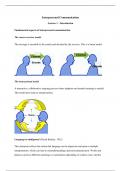
The source-receiver model

The message is encoded by the sender and decoded by the receiver. This is a linear model


The transactional model

A transactive, collaborative ongoing process where adaption and mutual meaning is needed.
This model also leads to interpretations.


Language is ambiguous! (Derek Bentley, 1952)

This statement reflects the notion that language can be imprecise and open to multiple
interpretations, which can lead to misunderstandings and miscommunication. Words and
phrases can have different meanings or connotations depending on context, tone, and the

,perspectives of the people involved in a conversation. This ambiguity in language is a
fundamental challenge in communication and often requires additional context or clarification
to convey intended meanings accurately.

Misinterpretations

 (unintentional) touch/eye contact
 Sexual overperception bias: the tendency to believe that others are more sexually
interested in you than they actually are (Haselton, 2003)

"It is a common misperception that language use has primarily to do with words and what
they mean. It does not. It has primarily to do with people and what they mean. It is essentially
about speakers' intentions” (Clark & Schober, 1992)

Context dimensions (mutual understanding):

 set induction
 physical environment
 temporal factors
 social psychological factors
o interpersonal relationship
o communication history
 culture
 type of situation


Behavior and mutual understanding

The behavior of conversation partners determines the course of conversations,
interdependence. Some important topics for this in IPC are nonverbal behavior, (non)verbal
dominance, questioning, reflecting, listening and response styles.

The medium and mutual understanding

Medium determines which (interactive) behavior is possible, which signals go back and forth.

,  constraints and affordances of different media
 media richness
 social presence

Nonverbal communication

Purposes of nonverbal communication:

 replacing, complementing and modifying verbal communication
 regulating conversations
 expressing emotions and interpersonal attitudes
 negotiating relationships
 conveying personal and social identity
 contextualising interaction

Negotiating relationships

The concept of "negotiating relationships" in interpersonal communication refers to the
ongoing process of managing and defining the nature of a relationship between two or more
individuals. Interpersonal relationships are complex and dynamic, and they often require
communication and interaction to establish boundaries, expectations, and mutual
understandings.

Nonverbal behavior Mimicry

The phenomenon in which one person unconsciously imitates or mirrors the nonverbal
behaviors, gestures, expressions, or postures of another person during a social interaction.
This mimicry can include subtle and unintentional copying of various nonverbal cues, such as
facial expressions, body language, vocal tones, and even gestures.

Mimicry occurs automatically. With more mimicry interaction is experienced as more
pleasant, interaction partner is judged as nicer.

 Communication Accomodation Theory

Nonverbal complementarity (power related)

,  Dominant body posture: taking up a lot of space, postural expansion
 Submissive body posture: taking up little space, postural constriction

In the first experiment by Tiedens and Fragale (2003) it was found that participants tend to
spontaneously take the complementary (opposite) body posture.

In the second experiment it was found that interaction was experienced nicer when the body
postures were complementary.

Verbally submissive:

 Hedges (sort of…, maybe…)
 Hesitations
 Tag questions (…right?)
 Higher vocal pitch/low volume
 Not interrupting
 Eye gaze: divert

Interpersonal circumplex models
€7,16
Krijg toegang tot het volledige document:

100% tevredenheidsgarantie
Direct beschikbaar na je betaling
Lees online óf als PDF
Geen vaste maandelijkse kosten

Maak kennis met de verkoper
Seller avatar
nynkerm

Maak kennis met de verkoper

Seller avatar
nynkerm Vrije Universiteit Amsterdam
Bekijk profiel
Volgen Je moet ingelogd zijn om studenten of vakken te kunnen volgen
Verkocht
7
Lid sinds
3 jaar
Aantal volgers
0
Documenten
8
Laatst verkocht
6 maanden geleden

0,0

0 beoordelingen

5
0
4
0
3
0
2
0
1
0

Recent door jou bekeken

Waarom studenten kiezen voor Stuvia

Gemaakt door medestudenten, geverifieerd door reviews

Kwaliteit die je kunt vertrouwen: geschreven door studenten die slaagden en beoordeeld door anderen die dit document gebruikten.

Niet tevreden? Kies een ander document

Geen zorgen! Je kunt voor hetzelfde geld direct een ander document kiezen dat beter past bij wat je zoekt.

Betaal zoals je wilt, start meteen met leren

Geen abonnement, geen verplichtingen. Betaal zoals je gewend bent via iDeal of creditcard en download je PDF-document meteen.

Student with book image

“Gekocht, gedownload en geslaagd. Zo makkelijk kan het dus zijn.”

Alisha Student

Veelgestelde vragen