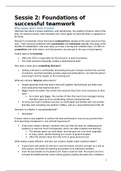
Sessie 2: Foundations of
successful teamwork
Why teams don’t work (Coutu)
Hackman has spent a career exploring—and questioning—the wisdom of teams. Most of the
time, his research shows, team members don’t even agree on what the team is supposed to
be doing.
Research consistently shows that teams underperform, despite all the extra resources they
have. That’s because problems with coordination and motivation typically chip away at the
benefits of collaboration. And even when you have a strong and cohesive team, it’s often in
competition with other teams, and that dynamic can also get in the way of real progress.
Teams have to be bounded.
Often the CEO is responsible for the fuzziness of team boundaries.
The chief executive frequently creates a dysfunctional team.
How does a team get a compelling direction?
Setting a direction is emotionally demanding because it always involves the exercise
of authority, and that inevitably arouses angst and ambivalence—for both the person
exercising it and the people on the receiving end.
What are common fallacies about teams?
People generally think that teams that work together harmoniously are better and
more productive than teams that don’t.
Bigger teams are better than small ones because they have more resources to draw
upon.
o As a team gets bigger, the number of links that need to be managed among
members goes up at an accelerating, almost exponential rate.
At some point team members become so comfortable and familiar with one another
that they start accepting one another’s foibles, and as a result performance falls off.
Newness is a liability (= aansprakelijkheid)?
Absolutely!
If teams need to stay together to achieve the best performance, how do you prevent them
from becoming complacent (= met zichzelf ingenomen)?
Every team needs a deviant, someone who can help the team by challenging the
tendency to want too much homogeneity, which can stifle creativity and learning.
1. The deviant opens up more ideas, and that gets you a lot more originality.
2. In many cases, deviant thinking is a source of great innovation
3. Often the deviant veers from the norm at great personal cost.
What makes a team effective, and how can a team’s leader make it perform better?
A good team will satisfy its internal or external clients, become stronger as a unit as
time passes, and foster the learning and growth of its individual members.
Even the best leader on the planet can’t make a team do well. All anyone can do is
increase the likelihood that a team will be great by putting into place five conditions.
1
, 1. Teams must be real
2. Teams need a compelling direction
3. Teams need enabling structures
4. Teams need a supportive organization
5. Teams need expert coaching
Teams create their own realities and control their own destinies to a greater extent,
and far sooner in their existence, than most team leaders realize.
The first few minutes of the start of any social system are the most important because
they establish not only where the group is going but also what the relationship will be
between the team leader and the group, and what basic norms of conduct will be
expected and enforced.
I do think there is one thing leaders can do to improve the chances that a team will
become something special, and that is to embrace their own quirkiness.
Exploit the daylights out of the stuff you’re great at, and get help in the areas where
you’re not so good.
How good are companies at providing a supportive context for teams?
The single-minded focus on the individual employee (instead of on the group as
whole) is one of the main reasons that teams don’t do as well as they might.
For the team to reap the benefits of coaching, it must focus on group processes. And
timing is everything.
Team coaching is about fostering better teamwork on the task, not about enhancing
members’ social interactions or interpersonal relationships.
Virtual teams need the basic conditions for effectiveness to be in place just as much
as face-to-face teams, if not more so. But even well-structured virtual teams need to
have a launch meeting with everyone present, a midpoint check-in that’s face-toface,
and a live debriefing.
Given the difficulty of making teams work, should we be rethinking their importance in
organizations?
The challenge for a leader, then, is to find a balance between individual autonomy
and collective action.
While it’s true that not being on a team can put your career on hold, being a real and
committed team player—whether as a team leader, a deviant, or just a regular member who
speaks the truth—can be dangerous business indeed.
Evidence for a collective intelligence factor in the performance of
human groups (Woolley et al)
In two studies with 699 people, working in groups of two to five, we find converging evidence
of a general collective intelligence factor that explains a group’s performance on a wide
variety of tasks.
The goal of the research reported here was to test the hypothesis that groups, like
individuals, do have characteristic levels of intelligence, which can be measured and used to
predict the groups’ performance on a wide variety of tasks.
By analogy with individual intelligence, we define a group’s collective intelligence (c) as
the general ability of the group to perform a wide variety of tasks. Empirically, collective
intelligence is the inference one draws when the ability of a group to perform one task is
correlated with that group’s ability to perform a wide range of other tasks.
2
successful teamwork
Why teams don’t work (Coutu)
Hackman has spent a career exploring—and questioning—the wisdom of teams. Most of the
time, his research shows, team members don’t even agree on what the team is supposed to
be doing.
Research consistently shows that teams underperform, despite all the extra resources they
have. That’s because problems with coordination and motivation typically chip away at the
benefits of collaboration. And even when you have a strong and cohesive team, it’s often in
competition with other teams, and that dynamic can also get in the way of real progress.
Teams have to be bounded.
Often the CEO is responsible for the fuzziness of team boundaries.
The chief executive frequently creates a dysfunctional team.
How does a team get a compelling direction?
Setting a direction is emotionally demanding because it always involves the exercise
of authority, and that inevitably arouses angst and ambivalence—for both the person
exercising it and the people on the receiving end.
What are common fallacies about teams?
People generally think that teams that work together harmoniously are better and
more productive than teams that don’t.
Bigger teams are better than small ones because they have more resources to draw
upon.
o As a team gets bigger, the number of links that need to be managed among
members goes up at an accelerating, almost exponential rate.
At some point team members become so comfortable and familiar with one another
that they start accepting one another’s foibles, and as a result performance falls off.
Newness is a liability (= aansprakelijkheid)?
Absolutely!
If teams need to stay together to achieve the best performance, how do you prevent them
from becoming complacent (= met zichzelf ingenomen)?
Every team needs a deviant, someone who can help the team by challenging the
tendency to want too much homogeneity, which can stifle creativity and learning.
1. The deviant opens up more ideas, and that gets you a lot more originality.
2. In many cases, deviant thinking is a source of great innovation
3. Often the deviant veers from the norm at great personal cost.
What makes a team effective, and how can a team’s leader make it perform better?
A good team will satisfy its internal or external clients, become stronger as a unit as
time passes, and foster the learning and growth of its individual members.
Even the best leader on the planet can’t make a team do well. All anyone can do is
increase the likelihood that a team will be great by putting into place five conditions.
1
, 1. Teams must be real
2. Teams need a compelling direction
3. Teams need enabling structures
4. Teams need a supportive organization
5. Teams need expert coaching
Teams create their own realities and control their own destinies to a greater extent,
and far sooner in their existence, than most team leaders realize.
The first few minutes of the start of any social system are the most important because
they establish not only where the group is going but also what the relationship will be
between the team leader and the group, and what basic norms of conduct will be
expected and enforced.
I do think there is one thing leaders can do to improve the chances that a team will
become something special, and that is to embrace their own quirkiness.
Exploit the daylights out of the stuff you’re great at, and get help in the areas where
you’re not so good.
How good are companies at providing a supportive context for teams?
The single-minded focus on the individual employee (instead of on the group as
whole) is one of the main reasons that teams don’t do as well as they might.
For the team to reap the benefits of coaching, it must focus on group processes. And
timing is everything.
Team coaching is about fostering better teamwork on the task, not about enhancing
members’ social interactions or interpersonal relationships.
Virtual teams need the basic conditions for effectiveness to be in place just as much
as face-to-face teams, if not more so. But even well-structured virtual teams need to
have a launch meeting with everyone present, a midpoint check-in that’s face-toface,
and a live debriefing.
Given the difficulty of making teams work, should we be rethinking their importance in
organizations?
The challenge for a leader, then, is to find a balance between individual autonomy
and collective action.
While it’s true that not being on a team can put your career on hold, being a real and
committed team player—whether as a team leader, a deviant, or just a regular member who
speaks the truth—can be dangerous business indeed.
Evidence for a collective intelligence factor in the performance of
human groups (Woolley et al)
In two studies with 699 people, working in groups of two to five, we find converging evidence
of a general collective intelligence factor that explains a group’s performance on a wide
variety of tasks.
The goal of the research reported here was to test the hypothesis that groups, like
individuals, do have characteristic levels of intelligence, which can be measured and used to
predict the groups’ performance on a wide variety of tasks.
By analogy with individual intelligence, we define a group’s collective intelligence (c) as
the general ability of the group to perform a wide variety of tasks. Empirically, collective
intelligence is the inference one draws when the ability of a group to perform one task is
correlated with that group’s ability to perform a wide range of other tasks.
2