MEMORY 16 MARKERS
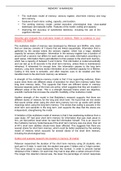
The multi-store model of memory: sensory register, short-term memory and long-
term memory.
Features of each store: coding, capacity, and duration.
The working memory model: central executive, phonological loop, visuo-spatial
sketchpad, and episodic buffer. Features of the model: coding and capacity.
Improving the accuracy of eyewitness testimony, including the use of the
cognitive interview.
Describe and evaluate the multi-store model of memory. Refer to evidence in your
answer. [16 marks]
The multistore model of memory was developed by Atkinson and Shiffrin, who claim
that our memory consists of 3 stores that are linked sequentially. Information that is
gathered by the senses enters the sensory register, which has a large, detailed
capacity for sensory information. Information in the sensory register has a duration of
around half a second, but differs for each sense, and codes information according to
each sense. Information that is paid attention to then passes to the short term memory,
which has a capacity of between 5 and 9 items. This information is coded acoustically
and can last up to 30 seconds in the short term memory, unless there is maintenance
rehearsal. If rehearsed for enough time, this information passes to the long term
memory. Long term memory stores information at an unlimited capacity for a lifetime.
Coding in this store is semantic, and often requires cues to be recalled and then
transfers back to the short term memory via retrieval.
A strength of the multistore memory model is that it has supporting evidence. Brain
scans show there are different areas of activation for short term memory tasks than
long term memory tasks. This supports that there are different stores in memory
because separate parts of the brain are active, which suggests that they are located in
different areas of the brain. This is a strength because brains scans are objective,
scientific methods that increase the scientific credibility of the multistore model.
Another strength of the model is that Baddeley’s research supports that there are
different stores of memory for the long and short term. He found that we mix words
that sound similar when using the short term memory but mix up words with similar
meanings when using the long term memory. This shows that coding is acoustic in the
short term and semantic in the long term, and supports the idea that the stores are
independent, strengthening the model.
A limitation of the multistore model of memory is that it has weakening evidence from a
case study. KF had poor short term memory for information that was read aloud to
him, yet had perfect recall when he read the information himself. This is an issue for
the multistore memory model because if the short term memory was one store, then all
of KF’s short term abilities should have been affected. This suggests that there are
several stores for short term memory, which could be better explained by the working
model of memory which accounts for several stores of the short term memory,
including the phonological loop.
Outline and evaluate research into duration in memory. [8 marks]
Peterson researched the duration of the short term memory using 24 students, who
took part in 8 trials. In each trial, the student was given 3 letters and a 3 digit number.
They were asked to count backwards from the number, in order to prevent mental
rehearsal of the 3 letters. On each trial, they had to stop after a certain amount of time.
The longer this retention interval was, the lower the percentage of correct responses
The multi-store model of memory: sensory register, short-term memory and long-
term memory.
Features of each store: coding, capacity, and duration.
The working memory model: central executive, phonological loop, visuo-spatial
sketchpad, and episodic buffer. Features of the model: coding and capacity.
Improving the accuracy of eyewitness testimony, including the use of the
cognitive interview.
Describe and evaluate the multi-store model of memory. Refer to evidence in your
answer. [16 marks]
The multistore model of memory was developed by Atkinson and Shiffrin, who claim
that our memory consists of 3 stores that are linked sequentially. Information that is
gathered by the senses enters the sensory register, which has a large, detailed
capacity for sensory information. Information in the sensory register has a duration of
around half a second, but differs for each sense, and codes information according to
each sense. Information that is paid attention to then passes to the short term memory,
which has a capacity of between 5 and 9 items. This information is coded acoustically
and can last up to 30 seconds in the short term memory, unless there is maintenance
rehearsal. If rehearsed for enough time, this information passes to the long term
memory. Long term memory stores information at an unlimited capacity for a lifetime.
Coding in this store is semantic, and often requires cues to be recalled and then
transfers back to the short term memory via retrieval.
A strength of the multistore memory model is that it has supporting evidence. Brain
scans show there are different areas of activation for short term memory tasks than
long term memory tasks. This supports that there are different stores in memory
because separate parts of the brain are active, which suggests that they are located in
different areas of the brain. This is a strength because brains scans are objective,
scientific methods that increase the scientific credibility of the multistore model.
Another strength of the model is that Baddeley’s research supports that there are
different stores of memory for the long and short term. He found that we mix words
that sound similar when using the short term memory but mix up words with similar
meanings when using the long term memory. This shows that coding is acoustic in the
short term and semantic in the long term, and supports the idea that the stores are
independent, strengthening the model.
A limitation of the multistore model of memory is that it has weakening evidence from a
case study. KF had poor short term memory for information that was read aloud to
him, yet had perfect recall when he read the information himself. This is an issue for
the multistore memory model because if the short term memory was one store, then all
of KF’s short term abilities should have been affected. This suggests that there are
several stores for short term memory, which could be better explained by the working
model of memory which accounts for several stores of the short term memory,
including the phonological loop.
Outline and evaluate research into duration in memory. [8 marks]
Peterson researched the duration of the short term memory using 24 students, who
took part in 8 trials. In each trial, the student was given 3 letters and a 3 digit number.
They were asked to count backwards from the number, in order to prevent mental
rehearsal of the 3 letters. On each trial, they had to stop after a certain amount of time.
The longer this retention interval was, the lower the percentage of correct responses