System theory
HC1, 4-9-2023, Introduction
1. Intro main theme
1A. Intuitive intro into main theme
Main theme “regulating systems”
- “Making sure that a system shows desired behavior despite disturbances”
System = Concrete unity consists of elements + relative sharing behavior
- Concrete unity = elements and relations showing behavior activities, effect of
behavior (variables + values)
Example: plank saw department
Behavior
- Activities: wood comes in (input), gets sawn (transform = activity), planks go out (output)
- Effect: relates to output of transformation process
o Direct pile of planks
o Indirect f.ex. employee satisfaction
- Variables: describe the effect.
o Quality for example % of neat planks
o Quantity for example number of planks sawn per week
o Variables for indirect effect, for example employee
satisfaction
- Behavior is sequence of values
Elements
- HR
- Technology (for example machines, buildings, lorries, ICT, etc.)
Related by means of structure
Relations
- Structure = way tasks in organizations are defined and related to another.
What is desired behavior?
To mark difference between desired and undesired you set a norm. If sequence of
variables are within norm-values, behavior is desired. When sequence of variables
are outside norm-values, behavior is undesired.
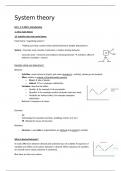
Blue lines are the norm values.
,Example PSD, norm is that you have to make between 200 – 300 planks
- Week 1 you make 250 (desired), week 2 you make 275 (desired), week 3 you make 50 planks
(undesired)
When you have undesired behavior, this means that a disturbance must has occurred.
- Disturbance = cause of undesired behavior
o Examples: machines break down, sickness employees, etc.
Regulate systems
Regulation stay between norm-values, despite disturbances
Regulation
- Actions – define
- Actions – perform
What actions to take when disturbances occur?
1B. Recipe for regulation
There are steps for regulation so it shows desired behavior
1. Define the system: concrete system or abstract system
2. Define desired behavior: set norms
3. Determine disturbances: what could occur which creates undesired behavior
4. Regulatory actions: define and carry out when necessary
Ashby
Someone taking a bath – look at this with a system view.
- Define system
o Concrete system = elements and relations showing behavior.
Concreet systeem in organisatie infrastructuur = mensen (HR), middelen
(technologie), arbeidsverdeling (structuur)
o Abstract system = set of variables you use to look at system.
Abstracte systeem essentiële variabelen/kritieke succes factoren
- Define desired behavior
o Behavior having a bath
o Variables: water level, temperature
o Norm values about variables: temperature between 36 – 38
o Based on norm values desired or undesired behavior
- Concrete unity
o Elements: the person having a bath, the bathtub, the tap, water
o Relation: script
- Describe disturbances: think of events that may cause undesired behavior. For example,
window opens and temperature drops.
, - Regulatory actions to make sure that even if these things occur, the water temperature
doesn’t go below 36 of above 38. For example, close the window.
1C. Complexity
Complexity measured in variety. High degree of variety system is complex.
Variety = number of different elements.
The more complex, the harder it is for the system to show desired behavior (more elements, more
influences, etc.).
Law of requisite variety Complexity in disturbances = negative complexity. Complexity in
regulatory actions = positive complexity. You need enough complexity in regulatory actions to fight
the complexity in disturbances.
2. Two types of System Theory
General System Theory (GST) = System theory that holds for any type of system. Apply this GST to
organizations Organization System Theory (OST).
It is applied in two ways:
- Understand an organization as a system “we see organizations as social system conducting
experiments”
- Design the infrastructure of organizations
2A. Brief model of organizations
Organizations have 4 basic activities
1. Primary process transformations that make products/services
2. Operational regulation dealing with disturbances that influence primary processes. Deal
with disturbances so primary processes can continue.
3. Setting goals goals for primary processes: which products/services, what quality, etc.
Without goals you don’t know if you’re doing well or not.
4. Design realize conditions so other 3 activities can be done
o Human Resources: personnel with knowledge, skills, motivation, etc.
o Technology: machines, ICT, buildings, etc.
o Structure: how tasks are defined and related. Define tasks and relate them well.
These three conditions are the infrastructure. Based on a well-designed infrastructure, the 4
activities can be performed efficiently and effective.
HC1, 4-9-2023, Introduction
1. Intro main theme
1A. Intuitive intro into main theme
Main theme “regulating systems”
- “Making sure that a system shows desired behavior despite disturbances”
System = Concrete unity consists of elements + relative sharing behavior
- Concrete unity = elements and relations showing behavior activities, effect of
behavior (variables + values)
Example: plank saw department
Behavior
- Activities: wood comes in (input), gets sawn (transform = activity), planks go out (output)
- Effect: relates to output of transformation process
o Direct pile of planks
o Indirect f.ex. employee satisfaction
- Variables: describe the effect.
o Quality for example % of neat planks
o Quantity for example number of planks sawn per week
o Variables for indirect effect, for example employee
satisfaction
- Behavior is sequence of values
Elements
- HR
- Technology (for example machines, buildings, lorries, ICT, etc.)
Related by means of structure
Relations
- Structure = way tasks in organizations are defined and related to another.
What is desired behavior?
To mark difference between desired and undesired you set a norm. If sequence of
variables are within norm-values, behavior is desired. When sequence of variables
are outside norm-values, behavior is undesired.
Blue lines are the norm values.
,Example PSD, norm is that you have to make between 200 – 300 planks
- Week 1 you make 250 (desired), week 2 you make 275 (desired), week 3 you make 50 planks
(undesired)
When you have undesired behavior, this means that a disturbance must has occurred.
- Disturbance = cause of undesired behavior
o Examples: machines break down, sickness employees, etc.
Regulate systems
Regulation stay between norm-values, despite disturbances
Regulation
- Actions – define
- Actions – perform
What actions to take when disturbances occur?
1B. Recipe for regulation
There are steps for regulation so it shows desired behavior
1. Define the system: concrete system or abstract system
2. Define desired behavior: set norms
3. Determine disturbances: what could occur which creates undesired behavior
4. Regulatory actions: define and carry out when necessary
Ashby
Someone taking a bath – look at this with a system view.
- Define system
o Concrete system = elements and relations showing behavior.
Concreet systeem in organisatie infrastructuur = mensen (HR), middelen
(technologie), arbeidsverdeling (structuur)
o Abstract system = set of variables you use to look at system.
Abstracte systeem essentiële variabelen/kritieke succes factoren
- Define desired behavior
o Behavior having a bath
o Variables: water level, temperature
o Norm values about variables: temperature between 36 – 38
o Based on norm values desired or undesired behavior
- Concrete unity
o Elements: the person having a bath, the bathtub, the tap, water
o Relation: script
- Describe disturbances: think of events that may cause undesired behavior. For example,
window opens and temperature drops.
, - Regulatory actions to make sure that even if these things occur, the water temperature
doesn’t go below 36 of above 38. For example, close the window.
1C. Complexity
Complexity measured in variety. High degree of variety system is complex.
Variety = number of different elements.
The more complex, the harder it is for the system to show desired behavior (more elements, more
influences, etc.).
Law of requisite variety Complexity in disturbances = negative complexity. Complexity in
regulatory actions = positive complexity. You need enough complexity in regulatory actions to fight
the complexity in disturbances.
2. Two types of System Theory
General System Theory (GST) = System theory that holds for any type of system. Apply this GST to
organizations Organization System Theory (OST).
It is applied in two ways:
- Understand an organization as a system “we see organizations as social system conducting
experiments”
- Design the infrastructure of organizations
2A. Brief model of organizations
Organizations have 4 basic activities
1. Primary process transformations that make products/services
2. Operational regulation dealing with disturbances that influence primary processes. Deal
with disturbances so primary processes can continue.
3. Setting goals goals for primary processes: which products/services, what quality, etc.
Without goals you don’t know if you’re doing well or not.
4. Design realize conditions so other 3 activities can be done
o Human Resources: personnel with knowledge, skills, motivation, etc.
o Technology: machines, ICT, buildings, etc.
o Structure: how tasks are defined and related. Define tasks and relate them well.
These three conditions are the infrastructure. Based on a well-designed infrastructure, the 4
activities can be performed efficiently and effective.