

Week 1:
Introduction
- Joseph A. Schumpeter: (introduces distinction between invention and innovation)
- Invention: an idea, a sketch or model for a new or improved device, product, process or
system
- Innovation: the process and outcome of creation and commercialization of something new.
o Includes: opportunity identification, ideation or invention to development,
prototyping, production, marketing and sales
o Is about: creation, change, novelty
Technological innovation: the act of introducing a new device, method, or material for application to
commercial or practical objectives
- Most important driver of competitive success
- Advantages: more efficient production, average GDP has risen, wider range of goods and
services developed worldwide, more communication
- Disadvantages: pollution, resource depletion
- Majority of funds comes from industrial firms (R&D funds)
Why so difficult?
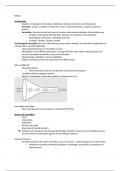
- Innovation funnel
o Most innovative ideas do not become successful new products.
- Carefully crafted strategies required
- Barriers, Competitors, Innovation patterns, Environment, etc.
Innovation and failure
- Most new ideas fail in the market (an estimated 70-90 %)
Sources of innovation
- Firms
- Universities
- Individuals
- Private non-profit
- Government funded research
Networks of innovators that leverage knowledge and other resources from multiple sources
are one of the most powerful agents of technological advance
Important factors:
- Creativity and idea (how does it function, how is it novel) -> underlying process of innovation
o Individuals creativity (intellectual abilities, knowledge, personality, motivation and
environment)
, o Organizational creativity (= function or the individuals within the organization and a
variety of social processes and contextual factors that shape way those individuals
interact and behave)
- The inventor (characteristics and qualities)
R&D by firms -> primary driver of innovation
- Research: basic and applied research.
o Basic research aims at increasing understanding of a topic or field without an
immediate commercial application in mind.
o Applied research aims at increasing understanding of a topic or field to meet a
specific need.
- Development: activities that apply knowledge to produce useful devices, materials, or
processes.
- R&D: a range of activities that extend from early exploration of a domain to specific
commercial implementations.
Demand Pull / Technology Push
Originate from linear models:
- “Technology/Science push”
o Scientific discovery → invention → manufacturing → marketing
o Linear model emphasizes “supply side”
o Risk: Technology push → develop solution for which there is no problem
- “Need/Demand pull”
o Customer suggestions → invention → manufacturing
o Linear model emphasizes “demand side”
o Risk: Demand pull → missing ability to invent technology to solve problem
- Innovation process likely to be non-linear
- Most current research emphasizes that innovation originates from a variety of sources and
follow a variety of paths.
Supply and demand determinants
- Supply determinants of innovation:
o technological opportunity → state of the relevant scientific and technological
knowledge
o cost and availability of inputs → knowledge workers, scientific personnel, equipment
o appropriability → ability to capture profit from innovation
- Demand determinants of innovation:
o cost reduction potential from innovation (process innovation; new sources of supply;
organizational change)
o consumer or producer benefit from novel product (product innovation)
o consumer or producer benefit from improvements (incremental product innovation)
,External Sources and Combinations
- External Sources
o Licensing, Purchasing
o Externalities (technological, pecuniary)
- Combinations of External and Internal Sources
o Strategic partnership
o Cross licensing
o (Networks for exchange, Joint venture, collective research associations, government-
sponsored joint research programs, informal networks, …)
Firms collaborate, mostly with external organizations, customers, suppliers and universities,
but sometimes with competitors, producers of complements, government laboratories,
nonprofit organizations and other research institutions
Innovation in Collaborative Networks -> important source of innovation
- Leverage resources and capabilities across multiple organizations or individuals
- Technology Clusters are regional clusters of firms that have a connection to a common
technology e.g., Silicon Valley’s semiconductor firms, lower Manhattan’s multimedia cluster
o Though today’s information technology enables fast, cheap and easy communication
across the globe, knowledge does not always transfer so easily.
o Encompass an array of industries that are linked through relationships between
suppliers, buyers and producers of complements.
- Complex knowledge: knowledge that has many underlying components, or many
interdependencies between those components, or both
- Tacit knowledge: knowledge that cannot be readily codified
Firms that are proximate thus have an advantage in sharing information that can lead to
greater productivity
- But downsized: competition might reduce pricing power, competitors can gain the firms
proprietary knowledge, clustering can lead to traffic congestion, high housing costs etc.
Technological spillovers / Knowledge externalities
- Technological spillovers occur when the benefits from the research activities of one entity
spill over to other entities. (positive externality of R&D)
, o Likelihood of spillovers is a function of:
Strength of protection mechanisms (e.g., patents, copyright, trade secrets)
Nature of underlying knowledge base (e.g., tacit, complex)
Mobility of the labor pool
Types of Innovation
- Product Innovation vs. Process Innovation
o Product innovation: in firm output (good or service) (New product)
o Process innovation: Techniques of producing output (More efficient production)
→ Appear very often in combination:
→ Product innovations can enable process innovations and vice versa
→ Product innovation for one firm may be a process innovation for another firm
- Level of newness
o Radical innovation= high degree of newness / differentness
o Incremental innovation= marginal degree of newness / differentness
- Competence-Enhancing vs. Competence Destroying Innovation
o Always from the perspective of a specific actor (e.g. firm/organization)
o Competence enhancing innovation: builds on existing knowledge and skills
o Competence destroying innovation: renders existing knowledge and skills obsolete
- Architectural vs Component (Modular) Innovation
o Architectural innovation: an innovation that changes the overall design of a system
or the way its components interact with each other
transition from high-wheel bicycle to safety bicycle.
o Component innovation: an innovation to one or more components that does not
significantly affect the overall configuration of the system
adding gel-filled material to a bicycle seat
Technology trajectory: the path a technology takes through its lifetime. This path may refer to its
rate of performance improvement, its rate of diffusion, or other change of interest
Patterns of Innovation
(1) Pattern of technology improvement
(2) Rate of technology diffusion
Technology S-curves
Introduction
- Joseph A. Schumpeter: (introduces distinction between invention and innovation)
- Invention: an idea, a sketch or model for a new or improved device, product, process or
system
- Innovation: the process and outcome of creation and commercialization of something new.
o Includes: opportunity identification, ideation or invention to development,
prototyping, production, marketing and sales
o Is about: creation, change, novelty
Technological innovation: the act of introducing a new device, method, or material for application to
commercial or practical objectives
- Most important driver of competitive success
- Advantages: more efficient production, average GDP has risen, wider range of goods and
services developed worldwide, more communication
- Disadvantages: pollution, resource depletion
- Majority of funds comes from industrial firms (R&D funds)
Why so difficult?
- Innovation funnel
o Most innovative ideas do not become successful new products.
- Carefully crafted strategies required
- Barriers, Competitors, Innovation patterns, Environment, etc.
Innovation and failure
- Most new ideas fail in the market (an estimated 70-90 %)
Sources of innovation
- Firms
- Universities
- Individuals
- Private non-profit
- Government funded research
Networks of innovators that leverage knowledge and other resources from multiple sources
are one of the most powerful agents of technological advance
Important factors:
- Creativity and idea (how does it function, how is it novel) -> underlying process of innovation
o Individuals creativity (intellectual abilities, knowledge, personality, motivation and
environment)
, o Organizational creativity (= function or the individuals within the organization and a
variety of social processes and contextual factors that shape way those individuals
interact and behave)
- The inventor (characteristics and qualities)
R&D by firms -> primary driver of innovation
- Research: basic and applied research.
o Basic research aims at increasing understanding of a topic or field without an
immediate commercial application in mind.
o Applied research aims at increasing understanding of a topic or field to meet a
specific need.
- Development: activities that apply knowledge to produce useful devices, materials, or
processes.
- R&D: a range of activities that extend from early exploration of a domain to specific
commercial implementations.
Demand Pull / Technology Push
Originate from linear models:
- “Technology/Science push”
o Scientific discovery → invention → manufacturing → marketing
o Linear model emphasizes “supply side”
o Risk: Technology push → develop solution for which there is no problem
- “Need/Demand pull”
o Customer suggestions → invention → manufacturing
o Linear model emphasizes “demand side”
o Risk: Demand pull → missing ability to invent technology to solve problem
- Innovation process likely to be non-linear
- Most current research emphasizes that innovation originates from a variety of sources and
follow a variety of paths.
Supply and demand determinants
- Supply determinants of innovation:
o technological opportunity → state of the relevant scientific and technological
knowledge
o cost and availability of inputs → knowledge workers, scientific personnel, equipment
o appropriability → ability to capture profit from innovation
- Demand determinants of innovation:
o cost reduction potential from innovation (process innovation; new sources of supply;
organizational change)
o consumer or producer benefit from novel product (product innovation)
o consumer or producer benefit from improvements (incremental product innovation)
,External Sources and Combinations
- External Sources
o Licensing, Purchasing
o Externalities (technological, pecuniary)
- Combinations of External and Internal Sources
o Strategic partnership
o Cross licensing
o (Networks for exchange, Joint venture, collective research associations, government-
sponsored joint research programs, informal networks, …)
Firms collaborate, mostly with external organizations, customers, suppliers and universities,
but sometimes with competitors, producers of complements, government laboratories,
nonprofit organizations and other research institutions
Innovation in Collaborative Networks -> important source of innovation
- Leverage resources and capabilities across multiple organizations or individuals
- Technology Clusters are regional clusters of firms that have a connection to a common
technology e.g., Silicon Valley’s semiconductor firms, lower Manhattan’s multimedia cluster
o Though today’s information technology enables fast, cheap and easy communication
across the globe, knowledge does not always transfer so easily.
o Encompass an array of industries that are linked through relationships between
suppliers, buyers and producers of complements.
- Complex knowledge: knowledge that has many underlying components, or many
interdependencies between those components, or both
- Tacit knowledge: knowledge that cannot be readily codified
Firms that are proximate thus have an advantage in sharing information that can lead to
greater productivity
- But downsized: competition might reduce pricing power, competitors can gain the firms
proprietary knowledge, clustering can lead to traffic congestion, high housing costs etc.
Technological spillovers / Knowledge externalities
- Technological spillovers occur when the benefits from the research activities of one entity
spill over to other entities. (positive externality of R&D)
, o Likelihood of spillovers is a function of:
Strength of protection mechanisms (e.g., patents, copyright, trade secrets)
Nature of underlying knowledge base (e.g., tacit, complex)
Mobility of the labor pool
Types of Innovation
- Product Innovation vs. Process Innovation
o Product innovation: in firm output (good or service) (New product)
o Process innovation: Techniques of producing output (More efficient production)
→ Appear very often in combination:
→ Product innovations can enable process innovations and vice versa
→ Product innovation for one firm may be a process innovation for another firm
- Level of newness
o Radical innovation= high degree of newness / differentness
o Incremental innovation= marginal degree of newness / differentness
- Competence-Enhancing vs. Competence Destroying Innovation
o Always from the perspective of a specific actor (e.g. firm/organization)
o Competence enhancing innovation: builds on existing knowledge and skills
o Competence destroying innovation: renders existing knowledge and skills obsolete
- Architectural vs Component (Modular) Innovation
o Architectural innovation: an innovation that changes the overall design of a system
or the way its components interact with each other
transition from high-wheel bicycle to safety bicycle.
o Component innovation: an innovation to one or more components that does not
significantly affect the overall configuration of the system
adding gel-filled material to a bicycle seat
Technology trajectory: the path a technology takes through its lifetime. This path may refer to its
rate of performance improvement, its rate of diffusion, or other change of interest
Patterns of Innovation
(1) Pattern of technology improvement
(2) Rate of technology diffusion
Technology S-curves



