AQA A Level Chemistry 2022 Paper 2 SOLUTION 2023//2024
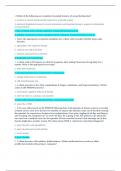
AQA A Level Chemistry 2022 Paper 2 SOLUTION 2023//2024 How can we make polymers more flexible? - ANSWER By adding a plasticiser How do plasticisers make polymers more flexible? - ANSWER They stick between the chains and keep the polymers further apart from each other, weakening the van der Waals forces and lets chains slide more easily. Uses of Kevlar - ANSWER bulletproof and used in body armour. Uses of Nylon - ANSWER commonly used in textiles. Why are polymers strong? - ANSWER Polymers are bound by van der Waals forces. The intermolecular forces are strong as the molecules are huge so there are lots of van der Waals forces between them! What is an example of a straight chained addition polymer? - ANSWER polyethene What are the two types of addition polymers? - ANSWER Straight and branched Why are Addition polymers often unreactive? - ANSWER This is because if the monomers were reactive, we'd get lots of side reactions during polymerisation. Addition polymers are NOT very reactive because the carbon chain is saturated and the side chains are usually non-polar. What is PVC? - ANSWER polyvinyl chloride which is now known as poly(chloroethane) What is PVC used for? - ANSWER PVC is used for rigid plastics like drainpipes. This is because it has strong dipole-dipole forces due to the presence of the chlorine atom. What can you use PVC for when you add a plasticiser? - ANSWER If you add a plasticiser, you can make more flexible PVC materials, which can be used in flooring tiles. Alkenes are good.... - ANSWER nucleophiles Why are alkenes nucleophiles? - ANSWER The alkenes are nucleophiles because of the high electron density between the carbon atoms at the carbon-carbon double bond. What is the general formula of an amino acid? - ANSWER RCH(NH2)COOH. Why are amino acids amphoteric? - ANSWER Amino acids are amphoteric because they contain both acidic and basic groups in the same molecule. zwitterion - ANSWER a molecule or ion having separate positively and negatively charged groups. What causes the formation of the zwitterion in amino acids? - ANSWER An internal acid-base reaction in an amino acid causes the nitrogen of the amine group to accept a proton from the carboxylic acid group. Why do amino acids have greater melting points than expected? - ANSWER The ionic nature of amino acids gives them higher melting points than expected. What do zwitter ions look like at low pHs? (Acidic) - ANSWER COOH NH3+ (gains H+) (R groups are affected too) What do zwitter ions look like at high pHs? (alkaline) - ANSWER COO- (OH- removes H+) NH2 (R groups are affected too) At an intermediate pH, which depends on the amino acid, the main species present is the zwitterion. What is this known as? - ANSWER This intermediate pH is known as the isoelectric point. primary structure of a protein - ANSWER the sequence of amino acids. What holds together the primary structure of a protein? - ANSWER Covalent bonds with peptide linkages between amino acid units What is the secondary structure of a protein? - ANSWER a result of the arrangement of polypeptide chains which causes specific hydrogen bonding interactions and lead to a specific secondary structure. alpha helix - ANSWER a regular coiled configuration held together by hydrogen bonding. The chain twists into a coiled helix shape. beta pleated sheet - ANSWER beta-pleated sheets cause amino acid sequences to run parallel to one another and extend to give a structure with pleated sheets tertiary structure of a protein - ANSWER The helices and sheets in the secondary structure can fold and interact to order the polypeptide strands into the final shape of the protein. The complex 3-D shape of a protein is stabilised by the following interactions of the amino acid side chains: - ANSWER Disulfide bridges (covalent S-S bonds). Weak van der Waals' forces. Hydrogen bonding. Ionic bonds. Enzymes have what type of

Geschreven voor
- Instelling
- AQA A
- Vak
- AQA A
Documentinformatie
- Geüpload op
- 8 februari 2024
- Aantal pagina's
- 5
- Geschreven in
- 2023/2024
- Type
- Tentamen (uitwerkingen)
- Bevat
- Vragen en antwoorden
Onderwerpen
-
aqa a level chemistry 2022 paper 2 solution 20
-
aqa a level chemistry 2022 paper 2 solution 2023

Ook beschikbaar in voordeelbundel