SUMMARY M5.2
INTERCULTURAL
MANAGEMENT
ICM
M. BENNINK
LITERATURE:
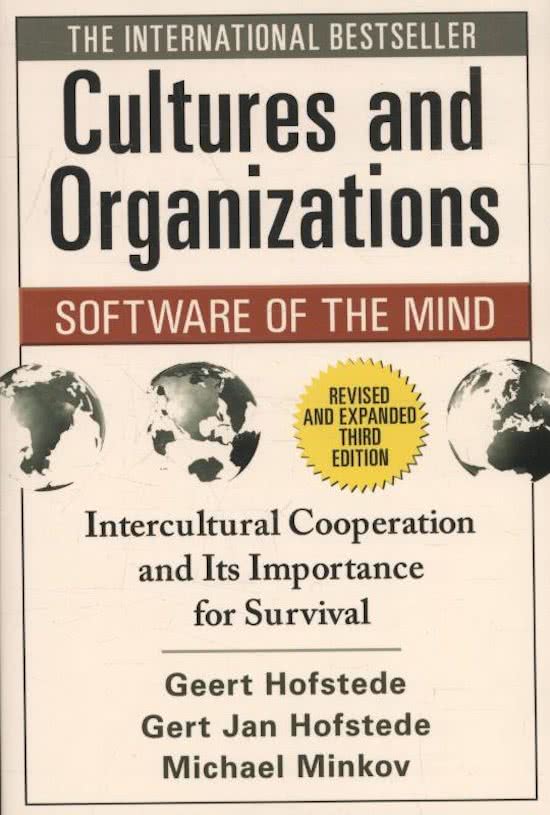
CULTURES AND ORGANIZATIONS
Geert Hofstede, Gert Jan Hofstede, Michael Minkov
,Chapter 1 – The Rules of the Social Game ...........................................................................................................2
Chapter 2 – Studying Cultural Differences ............................................................................................................5
Short Overview – Hofstede Dimensions ...............................................................................................................7
Chapter 3 – More Equal than Others .....................................................................................................................8
Chapter 4 – I, We and They................................................................................................................................... 10
PINTO ..................................................................................................................................................................... 12
Chapter 5 – He, She and (S)he .............................................................................................................................. 13
Chapter 6 – What is Different is Dangerous ..................................................................................................... 15
Chapter 7 – Yesterday, Now or Later? ............................................................................................................... 16
Chapter 8 – Light or Dark? .................................................................................................................................... 17
Chapter 9 – Organizing Across Nations ............................................................................................................. 18
Chapter 10 – Organizational Cultures................................................................................................................. 23
Chapter 11 – Intercultural Encounters ................................................................................................................ 26
Article 4.3 – Situational Leadership ...................................................................................................................... 28
Article 4.4 – Cross-Cultural Communication .................................................................................................... 30
Article 4.5 – Conflict ................................................................................................................................................ 32
Article 4.6 – Negotiation......................................................................................................................................... 35
Key Differences per Hofstede Dimension .......................................................................................................... 37
Power Distance Index ......................................................................................................................................... 37
Individualism vs. Collectivism............................................................................................................................. 38
Masculinity vs. Femininity.................................................................................................................................... 40
Uncertainty Avoidance Index ............................................................................................................................ 43
Long-term Orientation vs. Short-term Orientation .................................................................................... 45
Indulgent vs. Restraint ......................................................................................................................................... 47
Negotiation Styles ..................................................................................................................................................... 48
M5.2 INTERCULTURAL MANAGMENT 1
,Cultural differences can cause many confrontations between people, groups and nations who think,
feel and act differently. Ecological, economical, political, military, hygienic and meteorological
developments do not stop at national or regional borders.
National culture is the collective programming of the mind, acquired by growing up in a particular
country. Values, beliefs, patterns of behaviour, and shares, which distinguishes one group,
organisation or country from another. Differences between the dominant country and any
subcultures can occur because of different regions, ethics, religions or languages.
In Western languages culture commonly means ‘civilization’ or ‘refinement of the mind’ and
in particular the results of such refinement, like education, art and literature. This is culture
in the narrow sense.
In social anthropology, culture has a much broader meaning as a mental software. It is a
catchword for all the patterns of thinking, feeling, acting and also the ordinary an menial
things in life: greeting, eating, showing or not showing feelings, keeping a certain physical
distance, making love or maintaining body hygiene.
The sources of one’s mental programs lie within the social environments in which one grew up and
collected one’s life experiences (family > neighbourhood > school > youth groups > workplace >
living community). Culture is learned, not innate or inherited. It derives from someone’s
environment.
The three levels of human mental programming are:
Personality = inherited and learned, specific to individual
The unique personal set of mental programs. It is based on traits that are partly inherited within the
individual's unique set of genes and partly learned. Learned means modified by the influence of
collective programming (culture) as well as by unique personal experiences.
Culture = learned and specific to group or category
Culture is the collective programming of the mind that distinguishes the members of one group of
people from others. It derives from one's social environment rather than from one's genes.
Human nature = universal and inherited
The human abiltity to feel fear, anger, love, joy, sadness and shame; the need to associate with
others and to play and excercise oneself; and the facility to observe and to talk about it with other
humans all belong to this level of mental programming.
M5.2 INTERCULTURAL MANAGMENT 2
, Cultural relativism means that there are no scientific standards for considering one group as
intrinsically superior or inferior to another. It affirms that one culture has no absolute criteria for
judging the activities of another culture as low or noble.
Cultural differences manifest themselves in several ways. From the many terms used to describe
manifestations of culture, the following four cover the total concept rather neatly:
1. Symbols = words, gestures, pictures or
objects that carry a particular meaning which
is only recognized by those who share the
culture. The words in a language or jargon
belong to this category, as do dress,
hairstyles, flags, etc. New symbols are easily
developed and old ones disappear.
2. Heroes = persons, alive or dead, real or
imaginary, who possess characteristics which
are highly prized in a culture, and who this
serve as models for behaviour.
3. Rituals = collective activities, technically
superfluous in reaching desired ends, but
which, within a culture, are considered as
socially essential: they are therefore carried out for their own sake. Ways of greeting and
paying respect to others, social and religious ceremonies are examples.
Symbols, heroes and rituals can be subsumed under practices.
4. Values = the core of the culture. Values are broad tendencies to prefer certain states of
affairs over others. They are feelings with an arrow to it: they have a plus and a minus side.
They deal with pairings such as:
Evil vs. Good Dirty vs. Clean
Ugly vs. Beautiful Unnatural vs. Natural
Abnormal vs. Normal Paradoxical vs. Logical
Irrational vs. Rational Dangerous vs. Safe
Forbidden vs. Permitted Decent vs. Indecent
Values are among the first things children learn, implicitly (homeostasis). Development
psychologist believe that by the age of 10, most children have their basic value system firmly
in place and changes are difficult to make. Because they were acquired so early in our lives,
many values remain unconscious to those who hold them. Therefore they cannot be
discussed, nor can they be directly observed by outsiders. They can only be inferred from the
way people act under various circumstances.
Social scientists use the terms ‘in-group’ and ‘out-group’. The in-group refers to what we intuitively
feel to be “we”, while out-group refers to “they”. Humans really function in this simple way: we have
a persistent need to classify others in either group.
M5.2 INTERCULTURAL MANAGMENT 3
INTERCULTURAL
MANAGEMENT
ICM
M. BENNINK
LITERATURE:
CULTURES AND ORGANIZATIONS
Geert Hofstede, Gert Jan Hofstede, Michael Minkov
,Chapter 1 – The Rules of the Social Game ...........................................................................................................2
Chapter 2 – Studying Cultural Differences ............................................................................................................5
Short Overview – Hofstede Dimensions ...............................................................................................................7
Chapter 3 – More Equal than Others .....................................................................................................................8
Chapter 4 – I, We and They................................................................................................................................... 10
PINTO ..................................................................................................................................................................... 12
Chapter 5 – He, She and (S)he .............................................................................................................................. 13
Chapter 6 – What is Different is Dangerous ..................................................................................................... 15
Chapter 7 – Yesterday, Now or Later? ............................................................................................................... 16
Chapter 8 – Light or Dark? .................................................................................................................................... 17
Chapter 9 – Organizing Across Nations ............................................................................................................. 18
Chapter 10 – Organizational Cultures................................................................................................................. 23
Chapter 11 – Intercultural Encounters ................................................................................................................ 26
Article 4.3 – Situational Leadership ...................................................................................................................... 28
Article 4.4 – Cross-Cultural Communication .................................................................................................... 30
Article 4.5 – Conflict ................................................................................................................................................ 32
Article 4.6 – Negotiation......................................................................................................................................... 35
Key Differences per Hofstede Dimension .......................................................................................................... 37
Power Distance Index ......................................................................................................................................... 37
Individualism vs. Collectivism............................................................................................................................. 38
Masculinity vs. Femininity.................................................................................................................................... 40
Uncertainty Avoidance Index ............................................................................................................................ 43
Long-term Orientation vs. Short-term Orientation .................................................................................... 45
Indulgent vs. Restraint ......................................................................................................................................... 47
Negotiation Styles ..................................................................................................................................................... 48
M5.2 INTERCULTURAL MANAGMENT 1
,Cultural differences can cause many confrontations between people, groups and nations who think,
feel and act differently. Ecological, economical, political, military, hygienic and meteorological
developments do not stop at national or regional borders.
National culture is the collective programming of the mind, acquired by growing up in a particular
country. Values, beliefs, patterns of behaviour, and shares, which distinguishes one group,
organisation or country from another. Differences between the dominant country and any
subcultures can occur because of different regions, ethics, religions or languages.
In Western languages culture commonly means ‘civilization’ or ‘refinement of the mind’ and
in particular the results of such refinement, like education, art and literature. This is culture
in the narrow sense.
In social anthropology, culture has a much broader meaning as a mental software. It is a
catchword for all the patterns of thinking, feeling, acting and also the ordinary an menial
things in life: greeting, eating, showing or not showing feelings, keeping a certain physical
distance, making love or maintaining body hygiene.
The sources of one’s mental programs lie within the social environments in which one grew up and
collected one’s life experiences (family > neighbourhood > school > youth groups > workplace >
living community). Culture is learned, not innate or inherited. It derives from someone’s
environment.
The three levels of human mental programming are:
Personality = inherited and learned, specific to individual
The unique personal set of mental programs. It is based on traits that are partly inherited within the
individual's unique set of genes and partly learned. Learned means modified by the influence of
collective programming (culture) as well as by unique personal experiences.
Culture = learned and specific to group or category
Culture is the collective programming of the mind that distinguishes the members of one group of
people from others. It derives from one's social environment rather than from one's genes.
Human nature = universal and inherited
The human abiltity to feel fear, anger, love, joy, sadness and shame; the need to associate with
others and to play and excercise oneself; and the facility to observe and to talk about it with other
humans all belong to this level of mental programming.
M5.2 INTERCULTURAL MANAGMENT 2
, Cultural relativism means that there are no scientific standards for considering one group as
intrinsically superior or inferior to another. It affirms that one culture has no absolute criteria for
judging the activities of another culture as low or noble.
Cultural differences manifest themselves in several ways. From the many terms used to describe
manifestations of culture, the following four cover the total concept rather neatly:
1. Symbols = words, gestures, pictures or
objects that carry a particular meaning which
is only recognized by those who share the
culture. The words in a language or jargon
belong to this category, as do dress,
hairstyles, flags, etc. New symbols are easily
developed and old ones disappear.
2. Heroes = persons, alive or dead, real or
imaginary, who possess characteristics which
are highly prized in a culture, and who this
serve as models for behaviour.
3. Rituals = collective activities, technically
superfluous in reaching desired ends, but
which, within a culture, are considered as
socially essential: they are therefore carried out for their own sake. Ways of greeting and
paying respect to others, social and religious ceremonies are examples.
Symbols, heroes and rituals can be subsumed under practices.
4. Values = the core of the culture. Values are broad tendencies to prefer certain states of
affairs over others. They are feelings with an arrow to it: they have a plus and a minus side.
They deal with pairings such as:
Evil vs. Good Dirty vs. Clean
Ugly vs. Beautiful Unnatural vs. Natural
Abnormal vs. Normal Paradoxical vs. Logical
Irrational vs. Rational Dangerous vs. Safe
Forbidden vs. Permitted Decent vs. Indecent
Values are among the first things children learn, implicitly (homeostasis). Development
psychologist believe that by the age of 10, most children have their basic value system firmly
in place and changes are difficult to make. Because they were acquired so early in our lives,
many values remain unconscious to those who hold them. Therefore they cannot be
discussed, nor can they be directly observed by outsiders. They can only be inferred from the
way people act under various circumstances.
Social scientists use the terms ‘in-group’ and ‘out-group’. The in-group refers to what we intuitively
feel to be “we”, while out-group refers to “they”. Humans really function in this simple way: we have
a persistent need to classify others in either group.
M5.2 INTERCULTURAL MANAGMENT 3