Advanced Sociological Theory
- Week 1 -
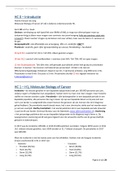
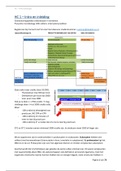
Coleman’s diagram is commonly used as a blueprint to help you build
sociological theories. It is used to ensure that certain crucial elements are
included in a theory. Sociology studies the relation between macro-conditions
and macro-outcomes. Coleman’s diagram can be utilized to go beyond common-
sense claims, ones that simply look at the direct relation between macro-
condition and macro-outcome. The diagram also considers individual behavior
and how behavioral reactions of many may lead back to a macro-outcome.
If you systematically follow Coleman’s diagram when forming your theory, you
ensure that arguments on bridge assumptions, transformation rules and
individual level theory are made explicit. You do not try to simply explain the
macro effect on its own. A Coleman’s diagram can follow up another Coleman’s
diagram, collective effects create another social condition after all. A Coleman
Fleet may be used to make a feedback loop explicit and thus to expand on the
Coleman diagram when it fails to cover a theory fully.
Key quotes from a sociologist’s apology (Watts, 2011).
“The paradox of common sense, […] is that even as it helps us make sense of the
world, it can actively undermine our ability to understand it.”
“The uncomfortable reality is that what applies to everyone necessarily applies to
us, too. That is, the fallacies embedded in our everyday thinking and
explanations […] must apply to many of our own, possibly deeply held, beliefs.”
“Learning to think like a sociologist means learning to question precisely your
instincts about how things work, and possibly to unlearn them all together.”
Key quotes from microfoundations and macrosocial behavior (Coleman,
1987).
“However, given that much of social theory is concerned not with individual
behavior but with the functioning of social systems of behavior, and given that
the most common and most natural observations are of individuals, a central
intellectual problem in the discipline is that movement from the individual level,
, where observations are made, to the systemic level, where the problem of
interest lies. This has been called the “micro-to-macro problem.”
The theory forming and researching cycle:
-> Problem -> Theory -> Empirical Research -> New Problem ->
Any sociological theory contains social phenomena and their social conditions.
Social conditions can be seen as causes for problems. Types of problems:
1) Descriptive problems: are usually trends over time. A difference
between spaces, groups or times exists (think rural/cities, Dutch/German,
1800s/2000s).
2) Explanatory problems: describes the mechanisms behind behavior or
outcomes of individuals. The effects of a development are detailed.
3) Normative problems: the degree in which something is seen as a
problem is subjective.
4) Problems of institutional design: problems that describe and track
institutional problems and their development (after action is or isn’t
taken).
*Note that these types of ‘problems’ are rather types of sociological research
angles. The word ‘problem’ is a little misplaced.
There are three types of explanations, they are used as blueprints for
sociological theory:
1) Covering-law explanations: phenomena can be explained by a causal
law. Statistical explanations are the same, but instead of a
phenomenon being explained by a causal law, it’s explained by a statistical
relationship (or statistical likeliness). Mechanism explanations explain
phenomena by social opportunities/restrictions that individuals face and
the resulting aggregation process of their actions.
2) Logical schemes use a simple scheme to combine information to form a
conclusion. If A = B and B = C, then C = A, for instance. The laws, social
conditions or statistics used as information are called explanans, the
combining of which is called deduction resulting in a conclusion or
explanandum. This method can be used to explain how social
phenomena result from social conditions.
3) Coleman’s diagram, which you should be familiar with by now.
*It is argued that there are no real social laws at the individual level. Thus, the
causal mechanisms in some theories may be unclear.
Micro: usually refers to a singular instance of something, be that an individual,
(small) group or organization.
Macro: refers to more substantive multiples, think countries, societies, or an
industry.
Meso: is in between the two and not always applicable.
Common sense: routine knowledge we have of our everyday world and
activities. It is non-formal, unstructured and practical.
The five big aspects of theory building:
1) Precision. Make things clear rather than ambiguous. This goes for
methods, but also definitions and general use of language.
2) Avoidance of black boxes. Think about plausible mechanisms that
explain a causal relationship.
- Week 1 -
Coleman’s diagram is commonly used as a blueprint to help you build
sociological theories. It is used to ensure that certain crucial elements are
included in a theory. Sociology studies the relation between macro-conditions
and macro-outcomes. Coleman’s diagram can be utilized to go beyond common-
sense claims, ones that simply look at the direct relation between macro-
condition and macro-outcome. The diagram also considers individual behavior
and how behavioral reactions of many may lead back to a macro-outcome.
If you systematically follow Coleman’s diagram when forming your theory, you
ensure that arguments on bridge assumptions, transformation rules and
individual level theory are made explicit. You do not try to simply explain the
macro effect on its own. A Coleman’s diagram can follow up another Coleman’s
diagram, collective effects create another social condition after all. A Coleman
Fleet may be used to make a feedback loop explicit and thus to expand on the
Coleman diagram when it fails to cover a theory fully.
Key quotes from a sociologist’s apology (Watts, 2011).
“The paradox of common sense, […] is that even as it helps us make sense of the
world, it can actively undermine our ability to understand it.”
“The uncomfortable reality is that what applies to everyone necessarily applies to
us, too. That is, the fallacies embedded in our everyday thinking and
explanations […] must apply to many of our own, possibly deeply held, beliefs.”
“Learning to think like a sociologist means learning to question precisely your
instincts about how things work, and possibly to unlearn them all together.”
Key quotes from microfoundations and macrosocial behavior (Coleman,
1987).
“However, given that much of social theory is concerned not with individual
behavior but with the functioning of social systems of behavior, and given that
the most common and most natural observations are of individuals, a central
intellectual problem in the discipline is that movement from the individual level,
, where observations are made, to the systemic level, where the problem of
interest lies. This has been called the “micro-to-macro problem.”
The theory forming and researching cycle:
-> Problem -> Theory -> Empirical Research -> New Problem ->
Any sociological theory contains social phenomena and their social conditions.
Social conditions can be seen as causes for problems. Types of problems:
1) Descriptive problems: are usually trends over time. A difference
between spaces, groups or times exists (think rural/cities, Dutch/German,
1800s/2000s).
2) Explanatory problems: describes the mechanisms behind behavior or
outcomes of individuals. The effects of a development are detailed.
3) Normative problems: the degree in which something is seen as a
problem is subjective.
4) Problems of institutional design: problems that describe and track
institutional problems and their development (after action is or isn’t
taken).
*Note that these types of ‘problems’ are rather types of sociological research
angles. The word ‘problem’ is a little misplaced.
There are three types of explanations, they are used as blueprints for
sociological theory:
1) Covering-law explanations: phenomena can be explained by a causal
law. Statistical explanations are the same, but instead of a
phenomenon being explained by a causal law, it’s explained by a statistical
relationship (or statistical likeliness). Mechanism explanations explain
phenomena by social opportunities/restrictions that individuals face and
the resulting aggregation process of their actions.
2) Logical schemes use a simple scheme to combine information to form a
conclusion. If A = B and B = C, then C = A, for instance. The laws, social
conditions or statistics used as information are called explanans, the
combining of which is called deduction resulting in a conclusion or
explanandum. This method can be used to explain how social
phenomena result from social conditions.
3) Coleman’s diagram, which you should be familiar with by now.
*It is argued that there are no real social laws at the individual level. Thus, the
causal mechanisms in some theories may be unclear.
Micro: usually refers to a singular instance of something, be that an individual,
(small) group or organization.
Macro: refers to more substantive multiples, think countries, societies, or an
industry.
Meso: is in between the two and not always applicable.
Common sense: routine knowledge we have of our everyday world and
activities. It is non-formal, unstructured and practical.
The five big aspects of theory building:
1) Precision. Make things clear rather than ambiguous. This goes for
methods, but also definitions and general use of language.
2) Avoidance of black boxes. Think about plausible mechanisms that
explain a causal relationship.