HRM
Chapter 14: Managing Expatriate Assignments
- Ethnocentric staffing occurs when expatriates are sent out from headquarters because
they 'know better' (about organisational policy or specific skills or practices).
- The advantages and disadvantages of ethnocentric staffing:
Advantages Disadvantages
Efficient co-ordination Adaptation of expatriates uncertain
Effective communication Selection procedures prone to errors
Direct control of foreign operations High costs
Diffusing central values, norms and beliefs throughout Complicated personnel planning procedures
the organisation
Broadening the view of expatriates and chance of Private life of expatriates severely affected
growth for expatriates
Rapid substitution of expatriates possible Difficulties in mentoring during stay abroad
No need for a well-developed international internal Reduced career opportunities for locals
labour market
Appropriate for entry into international business Government restrictions
- An expatriate employee is an employee who is sent to live abroad for a defined time
period.
- Key features of the modern expatriate population include:
• More people from outside the headquarters country
• More women
• Number of dual-career couples has increased
• The expatriate population is now better educated than it used to be
• New communication technology
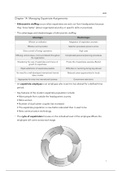
- The cycle of expatriation focuses on the individual level of the employee.Where the
employee will come across each stage.
!1
, HRM
- In line with the resource-based view of the firm, it is the transfer of intangible resources
(in particular, knowledge) which is most important to the firm both in value and as a basis
for competitive advantage. Depending on the extent to which subsidiaries develop these
dimensions of internationalisation, Bonache and Fernandez (1999) classified them into
four categories:
1. Implementor subsidiaries apply the sources developed in the headquarters or other
units of the organisation to a specific geographic area. Skills knowledge transfer is
expected to be a critical reason for using expatriation here due to the high need for tacit
knowledge transfer.
2. Autonomous units are much less dependent on the human and organisational
resources existing in the rest of the company's international network. They therefore will
have little use for expatriates for knowledge transfer and co-ordination, and would tend
to use local country nationals in key positions.
3. Learning units acquire and develop new resources that may later be exported to other
parts of the organisation. The dominant pattern of international transfer will therefore be
one of moving managers from these units to another country.
4. Globally integrated units develop new expertise but also use the resources generated
in other subsidiaries or in the headquarters. Expatriates are used for knowledge transfer,
but also for co-ordination.
- Strategic targets that are crucial when expatriates are sent to perform international
assignment:
• To improve business performance
• To foster the parent corporate culture in the subsidiary
• To break down barriers between the parent company and subsidiaries
• To solve technical problems
• To develop top talent and future leaders of the company
• To open new international markets
• To handle politically sensitive business
• To control business improvement initiatives
• To reduce risks
• To improve business relationships
et cetera...
- Expatriates are very expensive. Therefore, an organisation has to clarify why it is sending
them on an assignment. For an organisational they represent a high-cost investment; this
cost should be justified against a set of payoff benefits.
- The consensus view from HRM practitioners is that it is possible to specify a set of
competencies for international assignments, and that these can be used to assist the
!2
Chapter 14: Managing Expatriate Assignments
- Ethnocentric staffing occurs when expatriates are sent out from headquarters because
they 'know better' (about organisational policy or specific skills or practices).
- The advantages and disadvantages of ethnocentric staffing:
Advantages Disadvantages
Efficient co-ordination Adaptation of expatriates uncertain
Effective communication Selection procedures prone to errors
Direct control of foreign operations High costs
Diffusing central values, norms and beliefs throughout Complicated personnel planning procedures
the organisation
Broadening the view of expatriates and chance of Private life of expatriates severely affected
growth for expatriates
Rapid substitution of expatriates possible Difficulties in mentoring during stay abroad
No need for a well-developed international internal Reduced career opportunities for locals
labour market
Appropriate for entry into international business Government restrictions
- An expatriate employee is an employee who is sent to live abroad for a defined time
period.
- Key features of the modern expatriate population include:
• More people from outside the headquarters country
• More women
• Number of dual-career couples has increased
• The expatriate population is now better educated than it used to be
• New communication technology
- The cycle of expatriation focuses on the individual level of the employee.Where the
employee will come across each stage.
!1
, HRM
- In line with the resource-based view of the firm, it is the transfer of intangible resources
(in particular, knowledge) which is most important to the firm both in value and as a basis
for competitive advantage. Depending on the extent to which subsidiaries develop these
dimensions of internationalisation, Bonache and Fernandez (1999) classified them into
four categories:
1. Implementor subsidiaries apply the sources developed in the headquarters or other
units of the organisation to a specific geographic area. Skills knowledge transfer is
expected to be a critical reason for using expatriation here due to the high need for tacit
knowledge transfer.
2. Autonomous units are much less dependent on the human and organisational
resources existing in the rest of the company's international network. They therefore will
have little use for expatriates for knowledge transfer and co-ordination, and would tend
to use local country nationals in key positions.
3. Learning units acquire and develop new resources that may later be exported to other
parts of the organisation. The dominant pattern of international transfer will therefore be
one of moving managers from these units to another country.
4. Globally integrated units develop new expertise but also use the resources generated
in other subsidiaries or in the headquarters. Expatriates are used for knowledge transfer,
but also for co-ordination.
- Strategic targets that are crucial when expatriates are sent to perform international
assignment:
• To improve business performance
• To foster the parent corporate culture in the subsidiary
• To break down barriers between the parent company and subsidiaries
• To solve technical problems
• To develop top talent and future leaders of the company
• To open new international markets
• To handle politically sensitive business
• To control business improvement initiatives
• To reduce risks
• To improve business relationships
et cetera...
- Expatriates are very expensive. Therefore, an organisation has to clarify why it is sending
them on an assignment. For an organisational they represent a high-cost investment; this
cost should be justified against a set of payoff benefits.
- The consensus view from HRM practitioners is that it is possible to specify a set of
competencies for international assignments, and that these can be used to assist the
!2