
Chapter 1. Introduction
The term quantified self was first coined by Gary Wolf and Kevin Kelley in Wired Magazine.
“The quantified self is any individual engaged in the self-tracking of any kind of biological,
physical, behavioral, or environmental information. The self-tracking is driven by a certain
goal of the individual with a desire to act upon the collected information.”
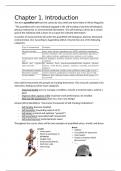
A number of measurements fall under this quantified self (biological, physical, behavioral,
environmental, etc). According to Augemberg (2012), they fall into one of the following
categories:
Choe (2014) researched why people are tracking themselves. This research consisted of 52
interviews, finding out three main categories:
- Improved health (cure or manage a condition, execute a treatment plan, achieve a
goal)
- Improve other aspects of life (maximize work performance, be mindful)
- Find new life experiences (have fun, learn new things)
Gimpel (2013) identified a “Five-Factor Framework of Self-Tracking Motivations”:
- Self-healing (become healthy)
- Self-discipline (rewarding aspects of it)
- Self-design (control and optimize “yourself”)
- Self-association (associated with movement)
- Self-entertainment (entertainment value)
Throughout the course, there will be two examples of quantified selves, Arnold, and Bruce:
,Basic terminology:
- A measurement is one value for an attribute recorded at a specific time point.
- A time series is a series of measurements in temporal order.
- We distinguish different types of machine learning:
o Supervised learning is the machine learning task of inferring a function from a
set of labeled training data.
o In unsupervised learning, there is no target measure (or label), and the goal is
to describe the associations and patterns among the attributes.
o Reinforcement learning tries to find optimal actions in a given situation so as
to maximize a numerical reward that does not immediately come with the
action but later in time.
, Chapter 2. Sensory Data
In a mobile phone, there are many sensors, for example:
The term quantified self was first coined by Gary Wolf and Kevin Kelley in Wired Magazine.
“The quantified self is any individual engaged in the self-tracking of any kind of biological,
physical, behavioral, or environmental information. The self-tracking is driven by a certain
goal of the individual with a desire to act upon the collected information.”
A number of measurements fall under this quantified self (biological, physical, behavioral,
environmental, etc). According to Augemberg (2012), they fall into one of the following
categories:
Choe (2014) researched why people are tracking themselves. This research consisted of 52
interviews, finding out three main categories:
- Improved health (cure or manage a condition, execute a treatment plan, achieve a
goal)
- Improve other aspects of life (maximize work performance, be mindful)
- Find new life experiences (have fun, learn new things)
Gimpel (2013) identified a “Five-Factor Framework of Self-Tracking Motivations”:
- Self-healing (become healthy)
- Self-discipline (rewarding aspects of it)
- Self-design (control and optimize “yourself”)
- Self-association (associated with movement)
- Self-entertainment (entertainment value)
Throughout the course, there will be two examples of quantified selves, Arnold, and Bruce:
,Basic terminology:
- A measurement is one value for an attribute recorded at a specific time point.
- A time series is a series of measurements in temporal order.
- We distinguish different types of machine learning:
o Supervised learning is the machine learning task of inferring a function from a
set of labeled training data.
o In unsupervised learning, there is no target measure (or label), and the goal is
to describe the associations and patterns among the attributes.
o Reinforcement learning tries to find optimal actions in a given situation so as
to maximize a numerical reward that does not immediately come with the
action but later in time.
, Chapter 2. Sensory Data
In a mobile phone, there are many sensors, for example:



