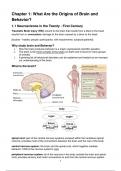
Chapter 1: What Are the Origins of Brain and
Behavior?
1.1 Neuroscience in the Twenty - First Century
Traumatic Brain lnjury (TBI): wound to the brain that results from a blow to the head
results from a: concussion: damage to the brain caused by a blow to the head
[studies - healthy people: participants; with impairments: subjects/patients]
Why study brain and Behavior?
1. How the brain produces behavior is a major unanswered scientific question.
2. The brain is the most complex living organ on Earth and is found in many groups
of animals
3. A growing list of behavioral disorders can be explained and treated as we increase
our understanding of the brain.
What is the brain?
spinal cord: part of the central nervous systems encased within the vertebrae (spina!
column); provides most of the connections between the brain and the rest of the body
central nervous system: the brain and the spinal cord, which together mediate
behavior; CNS is the nervous system's core
peripheral nervous system: all of the neurons in the body outside the brain and spinal
cord; provides sensory and motor connections to and from the central nervous system
1
,- sensory connections to receptors in the skin
- motor connections to body muscles
- sensory and motor connections to internal body organs and gut
neurons: specialized nerve cell engaged in information processing; send electrical and
chemical signals to communicate with one another
glial cells: brain cells that support the function of neurons
two major sets of structures in the brain are:
- Cerebrum (forebrain): has two nearly symmetrical halves, called hemispheres;
responsible for most of our conscious behaviors; it enfolds the brainstem (engaged in
unconscious behavior)
‣ hemisphere: literally, half a sphere, referring to one side of the cerebrum
‣ brainstem: central structure of the brain; responsible for most unconscious
behavior
- Cerebellum: specialized for learning and coordinating our movements; assists the
cerebrum in generating many behaviors
embodied behavior: theory that the movements we make and the movements
we perceive in others are central to communication with others
1. The CNS needs ongoing sensory stimulation from the environment and from its own
body's movements.
2. The brain communicates by producing movement and observing of movements.
(sensory deprivation)
3. Locked - in syndrome: condition in which a patient is aware and awake but cannot
move or communicate verbally because of complete paralysis of nearly all voluntary
muscles except the eyes —> shows that consciousness can persist in the absence of
most overt movement
Minimally conscious state (MCS): condition in which a person can display rudimentary
behaviors, such as smiling or uttering a few words, but is otherwise not conscious.
Clinical trial: consensual experiment directed toward developing a treatment.
Deep brain stimulation (DBS): neurosurgery in which electrodes implanted in the brain
stimulate a targeted area with a low-voltage electrical current to facilitate behavior.
Persistence vegetative state (PVS): condition in which a person is alive but unaware,
unable to communicate or to function independently at even the most basic level.
What is Behavior?
- lnnate and Learned behaviors: some animals behaviors are largely innate and fixed.
Others are largely learned. Learning is a form of cultural transmission.
- AnimaIs with smaller, simpler nervous systems exhibit a narrow range of behaviors that
depend mainly on heredity.
- AnimaIs with complex nervous systems have more behavioral options that depend on
learning.
- cultural/heredity
- any form of movement in a a living organism - observable, measurable
1.2 Perspectives on Brain and Behavior
causes of behavior:
1. Mentalism
2. Dualism
2
, 3. Materialism
Aristotle and Mentalism
psyche: synonym for mind, an entity once proposed to be the source of human behavior;
responsible for consciousness, perceptions and emotions
mind: proposed nonmaterial entity; responsible for intelligence, attention, awareness and
consciousness
mentalism: explanation of behavior as a function of the nonmaterial mind
- brain exists to cool the mind
Descartes and Dualism
dualist hypothesis: to explain how the mind controls the body, Descartes suggested that
the mind resides in the pineal gland, where it directs the flow of fluid through the ventricles
and into the muscles to move the body. The pineal gland actually influences daily and
seasonal biorhythms.
dualism: philosophical position that bath a nonmaterial and a material body contribute to
behavior
mind-body problem: difficulty of explaining how a nonmaterial mind and a material body
interact
Darwin and Materialism
materialism: philosophical position that behavior can be explained as a function of the
nervous system without recourse to the mind
Evolution by natural selection
natural selection: Darwin’s theory for explaining how new species evolve and how
existing species change over time. Differential success in the reproduction of different
characteristics results from the interaction of organisms with their environment.
species: group of organism that can interbreed (breed among themselves)
phenotypes: set of individual characteristics that can be seen or measured
lndividual organisms whose characteristics best help them to survive in their environment
are likely to leave more offspring than are less-fit members.
natural selection and heritable factors: Mendel deduced that heritable factors, which we
now call genes, govern various physical traits displayed by the species: Members of a
species that have a particular genotype are likely to express a similar genotypic traits.
genotype: particular genetic makeup of an individual.
lnterplay of genes, environments and experience: Environment participates in expression
of traits.
epigenetics: differences in gene expression related to environment and experience;
consist of a number of biochemical changes that influence wether a gene is active of
inactive
summarizing materialism:
1. Because all animal species are related, their brains must be related.
2. Because all animal species are related, their behavior must be related.
3. Brain and behavior in complex animals such as humans evolved from simpIer
animals' brains and behaviors and also depend on learning.
3
, Contemporary Perspectives on Brain and Behavior
Hebb: scientific acceptance of materialism; cell assemblies; eliminative materialism: if
behavior can me described adequately without recourse to the mind, then the mental
explanation should be eliminated
- materialism is neutral with respect to religion
[The Speaking Brain: „merge“ ability of humans —> infinite number of concepts]
1.3 Evolution of Brains and of Behavior
common ancestor: forebear of two or more lineages or family groups; ancestral to both
groups
Origin of Brain Cells and Brains
4.5 billion years ago: earth; 3.5 billion years ago: first life-forms; 700 million years ago: first
brain cells; 250 million years ago: first brain; 6 million years ago: humanlike brain; 200.000
years ago: modern human brain
Taxonomy is the branch of biology concerned with naming and classifying species by
grouping representative organisms according to their common characteristics and their
relationship to each other.
4
Behavior?
1.1 Neuroscience in the Twenty - First Century
Traumatic Brain lnjury (TBI): wound to the brain that results from a blow to the head
results from a: concussion: damage to the brain caused by a blow to the head
[studies - healthy people: participants; with impairments: subjects/patients]
Why study brain and Behavior?
1. How the brain produces behavior is a major unanswered scientific question.
2. The brain is the most complex living organ on Earth and is found in many groups
of animals
3. A growing list of behavioral disorders can be explained and treated as we increase
our understanding of the brain.
What is the brain?
spinal cord: part of the central nervous systems encased within the vertebrae (spina!
column); provides most of the connections between the brain and the rest of the body
central nervous system: the brain and the spinal cord, which together mediate
behavior; CNS is the nervous system's core
peripheral nervous system: all of the neurons in the body outside the brain and spinal
cord; provides sensory and motor connections to and from the central nervous system
1
,- sensory connections to receptors in the skin
- motor connections to body muscles
- sensory and motor connections to internal body organs and gut
neurons: specialized nerve cell engaged in information processing; send electrical and
chemical signals to communicate with one another
glial cells: brain cells that support the function of neurons
two major sets of structures in the brain are:
- Cerebrum (forebrain): has two nearly symmetrical halves, called hemispheres;
responsible for most of our conscious behaviors; it enfolds the brainstem (engaged in
unconscious behavior)
‣ hemisphere: literally, half a sphere, referring to one side of the cerebrum
‣ brainstem: central structure of the brain; responsible for most unconscious
behavior
- Cerebellum: specialized for learning and coordinating our movements; assists the
cerebrum in generating many behaviors
embodied behavior: theory that the movements we make and the movements
we perceive in others are central to communication with others
1. The CNS needs ongoing sensory stimulation from the environment and from its own
body's movements.
2. The brain communicates by producing movement and observing of movements.
(sensory deprivation)
3. Locked - in syndrome: condition in which a patient is aware and awake but cannot
move or communicate verbally because of complete paralysis of nearly all voluntary
muscles except the eyes —> shows that consciousness can persist in the absence of
most overt movement
Minimally conscious state (MCS): condition in which a person can display rudimentary
behaviors, such as smiling or uttering a few words, but is otherwise not conscious.
Clinical trial: consensual experiment directed toward developing a treatment.
Deep brain stimulation (DBS): neurosurgery in which electrodes implanted in the brain
stimulate a targeted area with a low-voltage electrical current to facilitate behavior.
Persistence vegetative state (PVS): condition in which a person is alive but unaware,
unable to communicate or to function independently at even the most basic level.
What is Behavior?
- lnnate and Learned behaviors: some animals behaviors are largely innate and fixed.
Others are largely learned. Learning is a form of cultural transmission.
- AnimaIs with smaller, simpler nervous systems exhibit a narrow range of behaviors that
depend mainly on heredity.
- AnimaIs with complex nervous systems have more behavioral options that depend on
learning.
- cultural/heredity
- any form of movement in a a living organism - observable, measurable
1.2 Perspectives on Brain and Behavior
causes of behavior:
1. Mentalism
2. Dualism
2
, 3. Materialism
Aristotle and Mentalism
psyche: synonym for mind, an entity once proposed to be the source of human behavior;
responsible for consciousness, perceptions and emotions
mind: proposed nonmaterial entity; responsible for intelligence, attention, awareness and
consciousness
mentalism: explanation of behavior as a function of the nonmaterial mind
- brain exists to cool the mind
Descartes and Dualism
dualist hypothesis: to explain how the mind controls the body, Descartes suggested that
the mind resides in the pineal gland, where it directs the flow of fluid through the ventricles
and into the muscles to move the body. The pineal gland actually influences daily and
seasonal biorhythms.
dualism: philosophical position that bath a nonmaterial and a material body contribute to
behavior
mind-body problem: difficulty of explaining how a nonmaterial mind and a material body
interact
Darwin and Materialism
materialism: philosophical position that behavior can be explained as a function of the
nervous system without recourse to the mind
Evolution by natural selection
natural selection: Darwin’s theory for explaining how new species evolve and how
existing species change over time. Differential success in the reproduction of different
characteristics results from the interaction of organisms with their environment.
species: group of organism that can interbreed (breed among themselves)
phenotypes: set of individual characteristics that can be seen or measured
lndividual organisms whose characteristics best help them to survive in their environment
are likely to leave more offspring than are less-fit members.
natural selection and heritable factors: Mendel deduced that heritable factors, which we
now call genes, govern various physical traits displayed by the species: Members of a
species that have a particular genotype are likely to express a similar genotypic traits.
genotype: particular genetic makeup of an individual.
lnterplay of genes, environments and experience: Environment participates in expression
of traits.
epigenetics: differences in gene expression related to environment and experience;
consist of a number of biochemical changes that influence wether a gene is active of
inactive
summarizing materialism:
1. Because all animal species are related, their brains must be related.
2. Because all animal species are related, their behavior must be related.
3. Brain and behavior in complex animals such as humans evolved from simpIer
animals' brains and behaviors and also depend on learning.
3
, Contemporary Perspectives on Brain and Behavior
Hebb: scientific acceptance of materialism; cell assemblies; eliminative materialism: if
behavior can me described adequately without recourse to the mind, then the mental
explanation should be eliminated
- materialism is neutral with respect to religion
[The Speaking Brain: „merge“ ability of humans —> infinite number of concepts]
1.3 Evolution of Brains and of Behavior
common ancestor: forebear of two or more lineages or family groups; ancestral to both
groups
Origin of Brain Cells and Brains
4.5 billion years ago: earth; 3.5 billion years ago: first life-forms; 700 million years ago: first
brain cells; 250 million years ago: first brain; 6 million years ago: humanlike brain; 200.000
years ago: modern human brain
Taxonomy is the branch of biology concerned with naming and classifying species by
grouping representative organisms according to their common characteristics and their
relationship to each other.
4